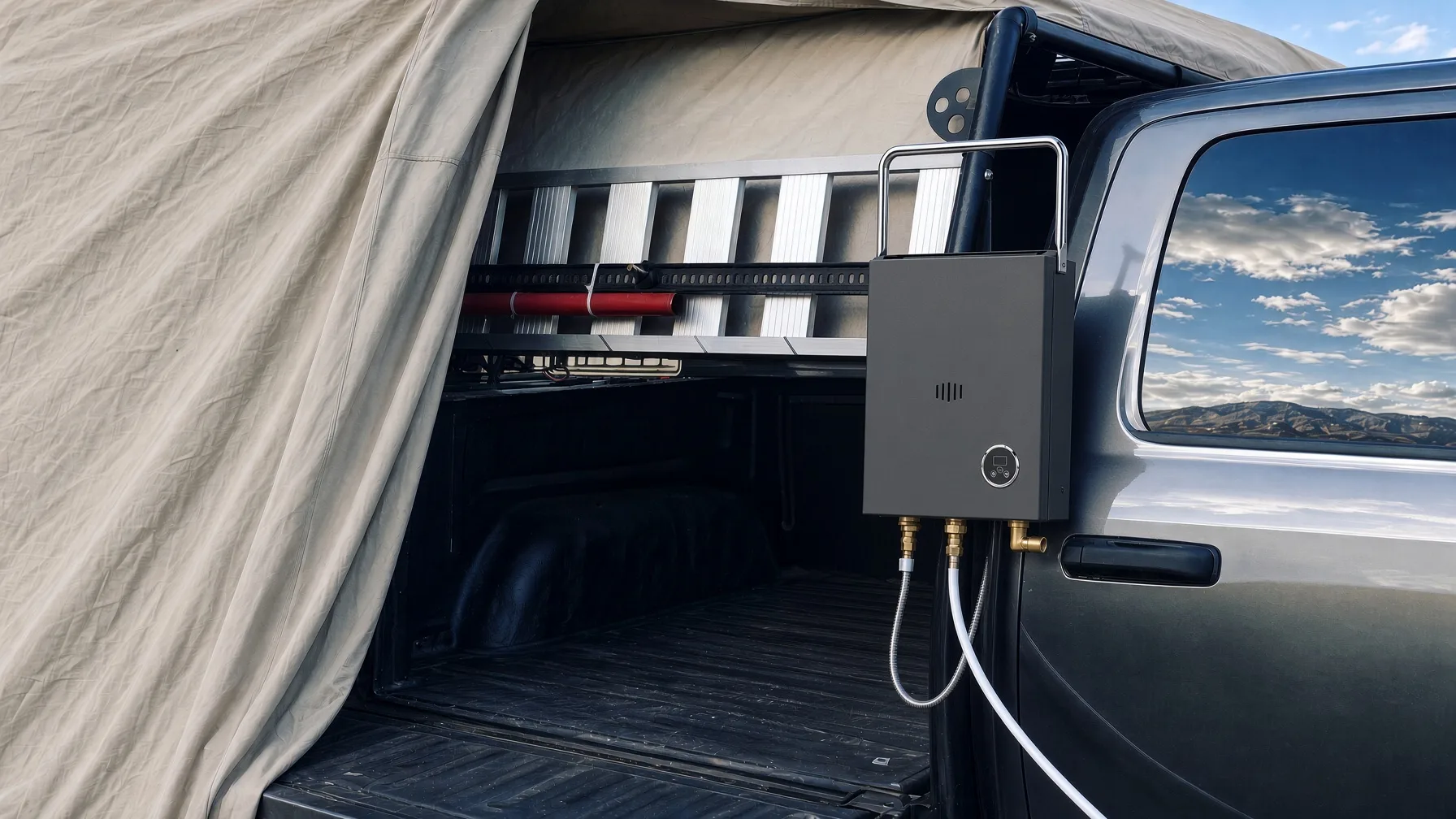
4L Constant Temperature Portable Water Heater · OEM / ODM
4L Constant Temperature Portable Water Heater Manufacturer, steady heat in a case you carry.
An OEM propane heater for camping, RV and off-grid wash points — a 30 MJ/h build with a 25 °C rise and four safety cut-outs, quoted from your drawing inside 48 hours and shipped under your own mark.
- 4 L/min
- continuous output
- DC 12V
- power supply
- 1/3-stage
- flame control
- 370 × 290 × 116 mm
- unit size
Application
A hot-water point you carry,
not one you plumb in.
A tankless propane heater on a 12V supply, built to be lifted out and set up wherever the water is. It heats as the tap opens and stops the moment the water does.
Carried, not fixed
Camping and outdoor showers
- A handle and a 370 × 290 × 116 mm case — one person lifts it and sets it up
- Tankless: it heats as the water runs, with no tank to fill or pre-heat
- Water-activated ignition, so the shower runs without a match or a pilot
Runs on the vehicle supply
RV, camper and off-grid rigs
- DC 12 V input matches the system already on board an RV or camper
- Propane from the cylinder the rig already carries at 2,750 Pa
- Starts on the flow of the tap — no mains, no switch to leave on
Where a hot tap is needed for a while
Gardens and temporary sites
- Garden washing, a temporary wash point, a jobsite standpipe
- Standard G1/2" connections match common fittings
- Packed away when the job is done — it does not stay on the wall
Heat control
Tankless heat,
held by a staged flame.
Instant hot water with no tank to wait on, and a burner that steps through three flame settings instead of only on or off — the mechanism the "constant temperature" name rests on.
Low flame
The burner drops to its lowest setting once the outlet is up to temperature — it holds the heat instead of overshooting it.
Mid flame
The middle setting carries a normal draw: an outdoor shower or a wash point running at a steady flow.
High flame
Full flame for a cold feed or a fast fill, then a step back down to hold the outlet rather than run past it.
The burner holds one of three flame settings and steps between them as the outlet and the flow move. Full flame for a cold feed or a fast fill, then a step down to hold the outlet — the mechanism behind the constant-temperature name.
Specification
Every figure this build ships to,
and its connections.
The production figures an installer works from and a buyer reads against a PO — grouped the way the unit is built, not the order the factory worksheet lists them in.
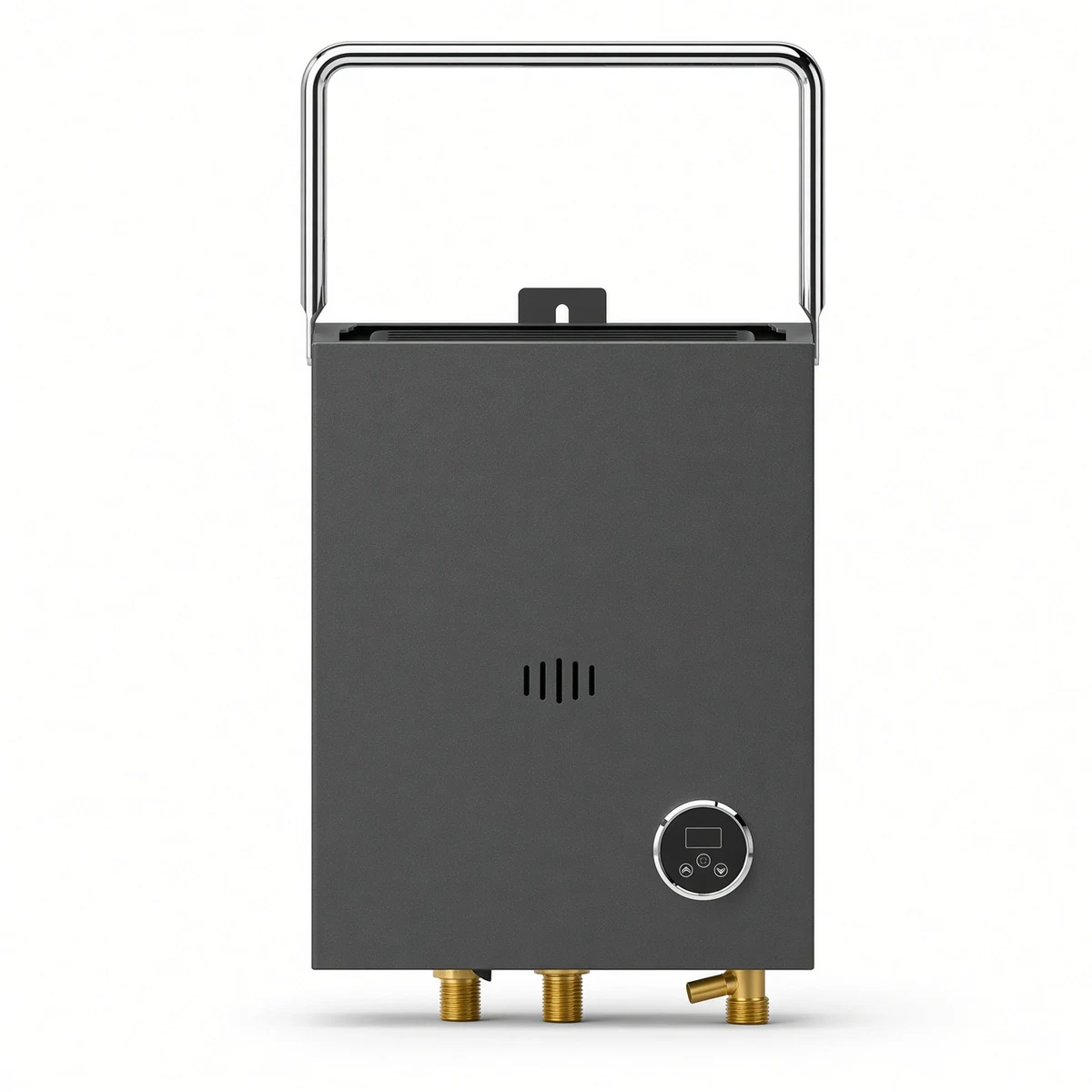
Performance
- Rated hot water output
- 4 L/min, continuous
- Rated heat load
- 30 MJ/h
- Temperature rise
- Up to 25 °C at rated flow
- Heating
- Tankless — instant, no storage tank
Gas path & control
- Gas type
- Propane only
- Set for propane at the factory. A different gas needs a different build, certified with the unit — not a field swap.
- Rated gas pressure
- 2,750 Pa
- A standard supply pressure from a regulated propane cylinder.
- Flame control
- 1 / 3-stage flame control
- Ignition
- Water-activated automatic
Power & water supply
- Supply voltage
- DC 12 V
- The same circuit an RV, camper or off-grid 12 V system already runs — no mains, no separate battery pack.
- Water pressure
- 0.06–0.45 MPa (10–65 PSI)
- Below the floor it will not fire; the band covers a gravity-fed tank and a pumped supply alike.
Build & connections
- Housing
- Weather-resistant metal
- Safety protections
- Flame failure, overheating, dry-burn, over-pressure
- Water in / out
- G1/2"
- A standard half-inch thread on both sides — feed in, hot out, matching common fittings.
- Gas connection
- G1/2"
- The same thread on the gas side, for a hose and regulator.
Protection
Four cut-outs,
before anything is at risk.
Each protection below stops the unit on its own — none of them waits for a person to act. They are the checks an importer reads first, because the liability for what ships travels with the container.
Flame-failure protection
If the flame does not prove or lifts while gas is flowing, the supply is cut.
Overheating protection
A thermal cut-out stops the burner before the outlet runs past its limit.
Dry-burn protection
With no water in the coil, the unit will not fire — it cannot heat an empty exchanger.
Over-pressure protection
The unit protects itself when the incoming water pressure runs high.
Open the tap
A sensor reads the water flow and the unit wakes — nothing has run until now.
Ignition fires itself
The burner lights automatically on the flow. There is no pilot and nothing to light by hand.
Heat at the set stage
The flame holds at one of the three stages, giving up to a 25 °C rise at the rated flow.
Close the tap
Flow stops, the burner goes out, and the unit returns to idle between draws.

Before you go further
A short brief is enough: where it lands, and how many a year.
Send the destination market and an annual volume, and what comes back is a cost direction, a sampling plan and the gas setting this model ships with.
Sourcing risk
What goes wrong in the field,
and the build that answers it.
A portable heater is judged by what fails after the season, not by a spec sheet. Five of the risks that come back to a buyer of a portable line — and what this build does about each.
A heater that fails its first season
Pitted coils and seized fittings turn every unit you sell into a claim against your brand, not the factory that made it.
What this build does
A weather-resistant metal case and a build set for propane only — the configuration confirmed against the production sheet before the order, not after.
A unit that will not run off the rig
A heater that wants mains power does not fit a camper, a van or an off-grid cabin, and rewiring around it undoes the saving.
What this build does
It runs on the 12V supply the vehicle or the cabin already carries, so it fits the rig rather than fighting it.
Scalding and cold patches
A single-stage burner overshoots and undershoots as the flow changes, and the person in the shower feels every swing.
What this build does
A flame that steps through three stages holds a steadier outlet as supply and flow move — the mechanism behind the constant-temperature name.
A white-label order that needs tooling
A private shape usually means a mould, and a mould means a volume a first order may not reach.
What this build does
The case is a metal shell, so colour, logo, carton and manual move under your mark with no tooling to buy.
Approvals that arrive too late
A unit shipped before its approval lands is a container you cannot sell, sitting against your cash.
What this build does
The certification scope is mapped and locked before the order is placed, so the certified unit is the unit that ships.
Programme
A first order, stage by stage —
and what each one holds.
A portable program follows a fixed order, and the two questions a buyer asks at every stage are the same: what is locked, and when. Here is the run this model follows, from the first brief to the sealed container.
Enquiry to scenario plan
Inside 48 hoursSend the destination market and an annual volume. What comes back is a cost direction, a sampling plan and the settings this model ships with — a costed reply, not an acknowledgement.
Sampling and approval
Off-toolSamples are built to your finish, dimensions and packaging and checked against the spec, so what is approved is what the line runs.
Certification and locking
Before the orderThe gas setting and the certification scope are fixed at build against your market. The configuration is locked before production, not adjusted at the destination.
Production
Gas-testedThe build runs against the locked configuration, and every assembled unit is burned in on the gas path and flame-proved before it is packed — not sampled.
Loading and consolidation
One containerUnits, spares and accessories are packed to one load and one packing list, so a first order does not have to fill a container on its own.
Compliance
Certified for the market
the container is going to.
Certification scope is mapped before the order, not after it sails. Tell us the destination, and the unit is fixed, tested and documented against that market — the certified unit is the one that ships.
Buyer voices
What came of the last two programs on this model
Two buyers on the 4L — a rental fleet that ran it hardest, and a converter that consolidated its hot-water fit onto it.
“The flame stages are what sold it — the shower stops scalding when the pump surges.”
We fit these to camper rentals, and the fault that came back on the old single-stage units was temperature swing: a weak gravity feed and a pump kicking in, and the water went from warm to scalding and back.
The 3-stage flame control on this one holds the outlet far steadier across a 12 V supply. Across 900 rentals over one season, the temperature-complaint tickets dropped from about 40 a season to under 5.

“One 12 V unit that fits the rig, with one carton and one spares line.”
We build campervan conversions and we were wiring around a mains-only heater plus a separate 12 V loop. Gulfstone set this one to run straight off the house battery we already fit.
It consolidated two part numbers into one, the 370 × 290 × 116 mm case slots into the same locker we were using, and the first container of 500 units landed 10 weeks after the drawing was signed off.

Questions on this model
What buyers ask about the 4L
The questions this build raises — the constant-temperature mechanism, the 12V supply, the pressures, the propane-only gas, and the private-label case.
01What makes this a "constant temperature" heater?
02Does it need mains power, or a battery?
03How does it start — is there a pilot light or a switch?
04What water pressure does it need?
05What gas does it take, and can it run on butane or natural gas?
06Can we have it under our own brand?
Start a program
The brief goes to the engineer who builds it.
Market, annual volume and the certification it must carry — three lines, and we have what we need. Your reply comes from the engineer who would run the line, scoped to your program rather than matched off a shelf.