Case file 06 · European brand · Private tooling
European Brand: From Market Brief to Private Tooling and Brand Exclusivity
A Northern European outdoor brand came with a market, a €349 price and no drawing. The build kept the certified gas core and tooled every part a buyer would see.
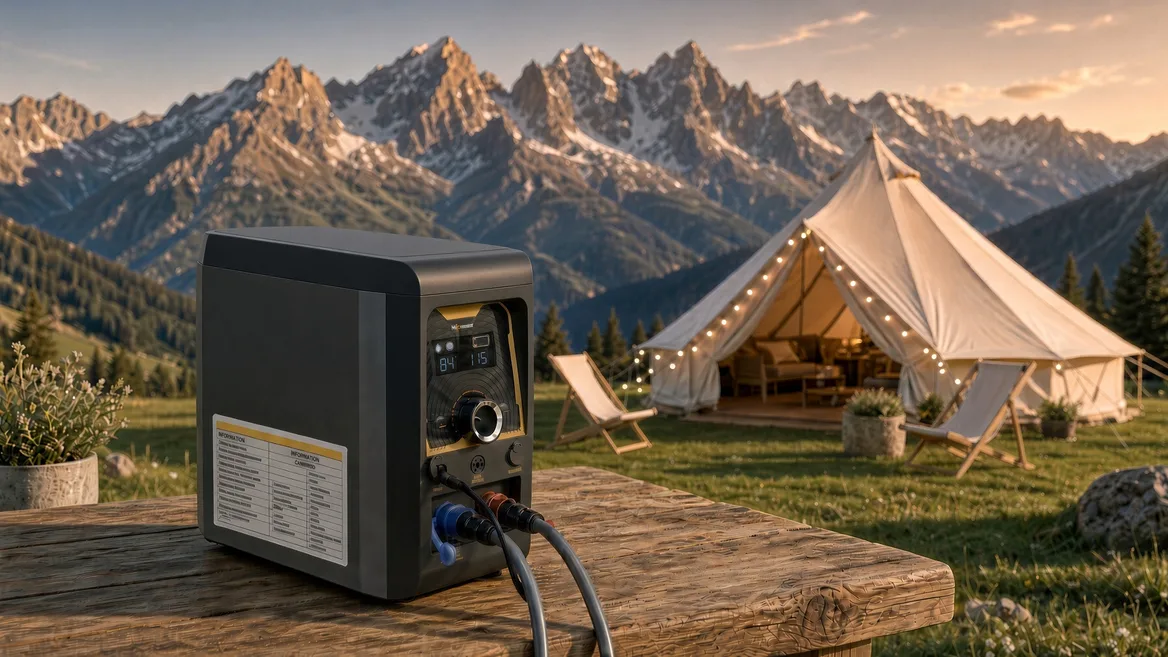
- $28,500
- Private tooling, verified total
- 3,000
- Units before the tooling rebate
- 180 days
- Brief to launch-ready
- ~4 months
- Lab and certification time saved
Client profile
Who the Program Was Built For
A Northern European outdoor brand selling to caravanners, glamping sites and outdoor retail, with no in-house gas engineering team.
- Industry
- Outdoor recreation retail, Northern Europe
- Product
- Portable tankless gas water heater
- Starting point
- A market, a €349 price and a required silhouette, no drawing
- Channels
- Caravanning, glamping, outdoor retail
- Forcing function
- Spring launch inside the retail buying window
- Build basis
- Pre-certified internal core, bespoke exterior tooling
- Development time
- 180 days from brief to launch-ready
- Client name
- Withheld under NDA
Company profile linked for reference; the program figures are anonymised.
Summary
What the Tooling Bought
This case covers one Northern European outdoor brand and one portable gas water heater program, not a template for every custom build. The figures come from the program's development logs, tooling approvals, mold-trial notes and commercial amortization records.
The brand needed a unit it could sell into caravanning, glamping and outdoor retail without sharing a shell with the catalog sellers beside it. Gulfstone took the brief to a launch-ready product in 180 days. The gas path stayed hybrid: a pre-certified internal core, and tooling built for the outside.
The private tooling investment came to $28,500, with a rebate trigger at 3,000 units. The bespoke front casing, dial knurl and badge recess protected a €349 shelf price while lookalikes sold for about €160. Reusing the certified core cut roughly four months of lab debugging and certification rework.
The sections that follow show the gates, the legal lock and the money in the order they happened.
- $28,500 — Private tooling, casing dies and dial tooling combined
- 3,000 units — Volume threshold for the tooling rebate
- €349 vs ~€160 — Shelf price against catalog clone offers
- ~4 months — Lab and certification rework avoided by reusing the core
- 180 days — Brief to launch-ready product
Conformity for gas appliances sold in the EU follows Regulation (EU) 2016/426, the Gas Appliances Regulation. The program's certification route was mapped against that regulation before tooling release.
I
Why a Catalog Shell Was Not an Option

The brief began with a market and a price, not a drawing. Everything the brand invested in had to survive a shelf where the same heater was already selling for less.
A Northern European outdoor brand wanted a portable tankless heater for caravanning, glamping and outdoor retail. It had no gas engineering team of its own. It had a market, a €349 price and a spring window.
The risk was not that nobody could build a heater. Catalog sellers could source one, re-badge it and undercut the line inside a season. Without exterior tooling and enforceable mold custody, the premium had nothing behind it.
Compliance added its own clock. GAR, Regulation (EU) 2016/426, required a technical file supporting CE marking and a route through an independent Notified Body. Gas pressure also varies by European market, so the same unit had to be proved more than once.
Money moved before volume did. The tooling bill fell due before a single container shipped, and the rebate only started at 3,000 units. A factory that could side-sell the design, or hold the molds, was the exposure nobody wanted to sign for.
“No signed mold title, no machining. We do not cut steel on a promise.”
What a Weak Exclusivity Story Costs
- Price erosion. Catalog clones at about €160 set the customer's reference point. Every season the brand cannot answer them, the €349 price reads as a markup rather than a difference.
- Missed buying window. A six-week slip in conformity work pushes container departure into April, past the spring buying window. The product lands after the shelf plan is set.
- Tooling exposure. Steel cut before custody papers are signed is hard to recover. A design already on the water cannot be claimed back by paperwork signed later.
- Four problems at once. Sourcing, compliance and finance each carried a separate question. The brand had to answer ownership, GAR routing, pressure variance and launch timing together.
The Cosmetic Reject at T0
At T0, the tooling lead checked the laser-etched client serial on the die block, then the first-off casing against the master sample.
One cavity came back with a 0.4 mm step at the dial bezel seam. Under retail lighting, that step would show.
A cosmetic reject at T0 costs a tooling adjustment. The same defect in a retail carton costs a return and a conversation with a buyer who is already watching the price.
What Makes Custom Gas Harder Than Private Label
- A new combustion platform means new test evidence. Keeping a pre-certified core is what kept the evidence path short.
- GAR is not one signature. The technical file, the Notified Body route and the production-conformity module all have to line up before CE marking.
- Pressure categories are physical. 30 mbar and 50 mbar markets need different injectors and regulators, and both need ignition and thermal stability re-run.
- Cosmetics get checked at T0 or at retail. There is no third option.
The Same Shelf, Two Products
| Element | Catalog clone | Private tooling |
|---|---|---|
| Front casing | Shared catalog shell, re-badged | Tooled geometry the brand owns |
| Control dial | Generic knob | Knurled ABS interface, tooled for this program |
| Badge | Printed or stuck on | Recessed into the tooling |
| Shelf price | About €160 | €349 |
| Defense | None beyond the brand name | Mold custody and a shell nobody else can buy |
Clone readings are the market offers this program priced against. Bespoke readings are the program record.
Settle mold title and NNN terms before the first cut. A design on the water cannot be recovered by paperwork signed afterwards.
II
The Hybrid Build: Certified Core, Bespoke Shell
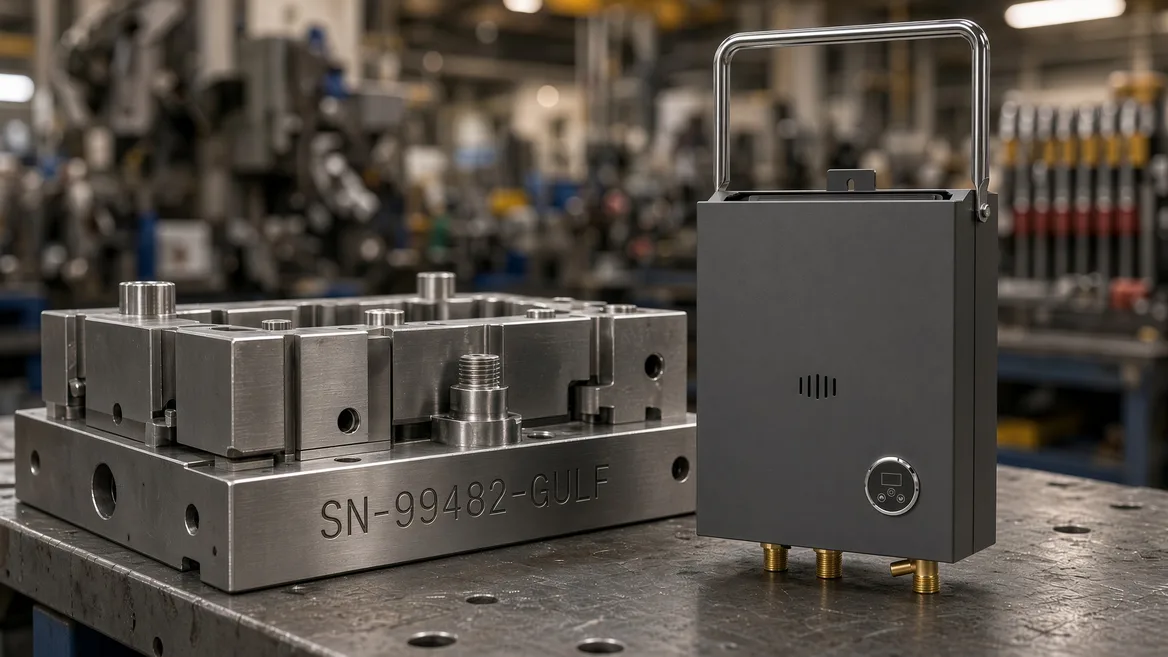
The program did not start a new combustion platform. It kept a proven gas core and spent the tooling budget where a buyer would see it.
The inside of a gas heater carries the evidence: burner behaviour, ignition, thermal stability, leak paths. All of that already existed in a pre-certified core. Rebuilding it would have repeated lab work the core had already passed.
The outside carries the price. A buyer recognises the casing, the dial and the badge before reading a spec sheet. Those parts went on the exclusivity list and were tooled for this program alone.
The Four Build Decisions
The Core · Reuse What Has Already Passed
An off-the-shelf, pre-certified manifold and burner core stayed as the fixed base. The injector matrix and burner mounting points were locked before die release, so a casing change could never move the combustion path.
The Casing · Tool the Part the Buyer Recognises
The front casing is fully bespoke. The stamping dies were cut to this program's geometry, which is what a competitor would have to reproduce before selling a lookalike.
The Dial · Make the Control Feel Like the Product
A bespoke ABS control dial carries a knurled edge for gloved hands and sits in a tooled bezel. It is the part a buyer touches before deciding, and it is in no catalog.
The Calibration · Split the Pressure, Share the Core
The same core serves both European pressure groups, but the injectors, regulators and test runs do not. Each market set was calibrated and re-proved rather than carried over.
One Casing, Two Pressure Categories
30 mbar markets
One injector set, calibrated and validated for the standard pressure group. Ignition and thermal stability were proved against that set.
50 mbar DACH markets
Different injectors and regulators, with ignition and thermal stability re-run. Category I3B/P and I3+ adaptation followed this split.
What does not change
The front casing, dial and badge recess stay identical. Pressure is handled inside, where a substitute part also shows up in the test data.
The Terms That Make Exclusivity Real
- Mold title
- Signed before the first cut. Title sits with the client, not the factory.
- NNN agreement
- Non-disclosure, non-use and non-circumvention, signed before any CAD file moved.
- Contract set
- Bilingual, with Chinese as the governing text and an official company chop.
- Die serials
- Each steel die carries a laser-etched client ownership serial, logged in the asset register.
- Storage
- Dies sit in a segregated vault, not on the open machine floor.
- Exit clause
- An unconditional return-or-destruction obligation if the relationship ends.
- Rebate
- The tooling-cost rebate triggers once volume passes 3,000 units.
Exclusivity on paper is not custody. The serial on the die and the vault it sits in are what let the client prove which steel is theirs.
“Reusing the certified core saved roughly four months. It only worked because the exterior and the market calibration stayed fully bespoke.”
III
From Brief to Launch Through Five Compliance Gates
The build ran in 180 days, with each gate closed before the next opened. The sequence follows Gulfstone's [ODM development process](/oem-odm/).
Market Brief and Feasibility LockDays 1–15
Target channels, the €349 price, country mix, pressure categories and warranty assumptions were locked. The brand named the cues that had to stay exclusive: casing geometry, dial knurl and badge recess. Those went on the exclusivity list; commodity internals stayed off it. No CAD release happened before the list was frozen.
Architecture DecisionDays 16–35
The team kept an off-the-shelf, pre-certified manifold and burner core and froze a bespoke casing and ABS dial around it. Injector matrix and burner mounting points were fixed before die release. The outside had to be exclusive; the combustion path had to be proven.
DFM and Thermal ReviewDays 36–70
Airflow, shielding, heat soak, sheet-metal tolerance stack-up, service access and dial ergonomics were reviewed. A 2 mm shield gap can shift a thermocouple reading, and a stacked tolerance can bind the valve access panel. A technician still has to reach the thermocouple and gas valve without stripping the casing.
Compliance and Legal LockDays 71–100
The GAR route was mapped as Module B plus a production-conformity module such as C2 or D. The technical file, manuals, drawings, BOM and risk assessment were prepared before tooling release. Legal review ran alongside DFM, so the file matched the released design. The NNN came before full CAD transfer.
Tooling Release and Pilot ValidationDays 101–180
Die blocks were measured and logged against the asset register before T0. T0 rejected a cavity for a 0.4 mm step at the bezel. T1 corrected cosmetic fit and a gas-valve bracket that flexed during ignition. T2 covered leak testing, thermal stability, packaging and pilot validation. Actions stayed open until evidence closed them.
The Gated Path, and What Each Gate Prevents
A gate is worth having only if skipping it has a known cost. These are the failures each one exists to stop.
Standard pathFive gates, one release
Exclusivity list frozen before CAD
Certified core fixed, exterior open
Thermal, tolerance and service access resolved
Technical file matches the released design
Serials logged, T0 to T2 closed on evidence
Exception pathWhat an ungated build pays for
A cosmetic change becomes a tooling reset
Months of lab and certification rework
The evidence and the product drift apart
Molds to chase and a design on the water
A unit that fails in its second market
IV
The Team on Keeping the Certified Core
The Director of ODM Engineering owns the build schedule and the gate sign-offs on custom programs. The tooling shop runs the dies and the serial register. Both sat in the same review room for this program.
Director of ODM Engineering
ODM Engineering, Gulfstone
Why not design a new burner for a custom program?
Because the burner is where the evidence lives. A new platform would have repeated months of ignition, thermal and leak work. The casing is where the customer looks, so that is where the tooling money went.
When does the tooling shop start cutting?
After the mold title and the NNN are signed, and not before. The contract set is bilingual and chopped, and each die gets a client serial. If the serial is not logged, it is not ours to cut.
What did rejecting one cavity at T0 protect?
A 0.4 mm step at the bezel seam. At T0 it costs a tooling pass. On a retail shelf under overhead light it costs a return and a conversation with a buyer who is already watching the price.
Why is 50 mbar a tooling decision rather than a note in the manual?
Because gas flow, flame shape and test outcomes all change with pressure. Different injectors and regulators mean a different build and a different test run. It is the same casing with a different inside.
Freeze the exclusivity list at feasibility. Every cosmetic change after die release is a tooling reset in disguise.
V
Private Tooling Results: A Protected Price, Not a Lower Bill

The figures below are the ones the program's amortization record and tooling asset register can support. Where a split is not documented, it is not shown.
NRE and private tooling
$28,500
Combined, one verified total
Covers the front-casing stamping dies and the ABS dial tooling. The record does not split the two sub-lines.
Amortization trigger
3,000 units
Then ≈ $9.50 per unit
The tooling burden reduces after the volume threshold. Below it, the brand carries the full tooling cost.
Retail price defense
€349 vs ~€160
A €189 gap held
The gap against catalog clones is the difference between the two shelf prices, not a margin figure.
Development time
~4 months saved
Certified core reused
Approximate, measured against a comparable new-platform schedule in the program's own timeline logs.
Custody
Serial on every die
Audit-traceable
Serials sit in the asset register, with a return-or-destruction clause behind the molds.
Where the Tooling Cost Lands
Catalog clone
€160
No private tooling; the shell is on every seller's shelf
Bespoke program
€349
Own casing, dial and badge on a certified core
Tooling per unit
≈ $9.50
$28,500 spread across the 3,000-unit rebate threshold
The $28,500 is the only verified total; the record does not split die and dial costs. The $9.50 is straight division before the rebate itself is applied. The €160 is the catalog price band this program was priced against, not a quote.
The commercial amortization record and the tooling asset register agree on one combined figure, $28,500. Neither splits the die and dial costs, so neither does this page. The four-month saving is approximate, taken from the timeline logs against a new-platform schedule. Mold trials, serials and the storage record were checked at the tooling shop.
Gulfstone ran this program, and its own engineering team kept the records. Treat the case as a vendor-participant account, not a third-party audit. The brand's name is withheld under NDA.
- Retail buyers defend a shelf price instead of discounting toward a clone.
- The spring window held, because the lab and certification path never restarted from zero.
- Compliance staff work from a technical file that matched the released design, not a promise to reconcile later.
- QC gets locked handoff points at pilot and mass production, with mold-trial evidence and serials already logged.
“The win was not a lower bill. It was a controlled bill: fewer unknowns at T0, a cleaner compliance file, and a price we could defend.”
VI
What Transfers From a Private-Tooling Program
Custom gas builds protect a price only when the tooling, the custody and the certification are planned as one bill.
Put only visible parts on the exclusivity list
Casing geometry, dial knurl and badge recess carried this premium. Commodity internals stayed off the list, which kept the tooling budget pointed at what a buyer sees. Freeze the list before CAD release.
Reuse the certified core, tool the outside
A new combustion platform would have cost roughly four months of lab and certification work. The core was already proven, so the engineering time went into the shell and the market calibration.
Sign custody before the first cut
Mold title, NNN terms and a return-or-destruction clause came before steel. Laser-etched serials and a segregated vault let the client point at their own dies in an audit.
Price the tooling against the shelf gap
$28,500 spread over 3,000 units is about $9.50 a unit. Against a €189 price gap, the question stops being whether the tooling is affordable and becomes whether the design is worth defending.
Write down the price the product has to hold and the price a clone will reach. If that difference will not carry the tooling, the design is not the first problem to solve.
VII
Why a Certified Core Scales Into the Next Model
The next variant does not have to restart the compliance strategy. Reuse the certified core, re-tool the visible housing, and re-run the calibration for the market being entered.
That keeps a family of products on one evidence base. An RV variant, an outdoor shower unit or a second casing for another retail chain can share the combustion work while each keeps its own exterior.
A brand planning two models should budget the tooling as a program rather than a single purchase, and put every die on the same custody register.
Frequently Asked Questions About Private Tooling for Gas Appliances
1. Do I need a notified body for gas appliances?
Yes. Gas appliances sold in the EU need an independent Notified Body under GAR, Regulation (EU) 2016/426. In this program the route was Module B plus a production-conformity module such as C2 or D, because Module B alone does not cover production. The technical file, manuals, drawings, BOM and risk assessment support the CE marking.
2. How much does private tooling cost for a gas appliance?
In this program, private tooling cost $28,500 combined, covering the front-casing stamping dies and the ABS dial tooling. The record does not document a sub-line split, so only the total is reported. A rebate triggers at 3,000 units, which spreads the tooling at about $9.50 a unit before the rebate itself applies.
3. Can a 30 mbar appliance run on 50 mbar?
No. Pressure changes gas flow, flame shape and test outcomes, so a 30 mbar unit cannot simply be used on 50 mbar. For 50 mbar DACH markets this program used different injectors and regulators and re-ran ignition and thermal stability checks. The casing is shared; the gas train is not.
4. How do I keep tooling ownership in China?
Sign mold title and an NNN agreement before any CAD file moves. In this program the contract set was bilingual with Chinese governing text and a company chop, each die carried a laser-etched client serial, and the molds sat in a segregated vault with a return-or-destruction clause if the relationship ends.

Forward
Co-founder & General Manager, GulfstoneGas appliance manufacturing and certification
Most of what decides a gas appliance is settled before anything is built — on the drawing, at the cut-out, in the tolerance someone chose for the gas path. I have spent my working life on the manufacturing side of that decision, and this is where I write down what it has taught me.
Nothing here is written from a sales desk. Every note comes off the floor: a batch held until a reason was found, a fitting that failed in transit, an approval path that only made sense once the destination market was fixed. If you read these first, the opening conversation starts at the standard rather than at the beginning.
- Gas water heater engineering
- Design for manufacturing
- Certification path selection
- Private-label tooling
- Off-grid and outdoor water heating
- Top 8 Outdoor Portable Gas Water Heater Factories in China for B2B BuyersNov 4, 2026
- Custom RV Appliance Industrial Design: An OEM Brief to a Validated PrototypeNov 3, 2026
- How to Build Custom Thermostat UI Design Software for OEM Embedded PanelsNov 3, 2026
- Top 8 RV Water Heater OEM Suppliers Canada: Vetted for Volume BuyersNov 3, 2026
Fifteen years in appliance manufacturing — home appliances, RV refrigeration, then gas water heating — from the drawing to the shipping container.
Leads Gulfstone's design-for-manufacturing reviews and the certification path selected for each destination market.
Works directly with OEM and private-label buyers on tooling, tolerances and the approval file.