Case file 05 · Off-grid cabin network
Off-Grid Cabin and Multi-Site: One Platform, Fewer Spares and Service Calls
A sixty-cabin resort network ran six retail heater brands and kept 84 spare-part SKUs to service them. One OEM platform with four common modules replaced the parts room, the guesswork and the winter refunds.

- 84 → 9
- Spare-part SKUs in the parts room
- −62%
- Remote technician dispatch cost
- Zero
- Peak-winter downtime refunds
- 60
- Cabins across four locations
Client profile
Who the Cabin Platform Was Built For
A multi-site resort operator running off-grid cabin accommodation across four locations, where water comes from a pump and gravity tank and a cold shower reaches the guest.
- Industry
- Off-grid cabin and resort accommodation
- Scale
- 60 cabins across 4 locations
- Water supply
- Pump and gravity tank, no city mains
- Power
- Battery ignition; no mains to the cabin wall
- Legacy fleet
- Six retail heater brands, 84 spare-part SKUs
- Forcing function
- Peak-winter occupancy; a cold shower becomes a refund
- Client name
- Withheld under NDA
Company profile linked for reference; the deployment figures are anonymised.
Summary
What Rebuilt the Cabin Fleet
This case covers one sixty-cabin off-grid resort network at four locations, not every cabin heater on the market. Maintenance tickets, spare-part orders and winter refund claims from the field team were traced for the deployment.
Six retail heater brands had spread across the sixty cabins. Each brand brought its own vent cap, ignition layout, thermocouple and board revision, and the spare-parts room held 84 SKUs to keep them running.
The operator replaced all six brands with one Gulfstone OEM platform built around intentional Common Core engineering. Four service-critical modules — the flow sensor, the microswitch assembly, the quick-release brass drain plug and the potted ignition control box — are identical across the 5L, 10L and 16L units.
Groundskeepers now clear common faults on site with one MRO kit and a 15-minute triage SOP. Spare-part SKUs fell from 84 to 9, remote dispatch cost fell 62%, and peak-winter downtime refunds went to zero.
- 84 → 9 — Warehouse SKUs, six brands to one platform
- 4 — Service-critical modules identical across 5L, 10L and 16L
- −62% — Remote technician dispatch cost, travel and labour
- Zero — Peak-winter downtime refunds
CSA Group treats venting and gas supply as system-level constraints, which is how the fleet audit treated them: the heater is one part of the water and gas path, not a standalone box.
I
Why Does a Mismatched Fleet Cost More Every Winter?
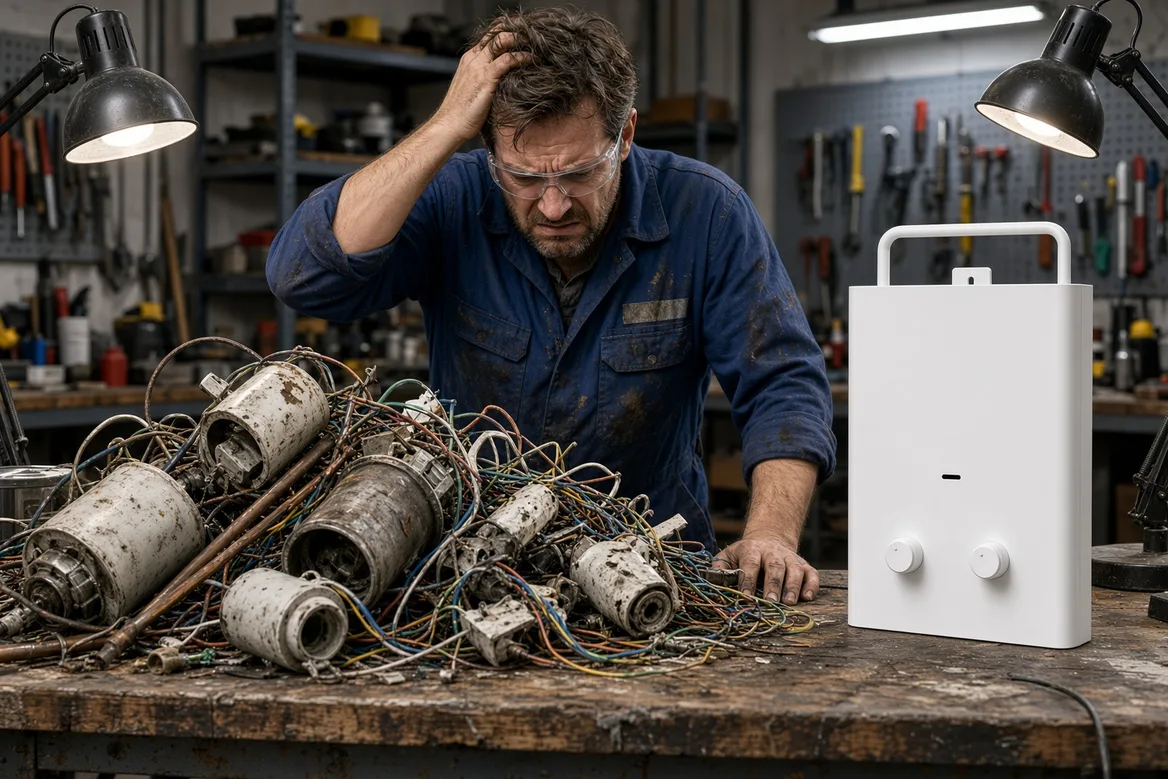
No spark and no gas was the symptom the maintenance team kept logging. The root cause sat in the parts room: six brands, six answer sets and no single test that could be trusted.
Six retail heater brands spread across sixty cabins, each with its own vent cap, ignition layout, thermocouple and board revision. The spare-parts room held 84 SKUs, and no clean stocking logic guided the staff who maintained them.
The same failure stack repeated in cabin after cabin. Batteries were dead while the igniter still clicked. Clogged inlet screens and weak pumps caused low-flow misfires. Microswitches failed at the gas valve, and staff confused boards and solenoids when they serviced unlike-for-unlike equipment.
Minimum water flow matters most in off-grid cabins. Pressure comes from a pump and gravity tank, not city mains, so a heater can spark and still shut down when a clogged screen, a weak pump or a partly closed valve drops flow below its activation threshold.
Not every ticket was a heater fault. Some hid pressure or water-quality problems, freeze damage or installation errors that mimicked a failed heater. One night call ended with a replaced board; a clogged screen was the real fault. That swap cost two hours and a return trip.
“One winter trip could require three different solenoid valves. That is not a parts problem. That is an architecture problem.”
What the Parts Room Cost the Season
- Emergency dispatches. A groundskeeper could not trust the first symptom report, so every call sent someone out to test the whole water and gas path before swapping anything.
- Guest refunds. Each winter outage risked a refund on a booking. A cold shower at midday is a review; at night in peak freeze, it is a cancellation.
- Long off-road travel. One dispatch could eat a full day of technician time in travel, overtime and delayed check-ins before the first part was touched.
- Training debt. Every new groundskeeper had to learn as many fault paths as there were brands, and the paper list of which brand used which module changed at every site.
The Night Call That Replaced the Wrong Part
A caller logged no spark and no gas on a cabin unit after dark.
The board was replaced as the likely fault. The real cause was a clogged inlet screen starving the unit below its flow threshold.
The correct diagnosis cost two hours and a second trip. Every later call carried the same uncertainty: which brand, which module, which answer.
Why Did the Six-Brand Fleet Never Settle?
- Six brands meant six vent caps, six ignition layouts and six board revisions that could not be stocked in any sensible ratio.
- Staff confused boards and solenoids because the module on one unit did not resemble the module on the next.
- The triage list lived on paper, and the paper changed at every site — so training never converged.
- Off-grid pressure, water quality and installation errors all presented as heater faults, and no single SOP separated them.
The Bench Comparison, Side by Side
| Component | Six-brand fleet | Gulfstone platform |
|---|---|---|
| Ignition box | Brand-specific, re-pinned per unit | Potted, common pinout across 5L, 10L, 16L |
| Microswitch | Different bodies and terminals by brand | One common assembly across all sizes |
| Flow sensor | OEM-specific, single-source | Common module, stocked as one line |
| Drain plug | Moulded, brand-specific thread | Quick-release brass, no tools |
| Bracket pattern | Drilled to each brand's housing | Common mounting holes across sizes |
| Triage path | Paper list per site | One 15-minute SOP for the whole fleet |
Legacy retail fleet on the left; the Gulfstone OEM platform on the right.
Count the spare-part SKUs before next winter. If one service trip can pull from three different solenoid lines, the fix is not a bigger parts stock — it is one platform.
II
What Is an Off-Grid Cabin Heater Platform?
One OEM architecture, sized by cabin, with the modules that fail in the field held common. Standardisation stops at the parts the technician touches; heat output still follows occupancy.
The answer was exact OEM replacement, not cross-brand substitution. The operator stopped reordering six retail SKUs and rebuilt the fleet around one Gulfstone OEM platform with intentional Common Core engineering.
Every failure mode across the sixty cabins was mapped with the engineering team before the order was placed. Four modules caused most of the downtime, and all four are now identical across the 5L, 10L and 16L units.
The Modules That Stay Common
Flow sensor · Can the Unit Read Its Own Water?
Off-grid flow is unstable, so the sensor that decides whether water is moving is the first module in the triage path. One common part means one reading, one test and one replacement across the fleet.
Microswitch assembly · Does the Gas Valve Answer the Same Way
The microswitch confirms flow at the gas valve. A common assembly means the click a groundskeeper listens for sounds and behaves the same in every cabin.
Quick-release brass drain plug · Can Winterisation Skip the Tools?
The quick-release drain plug empties the unit by hand, which is what turned winterisation from a technician visit into part of the seasonal groundskeeping round.
Potted ignition control box · Does the Board Survive the Cabin Wall?
The potted box seals the control electronics against moisture and vibration. Shared pinouts mean an ignition box swap needs no connector re-pinning, and matched safety timing means the ignition sequence behaves the same on all three sizes.
When a Cabin Unit Fails, Three Paths Apply
Groundskeeper clears it
Battery, flow and microswitch checks are inside the SOP, and so is a pre-approved common module swap on an isolated unit.
Licensed technician
Anything that opens the gas train — gas settings, leak diagnosis beyond a soap test, non-standard manifold work — routes to a licensed professional.
Back to the depot
Non-common damage goes to the central spares depot, where one module family is stocked instead of six brand-specific boards.
The Engineering Behind Shared Pinouts
- Shared pinouts
- A technician swaps an ignition box without re-pinning a connector.
- Common brackets
- The same mounting holes work across all three sizes.
- Matched safety timing
- The ignition sequence and flame-safety response are identical, so the triage path does not change from cabin to cabin.
- Potted control box
- The control electronics are sealed against moisture and vibration at the cabin wall.
- Quick-release drain
- Winterisation drains the unit by hand, without tools.
Heat output still changes by cabin demand: a 16L unit for a family cabin, a 5L for a solo bunk. The parts that fail in the field stay common.
“Shared pinouts matter because a technician can swap an ignition box without re-pinning a connector. Matched safety timing means the triage path does not change from cabin to cabin.”
III
The 15-Minute Field Triage Path
The kit and the SOP were written together: every step either clears the fault on site or names the exact point where the job leaves a groundskeeper's hands.
Battery CheckPower
Test the battery and replace it below 9V. A dead battery with a clicking igniter was the most common false alarm in the audit, and the check costs a minute.
Water-Flow CheckFlow
Confirm pump pressure and inlet screen condition. Off-grid flow drops from clogged screens, weak pumps and partly closed valves, and any of the three can shut a healthy heater down.
Microswitch ClickGas valve
Listen for the click at the gas valve. No click points at the microswitch assembly; a click with no ignition points further along the ignition path.
Ignition Box SwapModule
Replace the potted ignition box with the common module if there is no spark. Shared pinouts mean no connector work, and matched safety timing means the restart behaves as it did on the bench.
EscalateBoundary
Stop and route to a licensed technician if a gas leak, a combustion abnormality or a non-common manifold issue appears. The kit is not a licence to work on the gas train.
The Standard Triage, and the Calls That Must Stop
The standard path runs from fault report to guest-ready cabin. The exception path names the four points where the job leaves the groundskeeper's hands.
Standard pathReport to ready
No spark, no gas, or low temperature
Replace below 9V
Pump pressure and screen condition
Listen for the click at the gas valve
Common module swap, no re-pinning
Exception pathWhere the job escalates
Licensed technician, no exceptions
Isolate the unit and escalate
Depot and licensed technician
The SOP boundary, stated before the trip starts
IV
The Maintenance Supervisor on Drawing the Line
Maria Santos ran maintenance across the sites and enforced the boundary on every call. The kit was built to clear common faults fast, and the SOP named the point where fast stops being safe.
Maria Santos
Maintenance Supervisor, cabin resort network
Where does a groundskeeper's authority stop?
At the ignition-box swap. Anything that involves opening the gas train goes to a licensed technician. We train that boundary on the first day, before anyone touches a kit.
What changed first after the platform switch?
The guessing stopped. Every cabin answers the same four checks in the same order, so a new groundskeeper can diagnose a unit on their first week instead of their first month.
How did training change?
It went from three days to one afternoon. Every cabin follows the same triage path, so there is one procedure to learn rather than six brand variants of it.
Why does the SOP name the escalation triggers?
Because speed without limits invites risk. A fast swap is worth having only if the crew knows exactly where it ends and who takes over.
The kit is powerful, but it is not a licence to bypass gas safety. Write the escalation triggers into the SOP before the first kit reaches a site.
V
Cabin Network Results: One Platform, One Parts Room
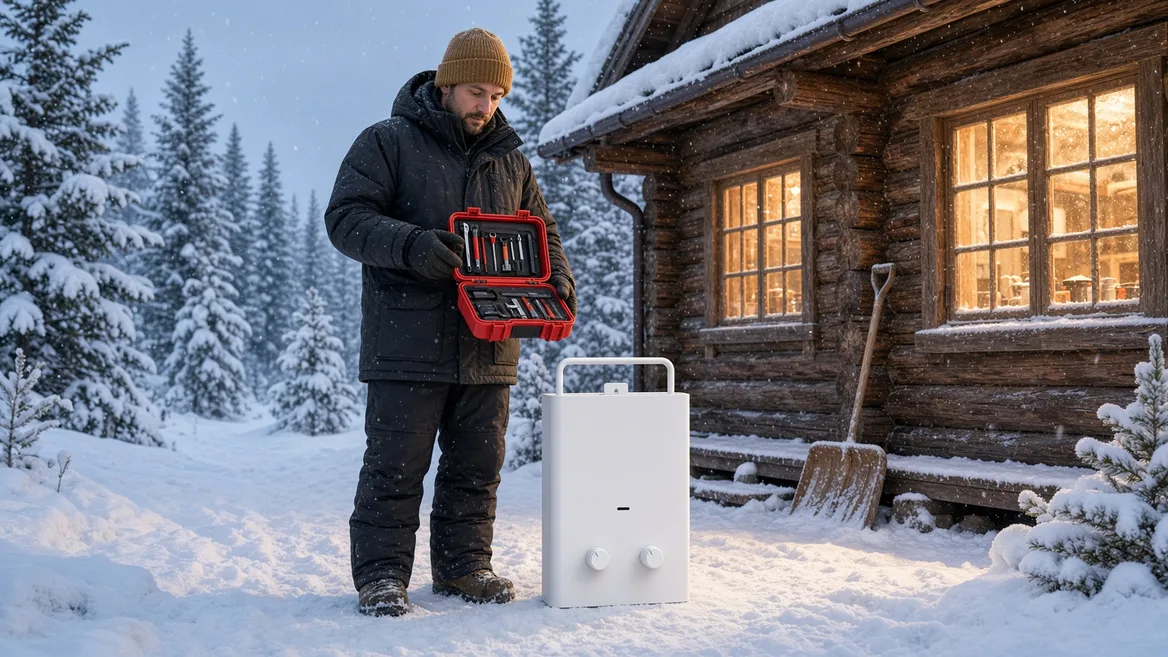
Measured against the operator's own maintenance logs and refund ledger over the post-deployment period. The 62% counts remote travel and labour only, not scheduled maintenance.
| Measure | Before | After |
|---|---|---|
| Spare-parts inventoryCommon Core engineering made the flow sensor, microswitch, drain plug and ignition box identical across 5L, 10L and 16L. | 84 warehouse SKUs across six retail brands | 9 core interchangeable modules |
| Remote technician dispatch costGroundskeepers cleared common faults on site with one MRO kit and the 15-minute triage SOP. | Prior per-call baseline | Down 62% |
| Peak-winter cabin downtime refundsCommon modules and the quick-release drain plug stabilised cold-weather starts and sped winterisation. | Open claims during each freeze | Zero |
Where the Ledger Turned
Legacy fleet
84 SKUs
Six brands, 84 SKUs, three solenoid lines and a dispatch to diagnose the diagnosis
One platform
9 modules
One parts matrix, one label set, one reset path and one replenishment line
Remote dispatch cost
−62%
Remote travel and labour only, not scheduled maintenance
The 84 SKUs and 9 modules are counts from the operator's own parts room. The 62% is the change in remote dispatch cost for travel and labour; scheduled maintenance is outside the measure.
The operator's maintenance logs and refund ledger were audited against the post-deployment period, and every common module passed incoming inspection before it entered a kit. The 62% dispatch-cost drop counts remote travel and labour only, not scheduled maintenance. CSA Group's guidance on venting and gas supply supports the same system-level view.
Gulfstone engineered the platform and its team gathered the field data with the operator. Treat this as a vendor-participant case study, not a neutral third-party audit. The operator's name is anonymised.
- Groundskeepers carry one kit and a one-page triage card, which lowered the cognitive load on rotating staff.
- The crew logs each swap by cabin and module lot, so parts use is visible instead of assumed.
- Procurement forecasts one module family instead of six brand-specific boards, and emergency orders dropped to one replenishment line.
- Guests avoided cold-shower disruptions during peak freezes, and finance stopped leaking margin through refunds, emergency travel and overtime dispatch.
“Before, my truck carried four different brand-specific boards and a binder of wiring diagrams. Now I carry one common kit and a one-page triage card. I stopped guessing which solenoid fits which cabin.”
VI
What Transfers From a Cabin Fleet Rebuild
A standardized platform can run a fleet of any size, but only when capacity tiers still match occupancy and the common parts are the ones a technician touches.
Standardise the service layer, not just the purchase order
One purchase order for sixty heaters fixes paperwork. It does not fix a 2 a.m. no-spark call. The leverage came from four common failure-path modules backed by one SOP and one labelled kit.
Run one architecture across cabin sizes
Heat output should follow cabin demand; service parts should not. A 16L family cabin and a 5L solo bunk share the ignition box, bracket pattern and safety timing, so one board replaces four.
Write escalation boundaries into the SOP
Fast on-site swaps cut remote dispatch cost 62%. Speed without limits invites risk, so the SOP names gas-train work, leak diagnosis beyond a soap test and non-standard manifold changes as licensed work before anyone leaves the yard.
Measure the parts matrix, not only the unit price
Before a price negotiation, pull every part the crew swapped last winter. Three solenoid lines on that list is an architecture problem, not a purchasing one.
Before you negotiate unit price, pull every part your crew swapped last winter. If three solenoid lines appear on that list, fix the architecture first.
VII
Why the Cabin Platform Becomes a Durability Program
Hardware standardisation solved the parts problem. The next maturity step is information: the operator plans to pair the common platform with telemetry on ignition cycles, flow rates and fault codes, so a weakening pump surfaces on a dashboard before a guest reports a cold shower.
Maintenance logs move from paper to a shared record keyed to cabin and module lot, which lets procurement forecast by failure trend instead of guesswork. A fixed seasonal winterisation cadence — drain plug, screen, battery, seal — runs on a calendar rather than a complaint.
The combination turns a parts decision into a durability program, and the benefit reaches groundstaff, procurement and guests at the same time.
Frequently Asked Questions About Off-Grid Cabin Water Heaters
1. Are ignition modules interchangeable across water heater brands?
No. Ignition modules are interchangeable within one Gulfstone OEM platform, not across retail brands. In this rollout the potted ignition control box was identical across the 5L, 10L and 16L units, so a technician could swap it without re-pinning a connector. The operator avoided unsafe cross-brand swaps.
2. What causes no spark and no gas on an off-grid heater?
No spark and no gas usually points to a failed ignition module, a dead battery, a clogged inlet screen, a weak pump or a microswitch that failed at the gas valve. In the sixty-cabin audit, low water flow also caused misfires that looked like heater faults. The triage checks battery, flow and the microswitch click before an ignition box swap.
3. How much water flow does an off-grid water heater need?
An off-grid heater needs flow above its activation threshold, and that minimum is a system requirement, not a heater-only spec. In this fleet pressure came from a pump and gravity tank, so a clogged screen, a weak pump or a partly closed valve could starve the unit and shut it down even when it sparked.
4. Can a tankless heater support large households?
Yes, when capacity tiers match occupancy. In this deployment a 16L unit served a family cabin and a 5L unit served a solo bunk, while the service-critical modules stayed common across both. Forcing one undersized model into every cabin is the failure mode the operator avoided.
5. Where does a groundskeeper's authority stop on the gas train?
At the ignition-box swap. Gas-setting changes, leak diagnosis beyond a soap-test confirmation and non-standard manifold work route to a licensed technician. Both site supervisors in this deployment enforced that boundary before anyone left the yard, and the SOP names the same escalation triggers.

Forward
Co-founder & General Manager, GulfstoneGas appliance manufacturing and certification
Most of what decides a gas appliance is settled before anything is built — on the drawing, at the cut-out, in the tolerance someone chose for the gas path. I have spent my working life on the manufacturing side of that decision, and this is where I write down what it has taught me.
Nothing here is written from a sales desk. Every note comes off the floor: a batch held until a reason was found, a fitting that failed in transit, an approval path that only made sense once the destination market was fixed. If you read these first, the opening conversation starts at the standard rather than at the beginning.
- Gas water heater engineering
- Design for manufacturing
- Certification path selection
- Private-label tooling
- Off-grid and outdoor water heating
- Top 8 Outdoor Portable Gas Water Heater Factories in China for B2B BuyersNov 4, 2026
- Custom RV Appliance Industrial Design: An OEM Brief to a Validated PrototypeNov 3, 2026
- How to Build Custom Thermostat UI Design Software for OEM Embedded PanelsNov 3, 2026
- Top 8 RV Water Heater OEM Suppliers Canada: Vetted for Volume BuyersNov 3, 2026
Fifteen years in appliance manufacturing — home appliances, RV refrigeration, then gas water heating — from the drawing to the shipping container.
Leads Gulfstone's design-for-manufacturing reviews and the certification path selected for each destination market.
Works directly with OEM and private-label buyers on tooling, tolerances and the approval file.