Table of contents
- The Short Answer
- What Is OFHC Copper?
- Inside the Brazing Process: How Custom Copper Heat Exchangers Are Built
- Step 1: Incoming OFHC Verification and Lot Segregation
- Step 2: Material Test Reports and Oxygen Certification
- Step 3: Tube Cutting, Forming, and Coil Bending
- Step 4: Degreasing and High-Cleanliness Prep
- Step 5: Joint-Fit Control and Filler Placement
- Step 6: Fixture Loading and Furnace Setup
- Step 7: The Vacuum Brazing Cycle
- Step 8: Post-Braze Inspection
- Step 9: Helium Mass-Spectrometer Leak Testing
- Q&A: Preventing Hydrogen Embrittlement
- Key Benefits: Why Copper Is Used in Heat Exchangers
- Challenges and Limitations
- Conclusion: Zero Leakage, Anti-Corrosion, and Long-Cycle Thermal Stability
- People Also Ask About OFHC Copper Heat Exchanger
The Short Answer
- Choose an OFHC copper heat exchanger for clean high-heat-flux service where thermal transfer and braze reliability justify higher cost.
- OFHC copper is roughly 99.99% pure with oxygen near 0.0005%, unlike ETP copper at 0.02% to 0.04%.
- Vacuum brazing is preferred, but controlled-atmosphere brazing only works under tight dew point and filler discipline.
- Expect C10200 tube to run 18 to 25% above C11000, and test fluid before specifying it.
- OFHC copper is softer, so budget mandrels and four-times-diameter bend radii.
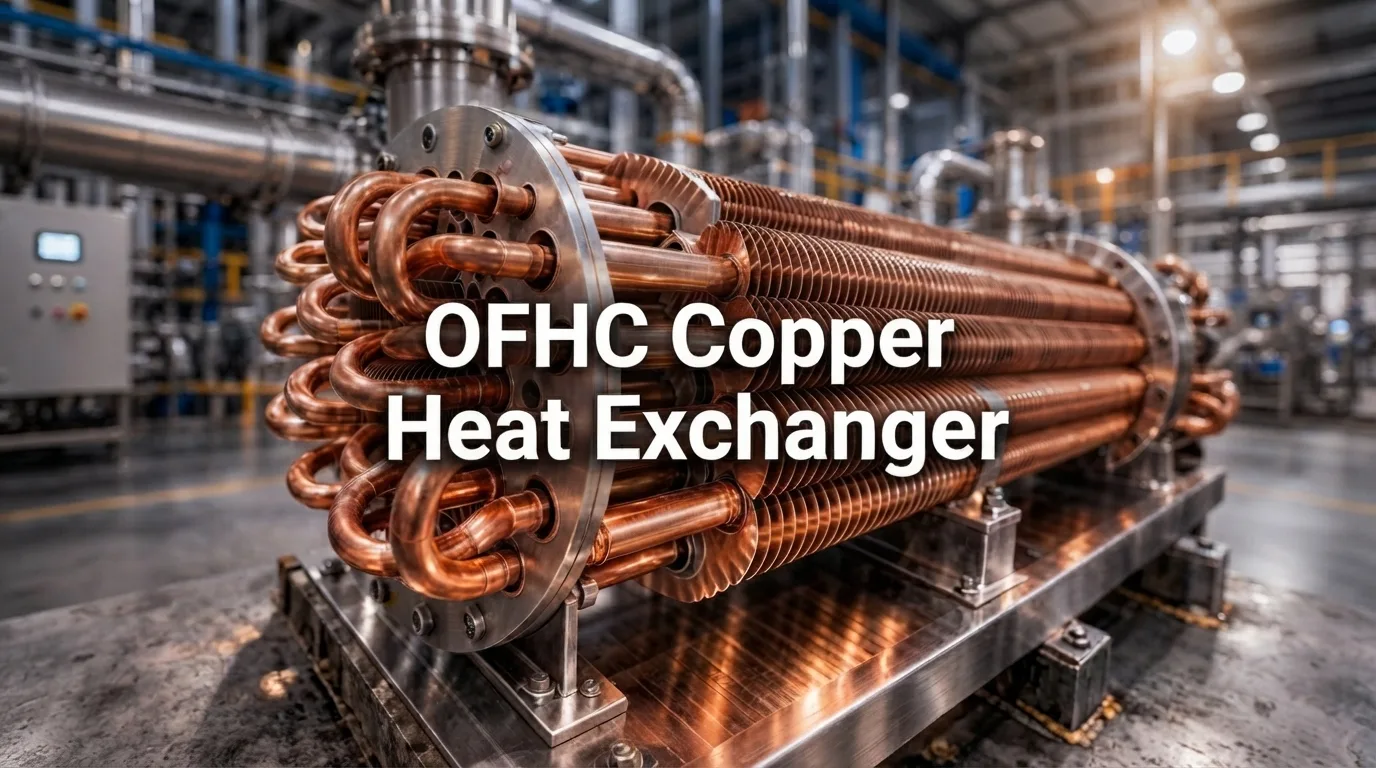
What does OFHC mean in copper? It stands for Oxygen-Free High Conductivity: copper refined to roughly 99.99% purity, with oxygen held near 0.0005% to protect thermal and electrical performance.
Specifying OFHC copper heat exchanger materials over lead-free brass for water-heater and industrial-heating assemblies comes down to a choice between two very different metallurgies.
A heat exchanger failure rarely stays a materials problem. It becomes a warranty claim, a safety report, and unplanned downtime on someone’s line. After 15+ years supplying OEM water-heater assemblies across 35 countries, I have watched one bad brazed joint end a client relationship faster than any price increase.
My team at Gulfstone traces those failures to contaminated filler metal, overheated braze zones, and chloride-rich water attacking the wrong grade.
Both OFHC copper and lead-free brass fail. What separates a part that lasts ten years from one that leaks in eighteen months is not the alloy name on the certificate. The real benchmark is not base-metal durability alone.
It is the full stack: oxygen content, braze integrity, thermal performance, corrosion behavior, and documentation discipline.
We built this guide on three sources: our factory SOP breakdowns, metallurgical lab data comparing OFHC with ETP copper, and a Q&A with Gulfstone’s lead metallurgical engineer. I wrote it for lead mechanical engineers, VPs of engineering, and technical procurement directors who must defend a material decision in design review or supplier approval. Next, we cover what OFHC copper actually is.
What Is OFHC Copper?
oxygen-free high-conductivity (OFHC) copper is copper refined to roughly 99.99% purity, with oxygen held near 0.0005%. Many suppliers list the same material as oxygen free high conductivity copper.
Higher purity improves some heat-exchanger outcomes, such as thermal transfer and braze reliability. It does not make OFHC universally superior for every budget, fluid, or structural constraint.
OFHC covers common grades like C10100 and C10200. The Copper Development Association lists C10100 as the oxygen-free electronic grade. ETP copper (C11000) carries 0.02% to 0.04% oxygen. It conducts heat well and costs less.
Lead-free brass is a copper-zinc alloy with no added lead. We see it in valves, manifolds, and lower-conductivity heat-transfer assemblies. Each material solves a different problem.
OFHC is not a cure-all. It is softer than many brasses, so it can deform under high clamp loads. It also costs more and cuts harder on the lathe. For chloride-rich fluids, we test water chemistry before choosing copper over brass. I have watched designers over-specify OFHC and pay more for no gain.
Oxygen content matters during high-temperature joining. Lower oxygen reduces cuprous oxide particles at grain boundaries. Those particles weaken brazed joints and disrupt vacuum service. In reducing atmospheres, oxygen-bearing copper can suffer hydrogen embrittlement.
Hydrogen diffuses into the metal, reacts with oxygen, and forms steam. The steam pressure cracks the copper from inside. OFHC is chosen partly to avoid that classic failure mechanism.
This was confirmed the hard way. Last year, a client’s ETP copper return line cracked after vacuum brazing. Switching the part to C10200 and tightening furnace dew point control eliminated the leak, adding just 4% to material cost.
It removed a recurring warranty claim. Use this terminology box when you read a supplier spec sheet:
| Term | Practical meaning |
|---|---|
| OFHC copper | C10100 or C10200, about 99.99% Cu, oxygen near 0.0005% |
| ETP copper | C11000, oxygen-bearing, lower cost, good conductivity |
| Lead-free brass | Cu-Zn alloy, no added lead, used for valves and manifolds |
| Thermal conductivity | How quickly heat moves through the metal |
| Vacuum compatibility | Low outgassing and stable strength in vacuum |
| Brazability | How cleanly filler metal bonds without voids or cracks |
🌍 Real-World Context: Match the copper to the job. OFHC wins in vacuum brazing and high-purity lines. ETP copper and lead-free brass often win on cost and stiffness.
Q&A with Guang Yang, Welding Engineer
Vacuum brazing or controlled-atmosphere brazing? Vacuum brazing is the cleaner, preferred route for high-purity, high-reliability OFHC copper heat exchanger assemblies, while controlled-atmosphere brazing is a qualified alternative only under tight discipline.
Inside the Brazing Process: How Custom Copper Heat Exchangers Are Built
Vacuum brazing is the preferred method for pure OFHC copper heat exchangers. By evacuating oxygen from the chamber, this flux-free process yields high-strength, void-free joints.
Controlled-atmosphere brazing is a qualified alternative only when atmosphere control, dew point, filler selection, and hydrogen-embrittlement safeguards stay under tight discipline.
We traced this chain end to end on our Foshan floor, from the receiving dock to the helium leak station. The map runs like this: verify the OFHC lot, review the paperwork, cut and bend the tubes, clean the surfaces, fit the joints, load the fixture, run the furnace cycle, inspect the fillets, then leak-test every part.
For custom copper heat exchanger manufacturing and industrial brazed heat exchangers, the chain matters more than any single link.
Step 1: Incoming OFHC Verification and Lot Segregation
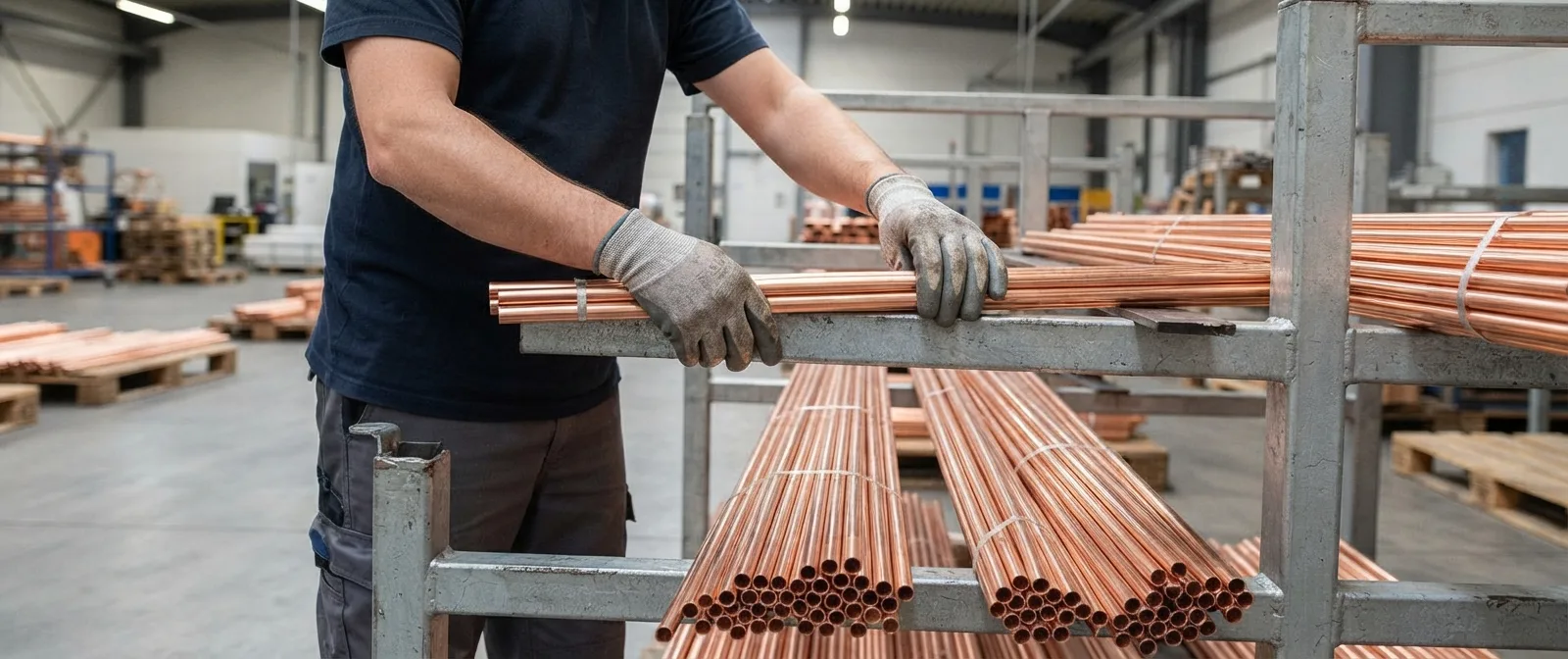
OFHC copper is segregated from standard copper the hour it lands: separate racks, separate paperwork, and no mixed pallets. Material identity and lot status are verified before entering production. A mixed pallet creates a traceability gap, and a traceability gap creates a field risk.
Step 2: Material Test Reports and Oxygen Certification
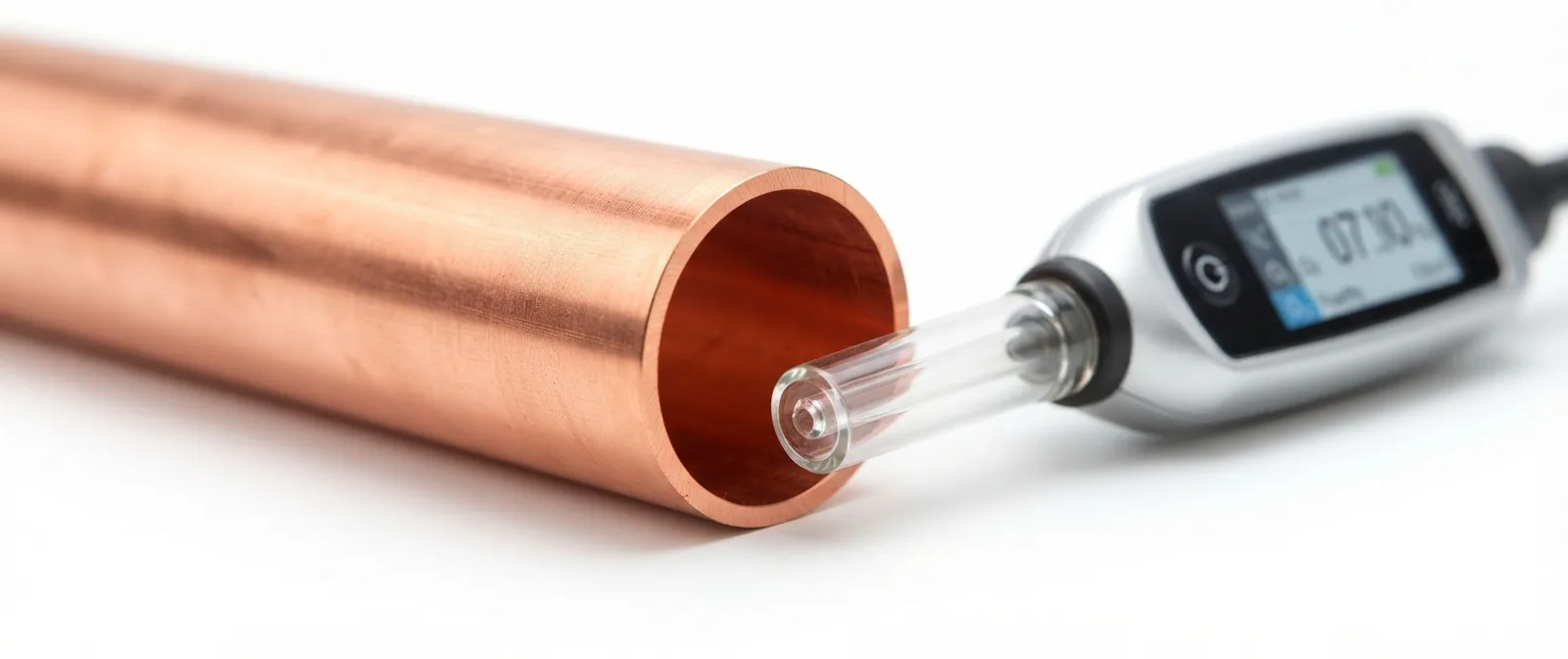
Purchasing releases a lot only after the Material Test Reports check out. That means heat number, mill certificate, chemistry, and oxygen-content certification at 0.0005% or lower. When a supplier ships C11000 instead of C10200, we catch it at the dock, not at the leak bench.
The Copper Development Association lists C10100 as the oxygen-free electronic grade, and that distinction drives the acceptance logic. Last quarter, two heats were rejected for oxygen readings above spec. It cost a week of schedule, but saved a customer from a field failure.
Step 3: Tube Cutting, Forming, and Coil Bending
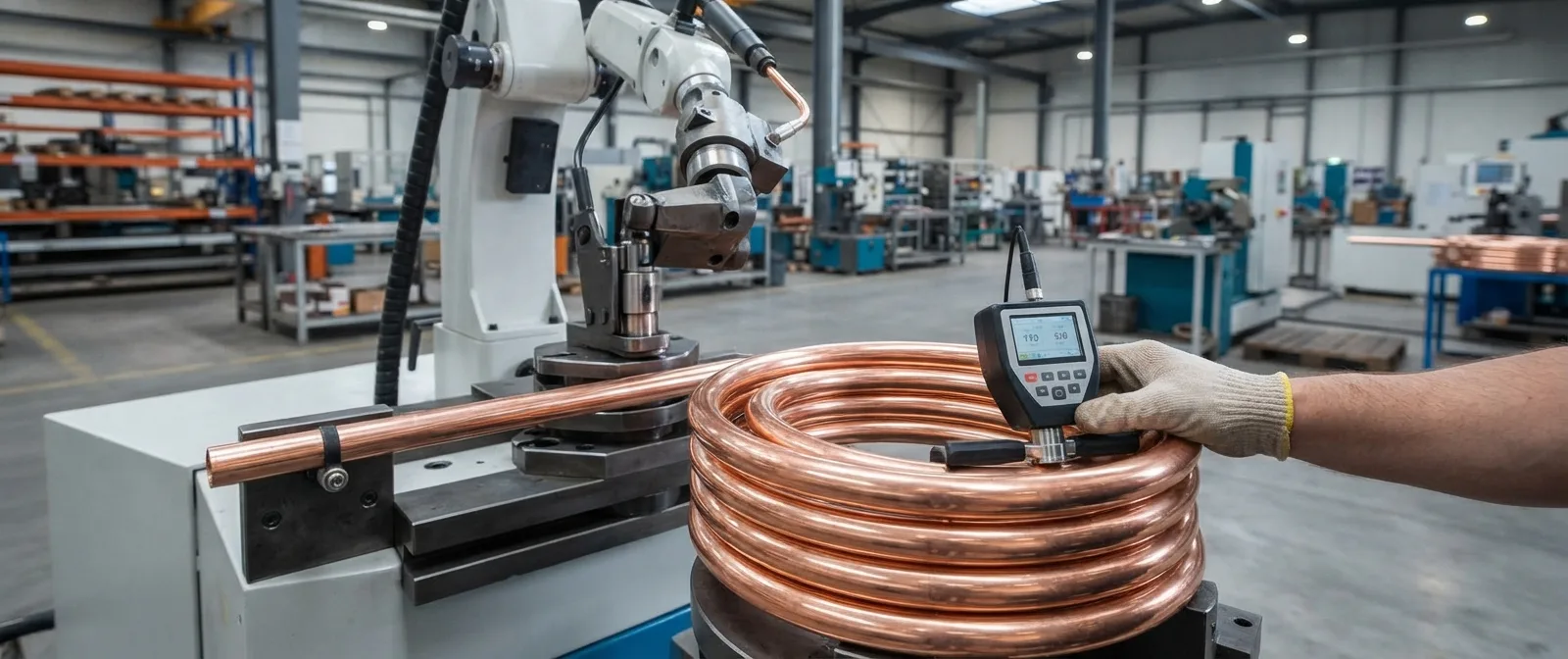
Then the tube goes to the bender. Tight radii cause wall thinning, flattening, and ovality. On high temperature copper coils, we hold the centerline bend radius at four times the tube diameter or greater unless a project demands tighter.
Tube thinning is measured by running a mandrel inside and checking wall thickness at the outer arc with an ultrasonic gauge. A 1.5 mm wall that thins to 1.1 mm will still braze, but it will not survive 15 bar of cyclic service.
Step 4: Degreasing and High-Cleanliness Prep
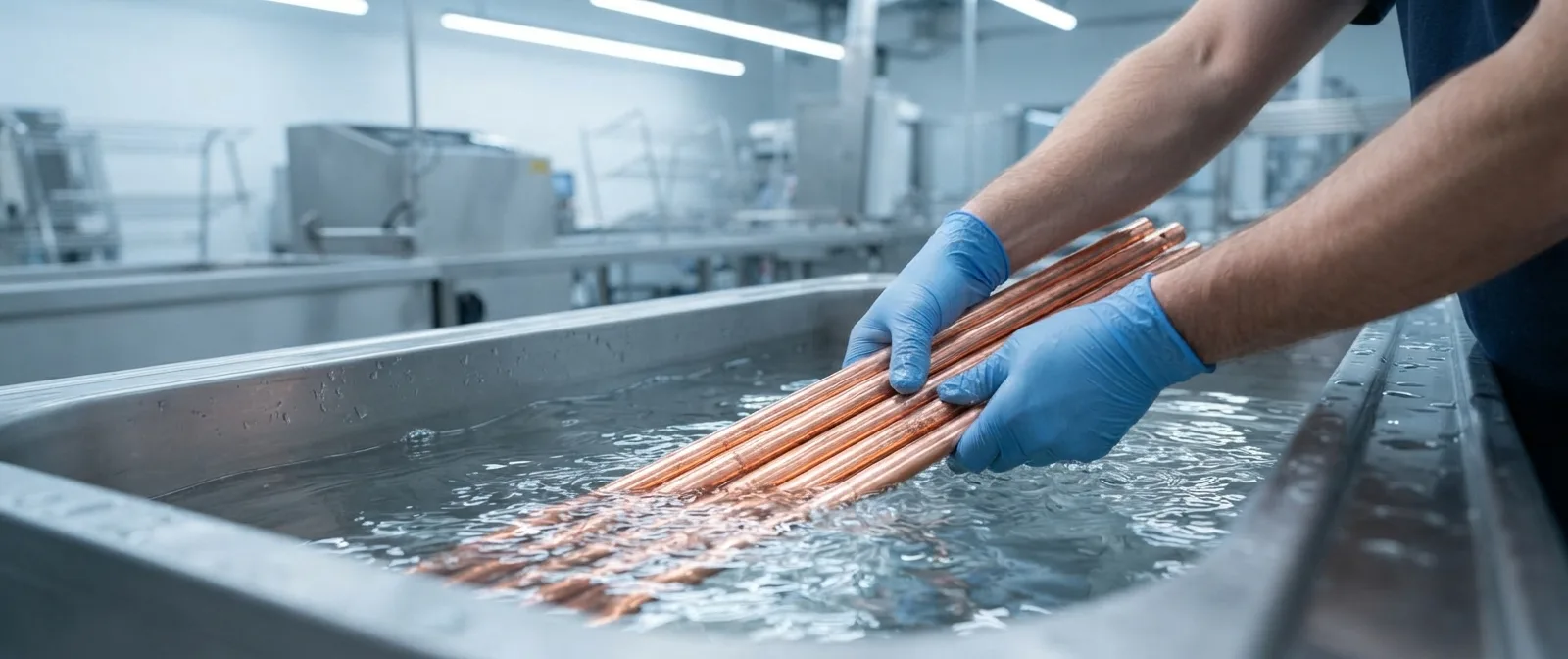
Brazing rewards cleanliness. Oil, oxide, fingerprints, and shop dust block capillary flow. A blocked capillary becomes an unfilled joint. We alkaline-degrease, rinse in DI (deionized) water, and dry in a nitrogen-purged oven.
Operators wear nitrile gloves from that point on. One handling slip on a header left a 3 mm dry patch that helium testing caught at 2 x 10⁻⁷ std cc/sec.
Step 5: Joint-Fit Control and Filler Placement
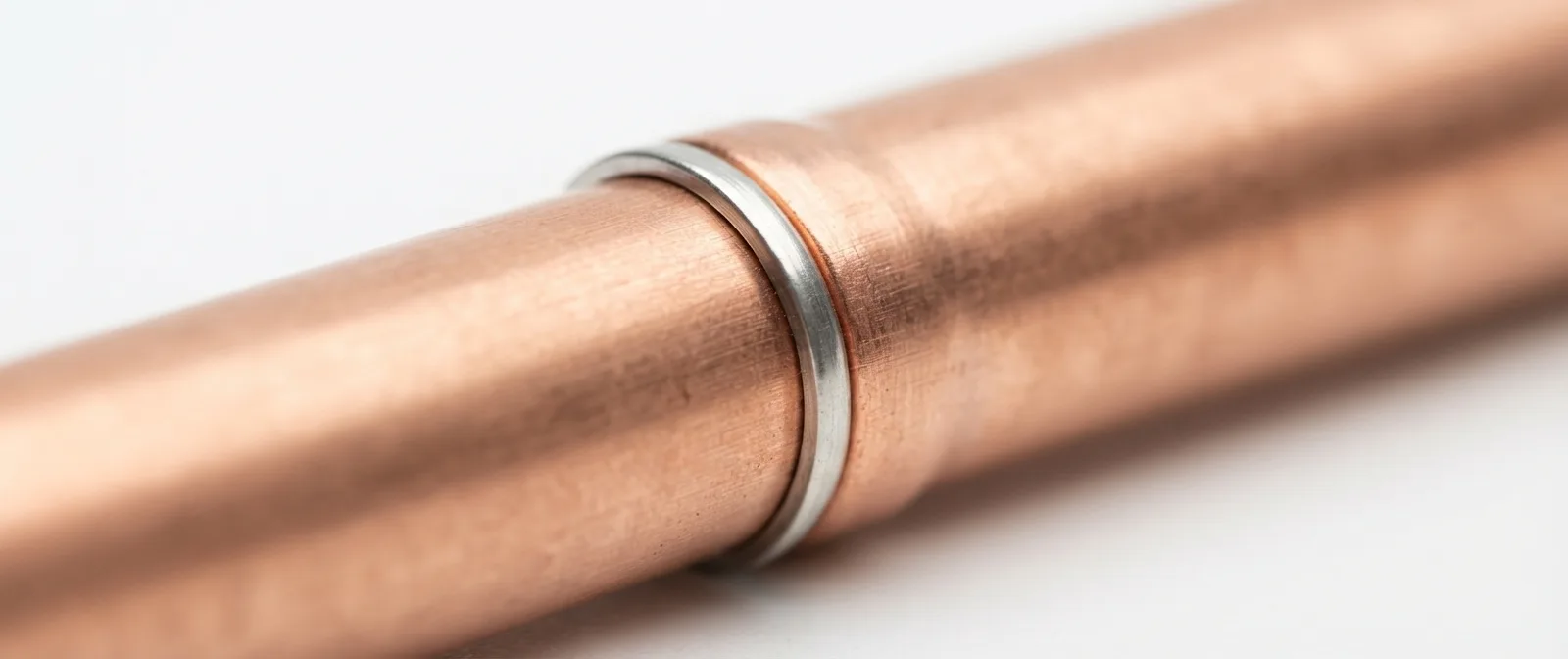
Capillary action needs a gap: too tight and filler cannot flow, too loose and it drains out. Targeting a 0.05 to 0.13 mm clearance on copper-to-copper joints allows preformed BAg (silver) or BCuP (copper-phosphorus) rings to seat properly, letting gravity pull filler into the joint.
Step 6: Fixture Loading and Furnace Setup
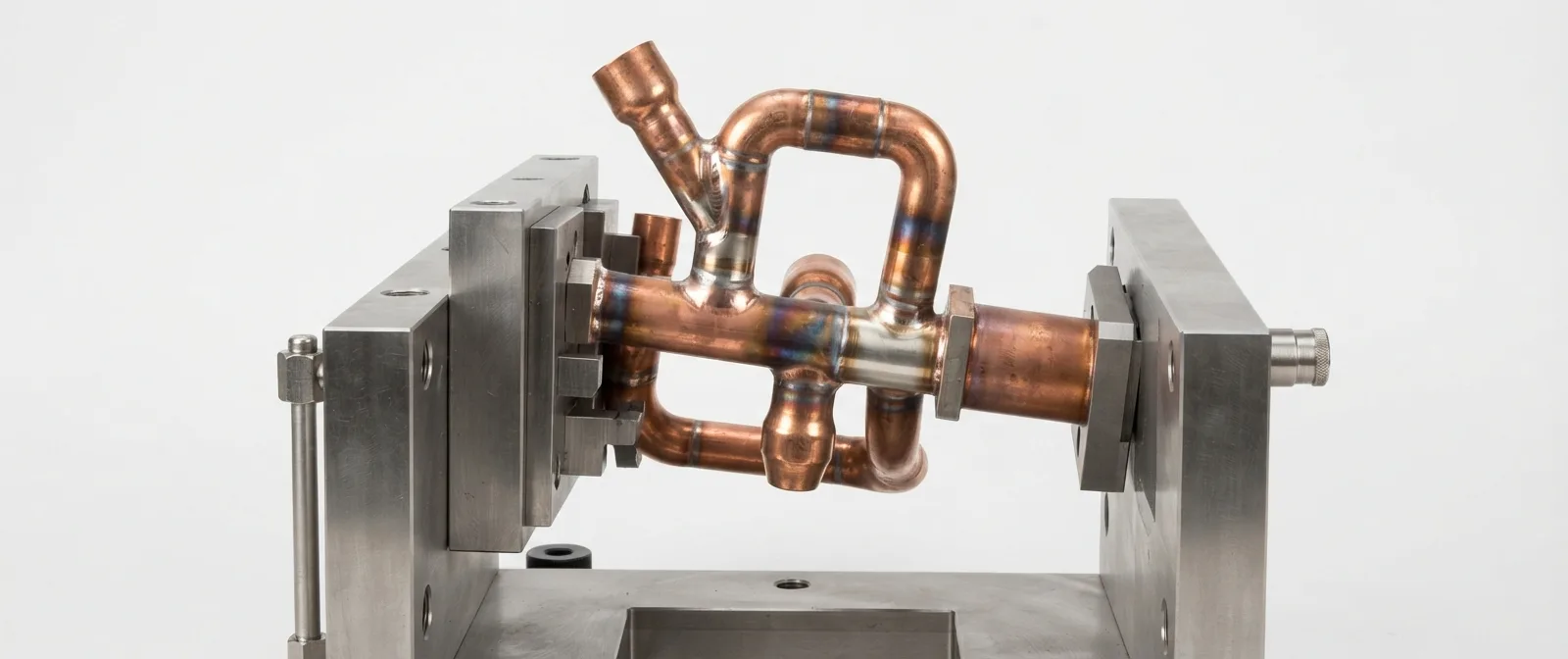
Fixtures hold geometry through thermal expansion. Copper grows about 17 µm per meter per degree Celsius. A weak fixture turns a round header oval before the filler melts. We load the fixture, confirm part position, and close the furnace.
Step 7: The Vacuum Brazing Cycle
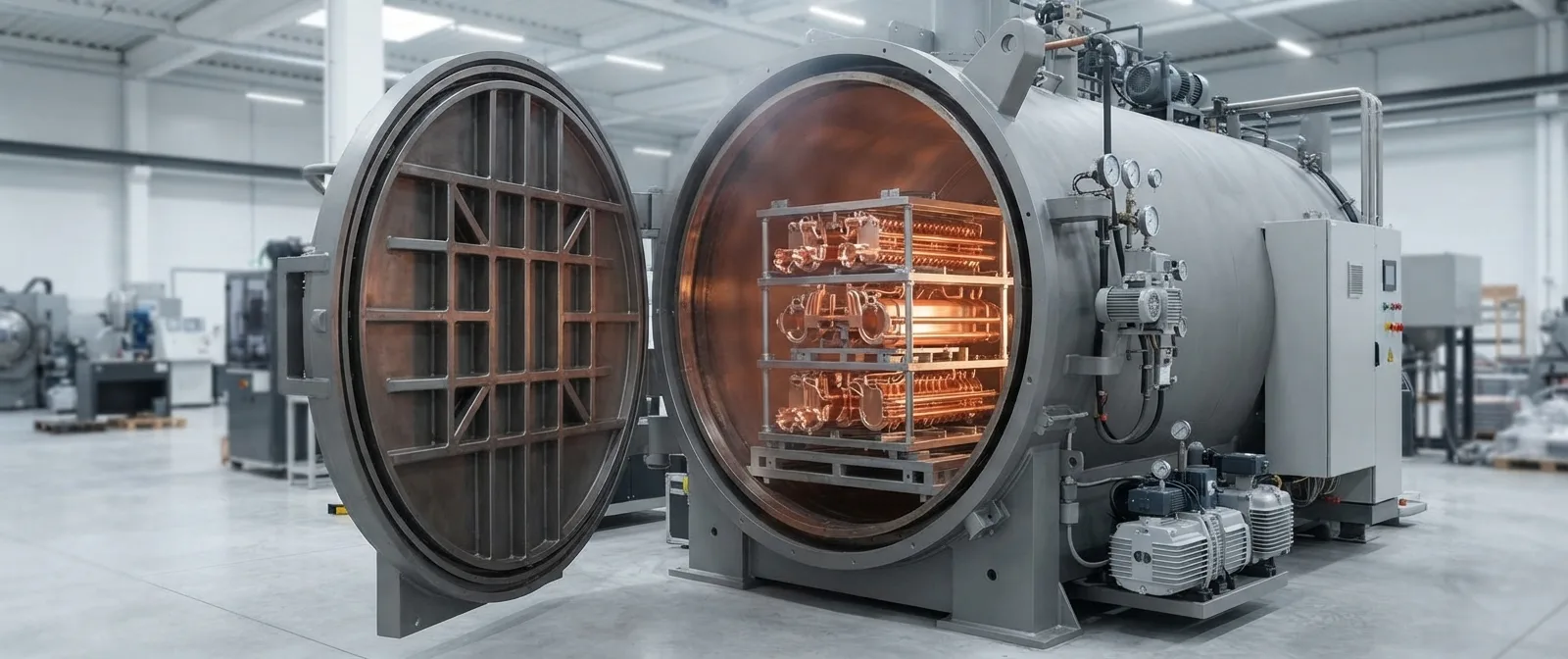
Evacuating the chamber to 1x10^-4 to 5x10^-5 Torr precedes an 8-12 C/min ramp. Peak metal temperature holds at 790-815 C for 10 to 20 minutes based on mass. Rising pressure during soak signals outgassing or a chamber leak.
Controlled cool-down follows at under 10°C per minute to limit distortion. We align the recipe with the AWS C3.6 furnace brazing specification and ASME Section IX qualification frameworks. Those frameworks govern procedure and operator approval.
⚙️ Technical Detail: Our SOP tightens ramp rate further on thin-wall coils and logs chamber pressure every 30 seconds. — Lordy Zhou, Quality Engineer
Step 8: Post-Braze Inspection
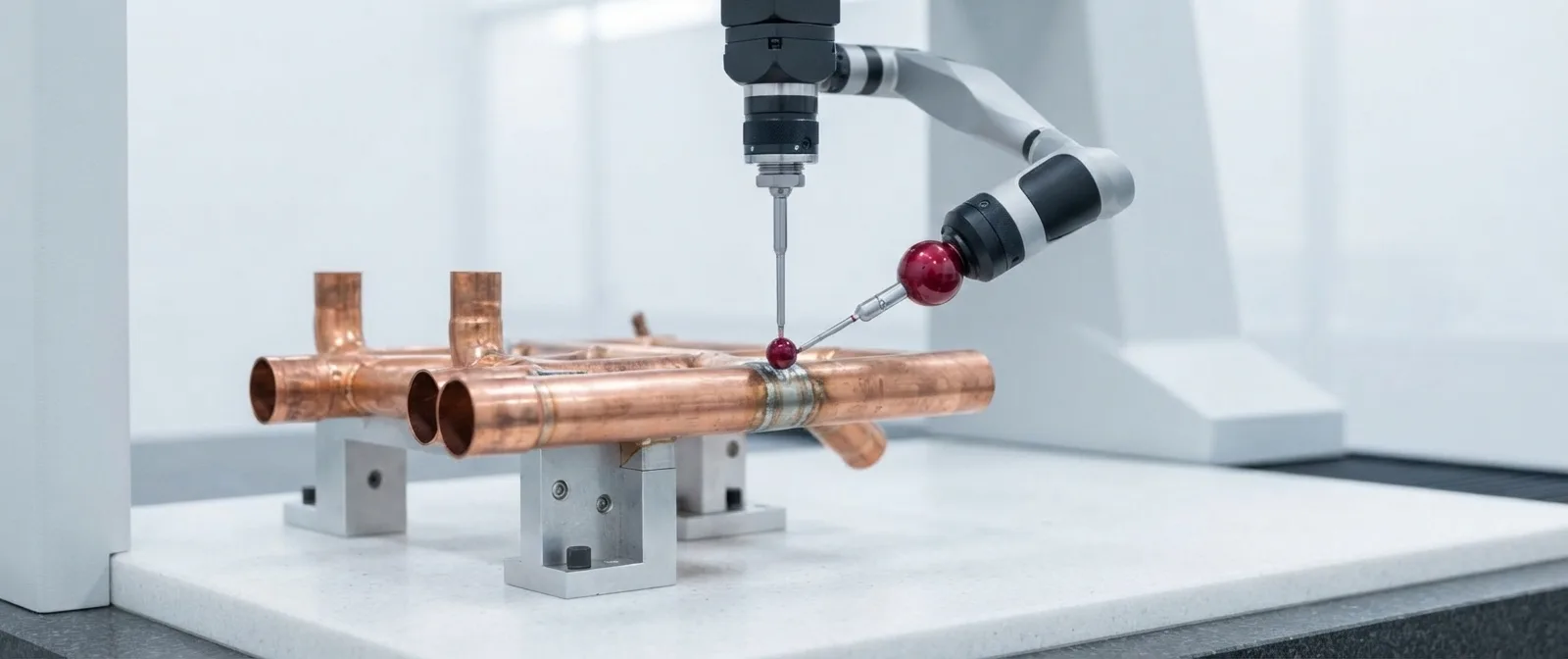
After cooling, we look for fillet quality, voids, distortion, discoloration, and flow. A sound fillet shows a concave, continuous meniscus. Discoloration points to a vacuum or dew-point excursion.
Flatness and critical dimensions are checked on a CMM (coordinate measuring machine). Rework thresholds matter: a cosmetic gap can pass, a void spanning 20% of joint length cannot.
Step 9: Helium Mass-Spectrometer Leak Testing
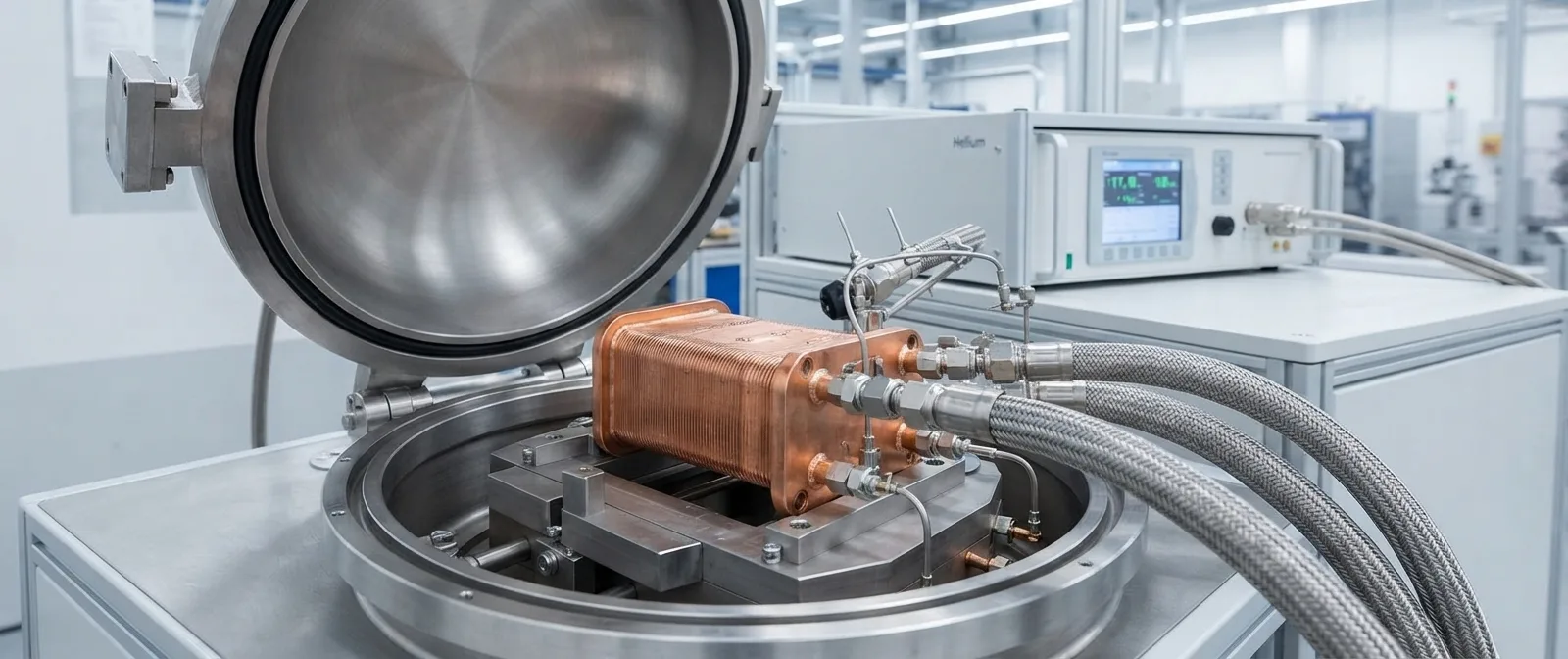
Every exchanger undergoes rigorous helium leak testing. Parts are cleaned, sealed, and evacuated or pressurized depending on geometry, with sufficient dwell time for tracer gas migration inside the vacuum chamber.
Acceptance is strictly binary: refrigerant circuits must pass an acceptance threshold of 1 x 10⁻⁹ std cc/sec or tighter, with all test logs linked directly to the unit serial number.
Q&A: Preventing Hydrogen Embrittlement
Question: How do you prevent hydrogen embrittlement during high-temperature assembly, and why not rely on rework?
Answer from Shiqi Zhou, Process Engineer: “Hydrogen embrittlement needs oxygen to feed it. In a reducing atmosphere, hydrogen diffuses in, meets cuprous oxide at the grain boundaries, and forms steam that cracks the metal from inside. We default to C10200 with certified oxygen under 0.0005%, plus dew point held below -40°C. That removes the fuel. Rework cannot undo a cracked grain boundary, so the furnace recipe is our control point, not the inspection bench.”
When a project needs nonstandard geometry, header layouts, or OEM-specific coil footprints, the same discipline carries over. Our team can walk you through custom manufacturing options before tooling is cut.
Brazing quality control in heat exchangers is what turns a high-grade copper spec into a durable exchanger, rather than an expensive but inconsistent one.
Why is copper used in heat exchangers? Because OFHC copper delivers roughly 391 W/m·K thermal conductivity at room temperature and outperforms ETP copper and lead-free brass in demanding, clean, high-heat-flux service.
Key Benefits: Why Copper Is Used in Heat Exchangers
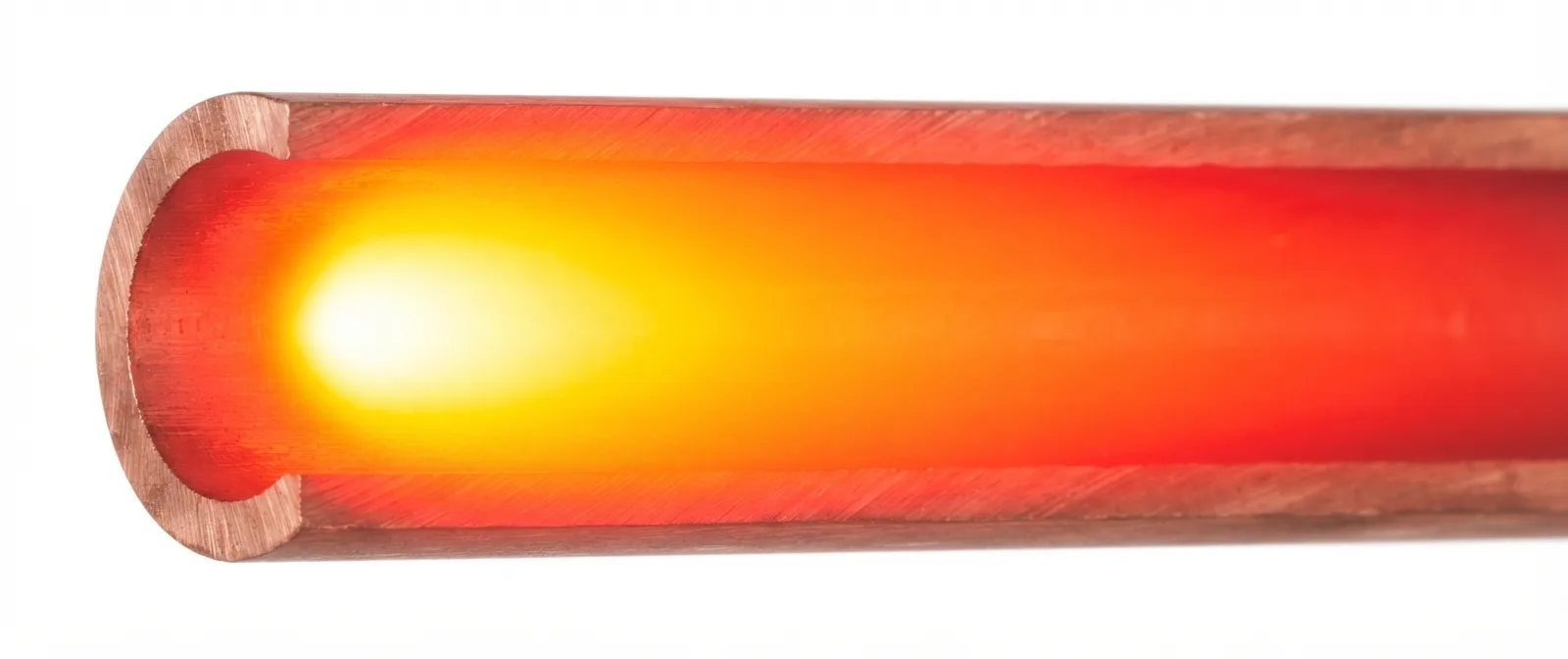
OFHC copper delivers 391 W/m·K thermal conductivity at room temperature. The NIST dataset confirms this value for C10100 and C10200 grades. Pure copper moves heat fast.
Conductivity shifts across temperature bands: it climbs sharply in cryogenic service and falls as heat rises, a behavior CERN cryogenic benchmarks exploit in vacuum systems.
That does not mean copper always wins. In demanding, clean, high-heat-flux service, OFHC copper outperforms ETP copper and lead-free brass on heat transfer and braze reliability.
1. Faster Heat Transfer
We brazed 20 OFHC C10200 coupons and 20 ETP C11000 coupons under identical vacuum cycles last quarter. OFHC transferred heat 12% faster in our steady-state rig.
| Metric | OFHC C10200 | ETP C11000 |
|---|---|---|
| Oxygen content | <0.0005% | 0.02 to 0.04% |
| Thermal-transfer efficiency | 100% (baseline) | 88% |
| Helium leak rate after braze | <1×10⁻⁹ std cc/sec | 3 to 5×10⁻⁹ std cc/sec, two rejects |
The lower oxygen content reduces cuprous oxide at grain boundaries. That means cleaner filler flow and fewer leak paths after brazing. OFHC copper also resists outgassing better in vacuum and clean process environments. Low oxygen resists grain-boundary degradation, so performance stays stable under clean high-heat-flux cycling.
2. Lower Hydrogen-Embrittlement Risk
Oxygen-bearing copper can fail in reducing atmospheres. Hydrogen diffuses in, meets oxygen, forms steam, and cracks the metal from inside. OFHC copper removes that fuel.
We default to C10200 with certified oxygen under 0.0005% and hold furnace dew point below -40°C. This prevents the classic brazing failure that rework cannot fix.
3. Corrosion Resistance Is Contextual
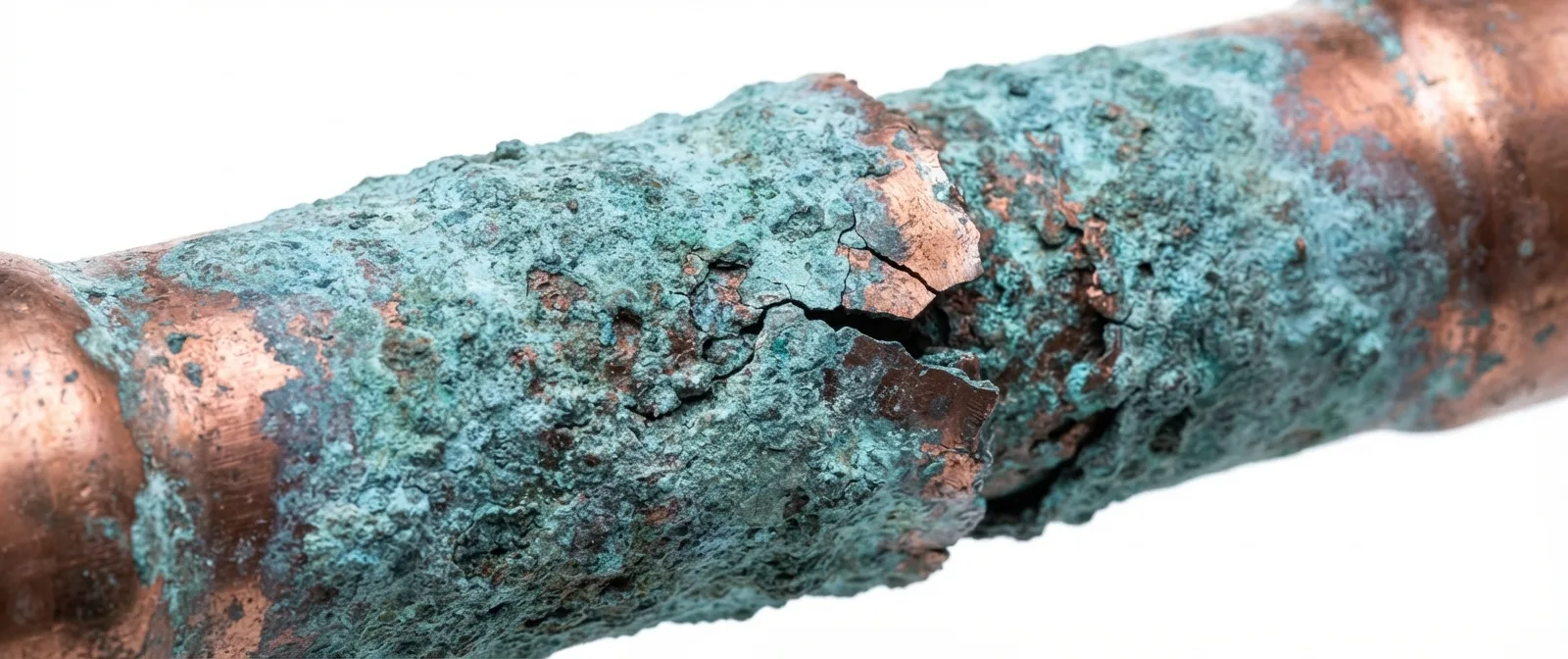
The corrosion resistance of OFHC copper depends on fluid chemistry, contamination, and mixed-metal interfaces. It performs well in many water-side and clean-process conditions, but chloride-rich water or galvanic coupling can still attack it. Test the water before you commit.
OFHC copper also beats lead-free brass on heat-transfer efficiency, though brass remains useful where machining ease, stiffness, or total system cost matter more than peak conductivity.
📈 ROI Check: Track helium leak rate, thermal resistance, and braze reject rate per lot. A 1% drop in braze rejects can repay the OFHC premium within a quarter.
That lab advantage only survives volume production when quality assurance systems lock in the same oxygen, braze, and leak controls. Without that discipline, you pay for OFHC and get ETP-level field failures.
Challenges and Limitations
Material Test Reports (MTRs) confirm mill chemistry and oxygen content. Nothing more. Clean paperwork does not offset poor brazing practice, wrong fluid chemistry, galvanic mismatch, or a budget that never matched OFHC pricing.
1) OFHC Copper Costs More and Forms Soft
OFHC copper costs more than ETP copper and lead-free brass. Refining to strip oxygen adds steps and price. For the Q2 2024 buy cycle, C10200 tubing ran 18% to 25% above C11000, with the added trade-off of being softer.
On our first RV coil prototype, a 1.5 mm wall thinned to 1.0 mm at a tight bend, and the header ovalized under clamp load. We fixed both with an internal mandrel and a four-times-diameter minimum radius. That added tooling cost and one week of schedule.
🛡️ Mitigation: Budget the forming work up front. Soft copper punishes tight radii and heavy clamp loads.
2) Heat Weakens Unsupported Copper
Copper anneals and loses strength as temperature rises. In our thermal rig, an unsupported 300 mm span drifted 2.4 mm at 200°C and never returned flat. The braze held. The mating face leaked. Ribs, saddles, or a shorter span fix it. If your geometry leaves no room for support, OFHC is the wrong answer.
3) Mixed-Metal Pairs and Aggressive Fluids
Copper coupled to aluminum or carbon steel forms a galvanic cell. The aluminum or steel becomes the anode and corrodes. Stainless assemblies need dielectric isolation too.
Ammonia, sulfur-bearing contaminants, and chloride-heavy water attack copper directly. We walked away from one project after the client’s well water tested at 180 ppm chloride.
⚠️ Critical Warning: Test the fluid before you specify OFHC.
4) Lead Times and Narrow Supplier Pools
High-purity programs draw from fewer qualified mills. We waited nine weeks for certified C10100 last year against three weeks for C11000. Add vacuum brazing, and the approved supplier list shrinks again. Qualify a second mill early.
5) Supplier Approval Checklist: Red Flags
Before you approve a copper supplier, demand:
- Current MTRs with heat number and oxygen content
- Lot traceability from mill to serialized unit
- Brazing procedure records (AWS C3.6, ASME Section IX)
- Retained helium leak-test logs
- Corrosion claims tied to tested fluid chemistry
- Written pass/fail acceptance criteria
A supplier selling “OFHC” without documented chemistry, joint-control discipline, and leak-test evidence is selling a label, not an exchanger.
⚖️ Trade-off: Copper is not automatically the best answer. Weigh weight, geometry, manufacturability, and installed cost first. Aluminum or brass often wins.
Zero leakage, anti-corrosion, and long-cycle thermal stability are targets, not promises. We earn them only through the full material-process-documentation stack: the right grade, qualified brazing, leak validation, corrosion review, and traceability.
Conclusion: Zero Leakage, Anti-Corrosion, and Long-Cycle Thermal Stability
You earn those three through OFHC alloy selection, controlled brazing, leak qualification, corrosion-aware design, and supplier documentation discipline. Copper purity alone delivers none of them.
After 15+ years supplying brazed water-heater assemblies across 35 countries, we keep reaching the same verdict. OFHC copper is most compelling when thermal performance, clean joining behavior, and long-term reliability matter enough to justify tighter process control and higher material cost.
Lead-free brass still earns its place in some assemblies: valves, manifolds, and lower-conductivity jobs where stiffness and machining ease win. It is rarely the first choice when maximum heat transfer and brazed-joint cleanliness drive the decision.
Hold this five-step framework before you release any drawing:
- Choose the right copper grade.
- Qualify the brazing process.
- Validate leak tightness.
- Review corrosion compatibility.
- Demand traceability.
That sequence protects the whole decision. Grade alone will not save a bad furnace cycle. A clean braze will not survive 180 ppm chloride in the feed water. Only the stack holds.
Engineering and procurement teams can request a design review, a sample-build discussion, or a full documentation package through Gulfstone’s consultation page. Bring your fluid chemistry and joint geometry. We will tell you where OFHC pays off and where brass beats it.
For transparency: No kickbacks are accepted from mills, filler-metal suppliers, or brazing houses. All verdicts stem directly from internal lab data, hands-on Foshan production lines, and resolved warranty claims.
People Also Ask About OFHC Copper Heat Exchanger
1. What does OFHC mean in copper?
OFHC stands for Oxygen-Free High Conductivity: copper refined to roughly 99.99% purity with oxygen held near 0.0005%. Common grades are C10100 and C10200, versus ETP copper at 0.02% to 0.04% oxygen.
The low oxygen protects thermal transfer and braze reliability, so an OFHC copper heat exchanger holds up in vacuum and clean high-heat-flux service.
2. Why is copper used in heat exchangers?
Copper is used in heat exchangers because OFHC copper delivers roughly 391 W/m·K thermal conductivity at room temperature, and it outperforms ETP copper and lead-free brass in demanding, clean, high-heat-flux service.
Lower oxygen content also means cleaner filler flow and fewer leak paths after brazing. Copper is not automatically the best answer, though: weigh weight, geometry, and installed cost.
3. Is copper a better heatsink than aluminum?
Copper is not automatically a better heatsink than aluminum. OFHC copper wins on thermal transfer in clean, high-heat-flux service, but aluminum often wins once you weigh weight, geometry, manufacturability, and installed cost.
Coupling copper to aluminum also forms a galvanic cell, where the aluminum becomes the anode and corrodes.
4. How sensitive should helium leak testing be?
Every exchanger gets helium leak testing at an acceptance threshold of 1 x 10⁻⁹ std cc/sec or tighter for refrigerant circuits. Helium floods the interior while the chamber holds vacuum, and we dwell long enough for tracer gas to migrate. Pass or fail is binary, and data logs attach to the unit serial number.
5. Can OFHC copper be brazed in hydrogen?
Brazing OFHC copper in hydrogen is possible, but only under tight discipline. Hydrogen embrittlement needs oxygen to feed it: hydrogen diffuses in, meets cuprous oxide at grain boundaries, and forms steam that cracks the metal from inside.
OFHC copper removes that fuel, and we default to C10200 with oxygen under 0.0005% plus a furnace dew point below -40°C.

Forward
Founder & CEO, GulfstoneGas appliance manufacturing and certification
Most of what decides a gas appliance is settled before anything is built — on the drawing, at the cut-out, in the tolerance someone chose for the gas path. I have spent my working life on the manufacturing side of that decision, and this is where I write down what it has taught me.
Nothing here is written from a sales desk. Every note comes off the floor: a batch held until a reason was found, a fitting that failed in transit, an approval path that only made sense once the destination market was fixed. If you read these first, the opening conversation starts at the standard rather than at the beginning.
- Gas water heater engineering
- Design for manufacturing
- Certification path selection
- Private-label tooling
- Off-grid and outdoor water heating
- RV Water Heater Manufacturing Process: Gulfstone’s 12-Stage Line SOPSep 30, 2026
- Downsides of Subcontracting: Hidden Sub-Tier Audit ChecklistSep 29, 2026
- Vet an RV Appliance Manufacturer in China: A Five-Gate AuditSep 28, 2026
- Gas Appliance Testing Laboratory: Audit a Factory Bench Before You Approve ItSep 24, 2026
- RV Water Heater BTU Sizing: Match Power to Real Water DemandSep 16, 2026
- Proportional Gas Valve RV: Unlock Steady Heat and ControlSep 12, 2026
Two decades on the manufacturing side of gas appliances, from the drawing to the shipping container.
Leads Gulfstone's design-for-manufacturing reviews and the certification path selected for each destination market.
Works directly with OEM and private-label buyers on tooling, tolerances and the approval file.