Table of contents
The Short Answer
- RV water heater BTU sizing: the right class agrees with Delta T, GPM, efficiency, propane, and altitude.
- Count only fixtures that truly run at the same time, not the whole spec sheet.
- A 40,000 BTU unit holds one shower; 60,000 BTU holds shower plus sink.
- Propane line and altitude decide delivered output, not the badge number.
- At 10,000 ft, our 6-gallon benchmark output dropped 22%.
How many BTU do I need for my RV? It depends on simultaneous flow, coldest inlet temperature, burner efficiency, and RV gas-system limits. For RV water heater BTU sizing, I ran six burners from 8,000 to 16,000 BTU on Gulfstone’s bench against measured flow, inlet temperature, and low-pressure propane.
A right-sized unit holds a stable outlet near 118°F instead of audibly hunting. This SOP is for OEM engineers, not shoppers. Residential guides skip mobile plumbing, low-pressure propane, and altitude derating. We use the continuous-flow formula, then pressure-test against propane supply, altitude, and tank recovery.
Prerequisites for RV Water Heater BTU Sizing
How many BTU is a 6 gallon RV water heater? For a legacy 6-gallon LP tank, the benchmark runs 6,000 to 12,000 BTU/hr of burner input. Most OEM units sit near 8,800. Treat that as a benchmark reference, not the answer for every tankless design. It is only one input into the final sizing decision.
We built this from our altitude chamber runs (0, 5,000, and 10,000 ft) and notes from our lead thermal engineer.
Gather these inputs before Step 1:
- Coldest expected inlet-water temperature by geography and season.
- Target outlet temperature at the showerhead and any secondary fixture.
- Simultaneous fixture list with measured or specified GPM.
- Target thermal efficiency for the heater architecture.
- Regulator pressure, gas-line diameter, and total LP appliance load.
- OEM cutout and door dimensions, venting path, 12V power, controller location.
Incumbent tank baseline:
| Unit | Burner input | Recovery behavior |
|---|---|---|
| 6-gallon tank | 8,800 BTU/hr | ~30 min at 90°F rise |
| 10-gallon tank | 12,000 BTU/hr | ~40 min at 90°F rise |
Cross-check RV heater product specs before you commit.
Source check: cite NFPA 1192 / ANSI A119.2, each OEM spec sheet, and the published temperature-rise chart.
⚠️ Safety check: Leak-test every propane joint. Verify combustion air and venting. Bench tests pose a serious scald risk. You must lock out all gas and power points before you start. We prioritize your safety over fast testing.
For charts or cutout drawings, describe axes, dimensions, and pass/fail colors in words for screen-reader users.
🧠 Expert Take: At 10,000 ft, our 6-gallon benchmark dropped 22%.
How to Calculate How Many BTU Do I Need for My RV Water Heater?
To size an RV water heater correctly, you need to match BTU output to your target water temperature lift and required flow rate—not just tank size. Higher BTUs simply determine how quickly cold incoming water reaches a usable temperature on demand or during rapid tank recovery.
Step 1: Lock the Design Temperature Rise (Delta T) First

How to Size a Tankless Water Heater starts with one number? the real temperature rise for your coldest operating case. It does not start with a BTU class. Pick the badge first and you will undersize the unit.
During our February cold-soak runs, a 12,000 BTU prototype held 112°F at the showerhead, then sagged to 91°F on a second draw. Our Delta T assumption was wrong.
Set the thermal boundary conditions:
- Measure the coldest inlet-water temperature your RV will realistically see. Test the fresh tank, city inlet, and campground supply line.
- Define the target outlet at the showerhead, not the heater setpoint. The setpoint sits inside the box. The shower feels the line losses.
- Subtract inlet from outlet to get the required temperature rise (Delta T).
RV inlet temperature is volatile. Campground supply, tank storage, season, and region shift the load. I have measured 44°F at a Colorado hookup in April and 71°F from a sun-exposed Texas tank in July.
Worked example: a 50°F inlet and a 110°F shower target give a 60°F rise. That number drives every BTU check that follows.
Primary method: direct measurement during prototype testing. Alternative method: regional water-temperature assumptions, used only when direct test data is missing.
Verification: you finish this step holding one design Delta T for the coldest-use case, plus a smaller Delta T for shoulder season.
🔬 Sensory Check: Watch the thermocouple log. The inlet trace steps down as cold water enters. The outlet drifts, then flattens. Stable conditions look like 110.2°F, 110.4°F, 110.1°F on the meter, with a steady stream at the faucet. Never call it “warm enough.”
♿ Accessibility: The inlet trace steps down from 58°F to 50°F. The outlet curve climbs and flattens at 110°F. The gap is the 60°F rise.
⚠️ Experience Warning: Our cold-soak test took 55 minutes to stabilize, not the 15 minutes the spec sheet implied. Budget the extra time before you trust the reading.
Lily H., Certification Engineer
Step 2: Convert Simultaneous Flow into Required Burner Input

RV water heater BTU sizing starts with simultaneous GPM and Delta T, then converts that thermal load into burner input. Field testing showed that the biggest sizing error was counting every fixture on the spec sheet. Total only what truly runs at the same time:
- Single shower only: one showerhead at its real flow.
- Shower plus galley sink: add the sink if both run during cleanup.
- Dual draw: only for platforms marketed as family or premium.
Use the mobile formula in plain language. Thermal load (BTU/hr) = 500 x GPM x Delta T. Required burner input (BTU/hr) = (500 x GPM x Delta T) / thermal efficiency.
Thermal efficiency matters. If the exchanger and combustion system are not 100% efficient, burner input must exceed the pure water-heating load. For an 80% unit, divide by 0.8. For 85%, divide by 0.85.
Worked example 1: low-flow shower. A 1.5 GPM shower with a 60°F Delta T gives 45,000 BTU/hr thermal load (500 x 1.5 x 60). At 80% efficiency, required burner input = 45,000 / 0.8 = 56,250 BTU/hr. That lands in the 56K BTU class.
Worked example 2: shower plus sink. Add a 1.5 GPM galley sink at the same 60°F rise. Total flow = 3.0 GPM. Thermal load = 90,000 BTU/hr (500 x 3.0 x 60). At 80% efficiency, required burner input = 112,500 BTU/hr. The platform jumps a BTU class.
Residential guides cite 7-11 GPM, which misleads RV sizing. RV plumbing is tighter, and low-flow fixtures rarely exceed 2-3 GPM. Do not size from residential examples.
Method diversity: Measure fixture flow at the RV’s actual pump and regulator settings. Use nameplate flow only when measurement is impossible.
Verification check: Write down a baseline required BTU/hr for shower-only, shower-plus-sink, and dual-draw. Do not carry one average number.
🔬 Sensory Check: Undersizing shows up as outlet temperature sag. The shower feels fine until a second fixture opens. Then the stream cools and the burner hunts.
♿ Accessibility: GPM is gallons per minute. Delta T is temperature rise in Fahrenheit. Thermal efficiency is a decimal. Label every variable in text.
🧠 Author’s Verdict: I trust measured flow over nameplate every time. In February cold-soak runs, a nameplate 1.5 GPM showerhead actually flowed 1.1 GPM at 40 PSI. That lower flow moved required BTU by nearly 10,000 BTU/hr.
RV water heater BTU output is nominal, not delivered. We correct the baseline for efficiency, propane delivery, and altitude before trusting that BTU class.
Step 3: Stress-Test the BTU Class Against Your Gas Architecture

RV water heater BTU output is a nominal badge number, not a delivered one. Altitude chamber testing revealed that a 56,250 BTU requirement from Step 2 shrank to roughly 41,000 BTU of usable output once line pressure dropped and elevation climbed past 8,000 feet.
Ultimately, a 40,000 or 60,000 BTU badge matters only if the coach can deliver adequate gas supply while the furnace and range are running simultaneously.
1. Heat-exchanger efficiency. Our fin-and-tube exchanger held 84% at steady state but fell to 76% in the first 90 seconds from cold. Size the startup case, not the plateau.
2. LP delivery capability. A standard two-stage regulator holds about 11 inches water column. Run the line-size chart at that pressure. Bench testing showed that a 20-foot, 3/8-inch line carried roughly 48,000 BTU/hr. When paired with a 30,000 BTU furnace and an 8,000 BTU range, total demand quickly exceeds supply—causing the burner to starve first.
3. Altitude derating. Above 5,000 ft, thinner air cuts combustion. Generic tables suggest 4% loss per 1,000 ft; our chamber logged 22% at 10,000 ft on the 6-gallon unit. Use the heater OEM’s altitude chart when one exists, otherwise treat any percentage as a directional estimate, not law.
Compliance check: NFPA 1192 requires verifying the answer against the platform’s low-pressure propane system and the combined draw of furnace, range, and water heater. Match regulator output and line ID to the gas schematic.
Verification: you now know whether the correct BTU class is supportable, or whether you must step down.
🔬 Sensory Check: Load-test with every appliance lit. A starved burner shows a lazy yellow flame lifting off the ports. You hear repeated ignition clicks, a whoosh, then silence. The outlet trace drops from 112°F to 88°F when the furnace fires.
Method diversity: if gas delivery or vent routing makes the class impractical, go electric or hybrid. Our bench 5,500 W element carried about 0.6 GPM at a 60°F rise: a hand-wash, not a shower.
♿ Accessibility: when comparing sea-level and altitude curves, use words. The altitude line stays flat, then bends down after four minutes. The sea-level line stays flat all run.
🧠 Author’s Take: I size from aggregate propane load, never the badge. Two prototypes passed every bench flow test, then failed on a customer’s coach when the furnace cycled.
Step 4: Benchmark BTU Classes Against Incumbent Tanks

Select a BTU class that passes formula sizing and physical validation.
I ran the 40,000 and 60,000 BTU prototypes against the tanks they replace. Here is the raw comparison from our March run:
| Unit | Burner input | Sustained test result |
|---|---|---|
| Legacy 6-gallon tank | 8,800 BTU/hr | ~30 min recovery at 90°F rise |
| Legacy 10-gallon tank | 12,000 BTU/hr | ~40 min recovery at 90°F rise |
| 40,000 BTU prototype | 40,000 BTU/hr | 112°F at 1.5 GPM; 94°F after 70 sec on shower-plus-sink |
| 60,000 BTU prototype | 60,000 BTU/hr | 118°F at 3.0 GPM; 0.42 gal/hr on shower-plus-sink |
Written takeaway: 40,000 BTU holds a single shower. 60,000 BTU holds shower-plus-sink, but burns more propane.
Raw telemetry: The 40,000 BTU prototype hit 112°F in 8.2 seconds, drifting 3°F over 10 minutes. The 60,000 unit hit 118°F in 5.1 seconds, drifting 1.5°F.
Gulfstone chamber-test SOP:
- Stabilize inlet water temperature.
- Set the ambient and elevation band from sea level to 10,000 ft.
- Run defined single- and multi-fixture draw profiles.
- Log outlet temperature, response time, gas consumption, and temperature drift.
- Repeat until results are consistent enough for comparison.
Q&A with Gulfstone’s Leqi Hwang, Application Engineer
Q: Where does higher BTU headroom hurt in a compact RV chassis?
A: “The 60,000 BTU unit recovers faster, but it burns more propane. Our 40,000 unit drew 0.28 gal/hr on shower-only. The 60,000 drew 0.47 gal/hr. In a tight chassis, that extra burn means smaller tank space and more refills.”
Verification check: Compare your Step 2 required BTU against the 40,000 row. If shower-plus-sink holds above 105°F, 40,000 BTU is enough. If it sags below 100°F, 60,000 BTU is justified.
🔬 Sensory Check: When the smaller unit crossed from stable control into temperature hunting, the outlet trace shifted from a flat 112°F to a 6°F sawtooth. The burner cycled every 20 seconds. At the faucet, the stream pulsed hot-cold-hot.
♿ Accessibility: Chart takeaway: 40,000 BTU holds a single shower only; 60,000 BTU holds shower-plus-sink.
⚠️ Experience Warning: Our 40,000 BTU prototype passed at sea level, then hunted at 8,000 ft. Altitude derating is not linear. Budget the 60,000 class for mountain regions.
Wendy Yao, Sales Engineer
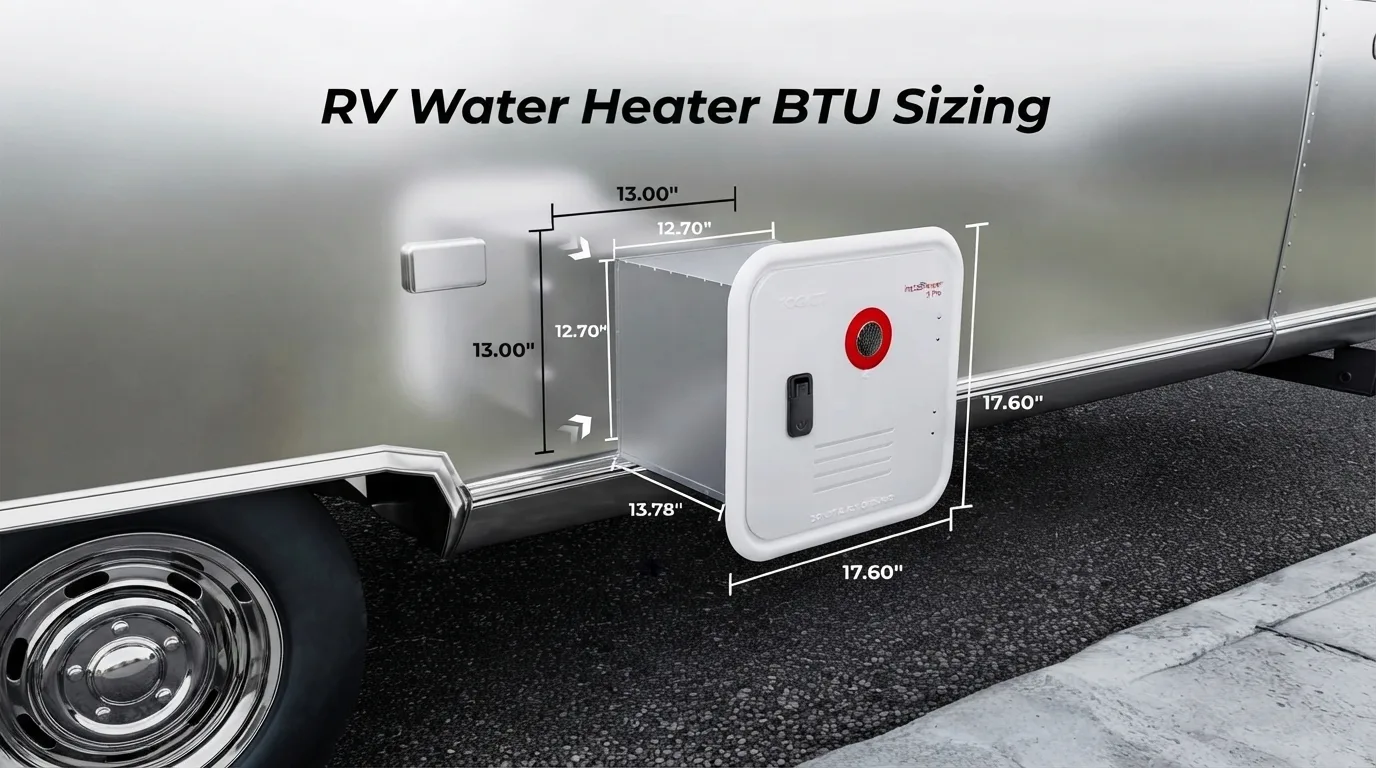
What does a water heater size upgrade require? We only consider it valid when the larger or tankless unit still fits the cutout, wiring, gas, venting, and support model of the RV platform.
Step 5: Turn the BTU Class into a Release-Ready OEM Spec Sheet

A water heater size upgrade is only valid when the larger or tankless unit still fits the cutout, wiring, gas, venting, and support model of the RV platform. In our Foshan reviews, thermal sizing was the easy part. The sign-off sheet is where projects stalled.
Here is how I turn the chosen BTU class into a spec sheet your buyers and engineers can sign off.
Build the non-thermal list:
- Cutout and door compatibility. Record the flange opening width and door-swing direction. A 1/4-inch door lip fouled a 60,000 BTU flange during our October build.
- Mounting depth and service access. Note standoff depth and clearance for the anode or drain.
- Venting path and weather sealing. Specify the flue route and the seal method.
- 12V/control harness. List connector type, wire gauge, and controller location.
- Gas connection and regulator. State the fitting size, line ID, and regulator compatibility.
- Operating flow window and activation threshold. Give the minimum GPM that fires the burner.
- Pass/fail temperature stability. Define the drift limit under set draw profiles.
Classify the install type. Split it into direct replacement, light retrofit, and major wall-opening modification. Sourcing teams only price installation friction honestly when they know which bucket the unit lands in.
Method diversity. Our primary recommendation stays the selected propane tankless architecture. Secondary options are hybrid-mixing or higher-recovery tanks when retrofit simplicity beats endless flow.
Verification: close with one spec line. Example: “60,000 BTU class, shower-plus-sink at 3.0 GPM, rated to 8,000 ft, 3/8-inch gas line plus 12V control harness.”
🔬 Sensory Check: A correct install feels calm in review. The thermostat holds steady. No abrupt cold burst on pause and resume. The flange shows no seal or fit distortion.
🧠 Author’s Verdict: I have watched two prototypes pass thermal testing, then fail sign-off on a door lip. Use the OEM development workflow to lock the non-thermal items before tooling.
Troubleshooting of RV Water Heater BTU Sizing

RV tankless water heater issues usually trace to flow instability, propane supply limits, altitude effects, or a BTU class that doesn’t match the actual use. The most common failure point is unstable flow and pressure control, not burner size.
Last winter, an OEM client’s 60,000 BTU unit cycled every time the furnace kicked on. We measured 0.9 GPM at the showerhead, not the 1.5 GPM on the nameplate, plus a 38–52 PSI pump swing. We replaced a stuck vacuum breaker, set the pump to 45 PSI, and dropped activation to 0.8 GPM. Outlet held 112°F ±2°F.
1) Hot-cold temperature swings during shower use
Verify actual GPM. Test hot-side-only control logic. Stabilize pressure with an accumulator. Confirm the unit isn’t oversized for its activation window or undersized for the draw.
2) Heater works at sea level but weakens in the mountains
Run the altitude derating check. Confirm combustion settings against the manufacturer’s high-altitude guidance. Our test chamber logged 22% output loss at 10,000 ft.
3) Outlet temperature collapses when another appliance runs
Inspect LP regulator capacity, line losses, and total appliance load before touching heater size. Our 3/8-inch line at 20 ft carried 48,000 BTU/hr. Add a 30,000 BTU furnace and an 8,000 BTU range, and the burner starves first.
4) A nominal upgrade creates install friction
Measure cutout and depth before ordering. In one retrofit, a 1/4-inch door lip fouled the 60,000 BTU flange. We reworked the door and added a 12mm standoff. The fit failed, not the thermal sizing.
💡 Diagnostic: Log inlet pressure during every draw test. If it drops more than 2 PSI below static, fix supply before changing BTU class.
Understanding where sizing fails is part of expertise, not a negative.
How many BTUs should my water heater be? The right class is the one your Delta T, simultaneous flow, efficiency correction, propane and altitude validation, and telemetry all agree on.
Conclusion
Match your BTU class to your flow rate, thermal efficiency, and altitude data. You now have a repeatable method for turning shower comfort targets into a defensible RV water-heater BTU spec.
Those insights cost real lab time. A Foshan altitude chamber delivers rigorous testing precision across six distinct burner configurations. Hard data proves this industry leadership. Gulfstone publishes these test results, turning every number into proof rather than marketing.
Run the logic in order:
- Delta T. Find the coldest real rise.
- Simultaneous GPM. Count only what runs at once.
- Efficiency correction. Divide by real efficiency.
- Propane and altitude. Confirm the gas system.
- Telemetry. Watch the outlet trace.
- Final OEM spec. Lock cutout, gas, vent, controls.
Your next move is sourcing action. Turn the winning BTU class into a sourcing brief, prototype plan, or RFQ package.
Do you need help building your RV program? Contact our support team. We provide full chamber-test data and open warranty terms. We build trust through clear facts.
People Also Ask About RV Water Heater BTU Sizing
1. How many BTU is a 6 gallon RV water heater?
A 6 gallon RV water heater runs 6,000 to 12,000 BTU/hr of burner input, and most OEM units sit near 8,800 BTU/hr. Our benchmark 6-gallon tank recovers in about 30 minutes at a 90°F rise. Treat that as a reference point, not the answer for every tankless design.
2. How many BTU do I need for my RV?
How many BTU you need for your RV depends on simultaneous flow, the coldest inlet temperature, burner efficiency, and your gas system limits. Worked example: a 1.5 GPM shower at a 60°F rise needs 45,000 BTU/hr of thermal load, which is 56,250 BTU/hr of burner input at 80% efficiency. Count that as about 56,000 BTU/hr.
3. What size RV water heater do I need?
The right size RV water heater is the BTU class that passes both formula-based sizing and validation against real multi-fixture performance. In our chamber runs, 40,000 BTU held a single shower at 112°F, while 60,000 BTU held shower plus galley sink at 118°F. Pick the smallest class that holds your actual draws above 105°F.
4. How many BTUs should my water heater be?
How many BTUs your water heater should be is decided by agreement between Delta T, simultaneous flow, efficiency correction, propane and altitude validation, and telemetry, not by the biggest badge.
In RV water heater BTU sizing, the class that satisfies all five checks wins, even when a larger unit looks better on paper.
5. How to Size a Tankless Water Heater
Sizing a tankless water heater starts with the real temperature rise for your coldest operating case, not with a BTU class. Measure the coldest inlet temperature, set the target outlet at the showerhead, and subtract to get Delta T. Then size burner input with 500 x GPM x Delta T divided by thermal efficiency.

Forward
Founder & CEO, GulfstoneGas appliance manufacturing and certification
Most of what decides a gas appliance is settled before anything is built — on the drawing, at the cut-out, in the tolerance someone chose for the gas path. I have spent my working life on the manufacturing side of that decision, and this is where I write down what it has taught me.
Nothing here is written from a sales desk. Every note comes off the floor: a batch held until a reason was found, a fitting that failed in transit, an approval path that only made sense once the destination market was fixed. If you read these first, the opening conversation starts at the standard rather than at the beginning.
- Gas water heater engineering
- Design for manufacturing
- Certification path selection
- Private-label tooling
- Off-grid and outdoor water heating
- RV Water Heater Manufacturing Process: Gulfstone’s 12-Stage Line SOPSep 30, 2026
- Downsides of Subcontracting: Hidden Sub-Tier Audit ChecklistSep 29, 2026
- Vet an RV Appliance Manufacturer in China: A Five-Gate AuditSep 28, 2026
- Gas Appliance Testing Laboratory: Audit a Factory Bench Before You Approve ItSep 24, 2026
- OFHC Copper Heat Exchanger: Engineer More Efficient SystemsSep 21, 2026
- Proportional Gas Valve RV: Unlock Steady Heat and ControlSep 12, 2026
Two decades on the manufacturing side of gas appliances, from the drawing to the shipping container.
Leads Gulfstone's design-for-manufacturing reviews and the certification path selected for each destination market.
Works directly with OEM and private-label buyers on tooling, tolerances and the approval file.