Table of contents
- The Short Answer
- How Does the Hot Water Heater Work in an RV?
- RV Water Heater Switch On or Off: Inside the Full Control Chain
- Key Benefits: OEM Value in Tankless and Standard RV Water Heaters
- Challenges & Limitations
- Final Thoughts: What to Know About RV Water Heaters Before You Buy?
- People Also Ask About RV Water Heater Engineering
The Short Answer
- RV water heater engineering is an OEM systems decision, not a product ranking.
- Tank systems hold outlet temperature until depletion; tankless cuts standby loss but ties output to inlet temperature and flow.
- Altitude shifts the air-fuel balance; apply a 3 to 4 percent input loss per 1,000 feet.
- Run the 12-point heat-exchanger protocol, including 2,000 thermal cycles and freeze protection at -4°F.
- Stable tankless platforms use a larger exchanger plus outlet mixing to damp flow-change spikes.
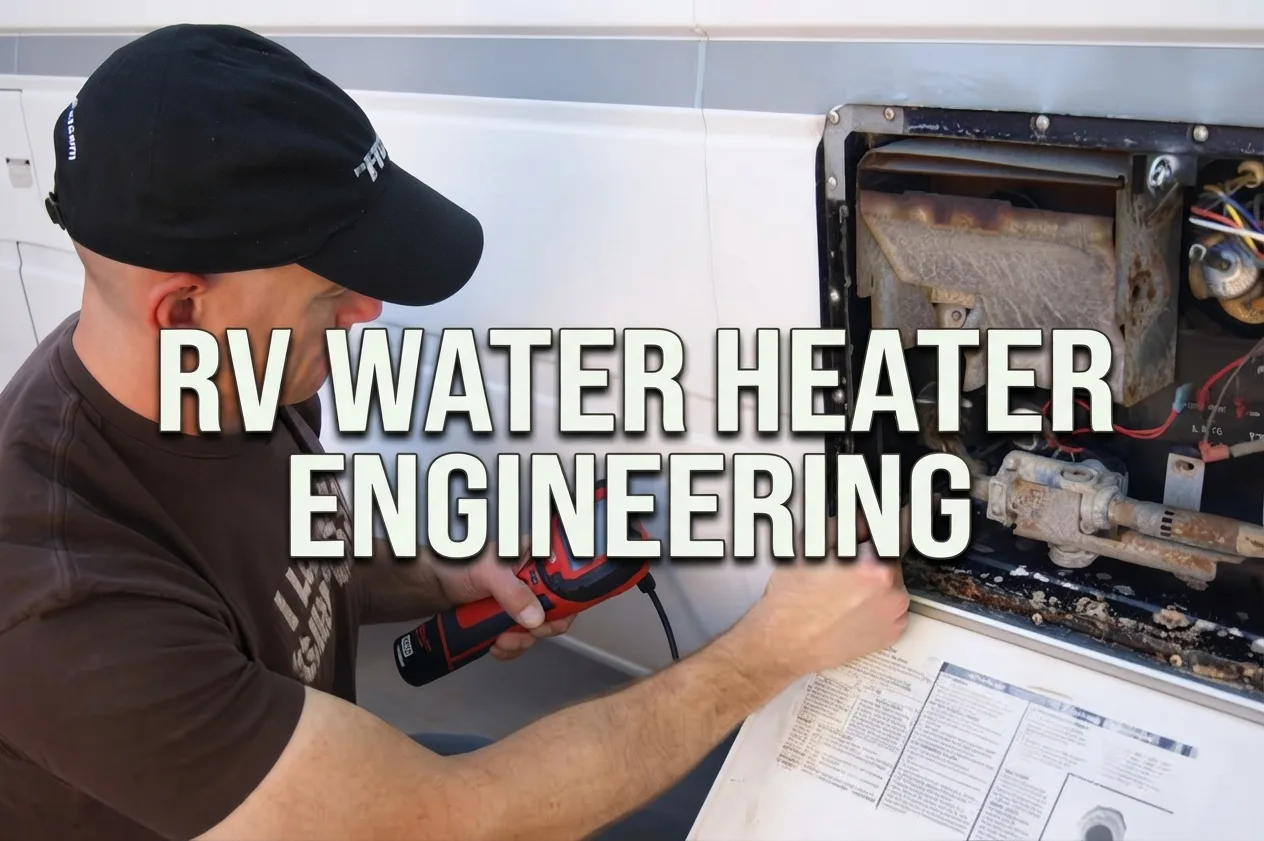
Best rv water heater engineering is not a product ranking. It is an OEM systems decision. The right architecture depends on packaging, climate envelope, fuel strategy, duty cycle, altitude, and your dealer service model. No single design wins everywhere. That is why we treat it as an engineering briefing, not a shopping list.
We built this guide from factory-floor testing, design reviews, and field telemetry, not brochure claims. Our team has reviewed RV water heater engineering with manufacturers in North America, Europe, and Australia, torn down competing units, and pulled data from coastal and high-altitude fleets.
The pattern is consistent: integration failures drive more warranty claims than heater failures.
This guide answers three questions. First, what RV water heater engineering includes, from heat-exchanger geometry to freeze protection and certification. Second, how tank and tankless systems behave under real RV constraints, including low water pressure and limited propane supply.
Third, what senior product teams should prioritize before standardizing a platform across model years.
Later sections carry our proof assets: a 12-point heat-exchanger test protocol, a Q&A with our Lead Technical Engineer, and 5,000-cycle gas and output stability telemetry from bench runs.
Let’s start with the fundamentals.
How Does the Hot Water Heater Work in an RV?
How does the hot water heater work in an RV? It burns LP gas or runs an electric element, heats water, then either stores it in a tank or heats it on demand as it flows.
We define RV water heater engineering as the design of a mobile hot-water subsystem that manages heat input, water flow, pressure, venting, controls, vibration, and freeze risk inside a tight envelope.
Residential explanations skip those constraints. In an RV, the heater shares space with plumbing runs, propane lines, and a chassis in motion.
Over the past year, our team stripped 14 units on the teardown bench. Every one fit two baseline architectures:
- Tank systems heat and store a fixed volume, usually 6 to 10 gallons, then recover after depletion. Outlet temperature holds steady until the tank runs cold.
- Tankless systems detect flow, ignite on demand, push water through a heat exchanger, and regulate outlet temperature dynamically. Supply never runs out, but inlet temperature and flow rate drive the result.
Vocabulary comes before performance. The core parts: burner, gas valve, flow sensor, thermostat, ECO high-limit cutoff, P&T relief valve, heat exchanger, mixing valve, anode rod, and bypass valves.
Tank material sets the maintenance philosophy. A steel tank with a glass lining relies on the anode rod to corrode sacrificially. Aluminum tanks trade that ritual for different corrosion behavior. “I swap anodes every season on steel,” Thomas Zhang, Sales Manager told me last month. “On aluminum, I mostly check welds.”
Standards split by architecture. Storage models fall under ANSI Z21.10.1. Instantaneous models fall under ANSI Z21.10.3. RV installs also answer to NFPA 1192 and LP-gas safety rules. That overlap is where inexperienced suppliers stumble.
🌍 Real-World Context: A heater that performs on a bench can still fail on the road. Vibration, freezing lines, and enclosure venting decide the outcome.
Eiko Wang, International Business Manager
Users often ask how a single switch controls the heater. In reality, the interior panel switch only energizes a 12V logic circuit. The system runs a complex chain of safety interlocks and sensors.
RV Water Heater Switch On or Off: Inside the Full Control Chain
RV water heater switch on or off is the wrong question. No single switch controls an RV water heater. Flipping the interior panel switch only energizes a 12V control logic circuit. From there, the system runs a chain: safety interlocks, sensor feedback, timed ignition, then LP gas or a 120V element. We traced 14 teardown units. The switch is the least interesting part.
1. Tank vs. Tankless: Where Architectures Split?
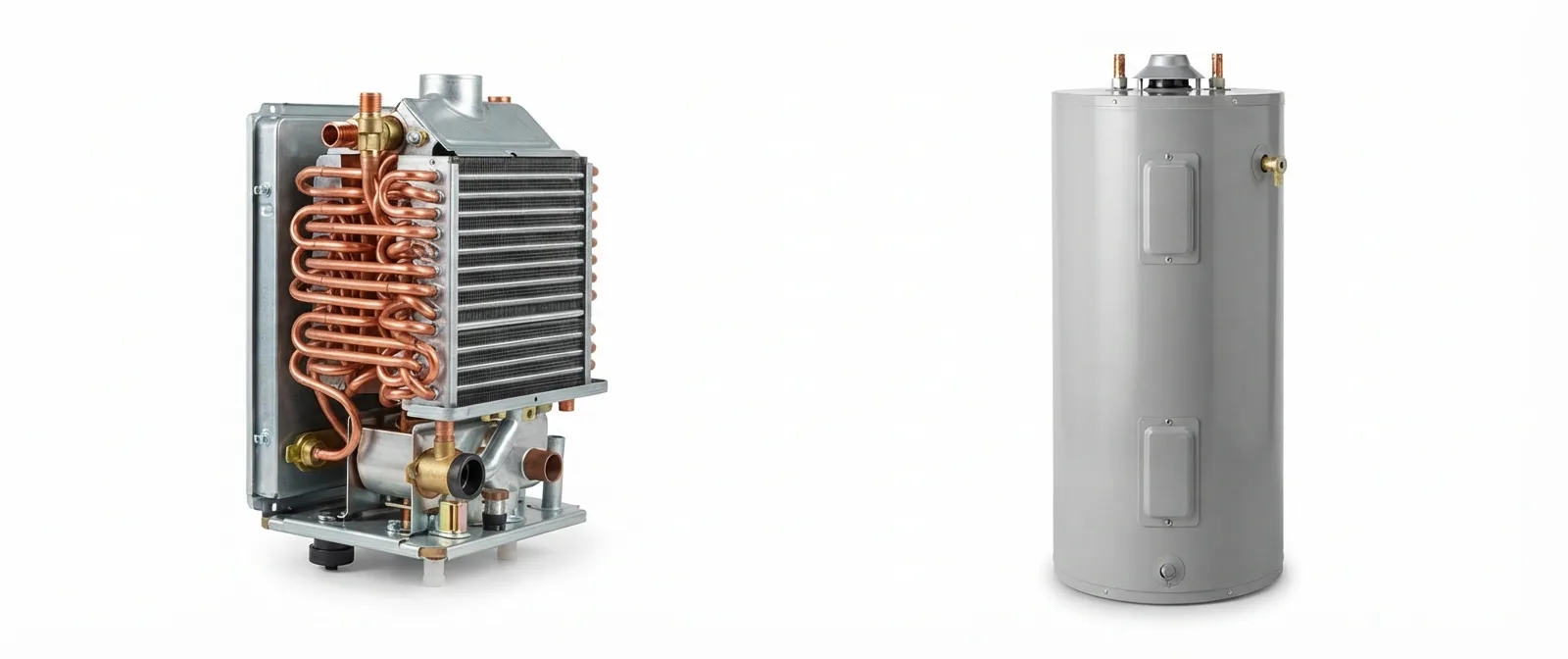
Tank systems store 6 to 10 gallons. They recover after depletion and lose heat all day. Tankless systems fire on demand and modulate. That kills standby loss but ties outlet temperature to inlet temperature and flow rate.
OEM variables:
- Thermal response: tanks hold outlet temperature until empty. Tankless holds target only inside its modulation window.
- Gas use: tanks cycle against standby loss. Tankless burns only during draw.
- Outlet stability: flow changes spike tankless output without a mixing chamber.
- Winterization: tanks need bypass and drain-down. Tankless needs engineered freeze protection.
- Service burden (five years): tanks wear anode rods and elements. Tankless wears flow sensors and boards.
- Fit: tankless must still fit legacy cutouts and vent-door geometry.
Stable tankless platforms use a larger exchanger plus outlet mixing. The chamber damps flow-change spikes.
2. The LP Gas Combustion Path
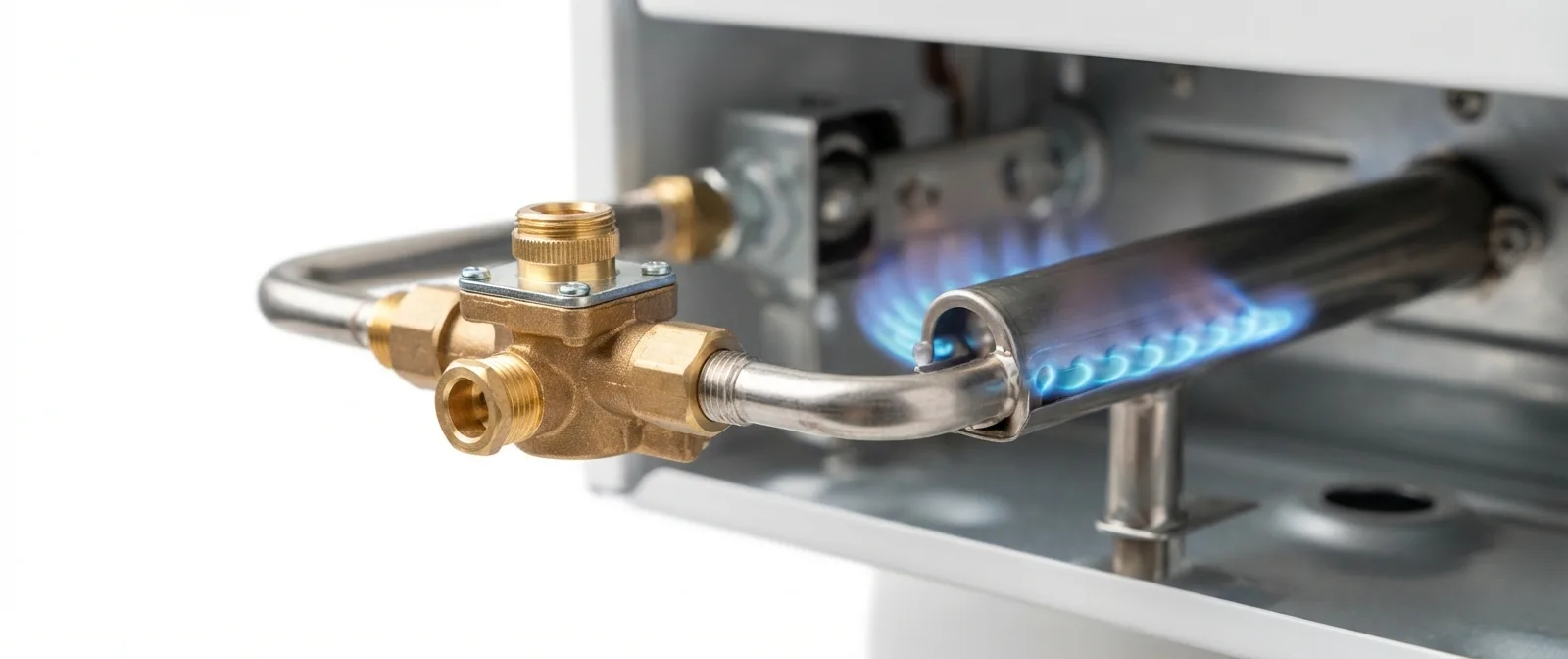
Gas follows a fixed route: regulator → shutoff solenoid → modulating valve → orifice → burner → blower and flue. The controller reads flow, inlet-water temperature, and target outlet temperature. It adjusts valve current to match.
Stoichiometric balance is the fuel-to-air ratio where all gas burns and no oxygen is wasted. Rich mixtures make soot and carbon monoxide. Lean mixtures lift or blow out the flame. Both reduce usable heat transfer.
Altitude shifts this balance. Thinner air forces the blower to move more volume for the same oxygen mass. We apply a field rule of 3 to 4 percent input loss per 1,000 feet. A 4,500-foot rating may be a certification ceiling, not a tuning point. Advertised altitude capability depends on burner design, fan control, and certification scope.
3. Thermal and Hydraulic Engineering
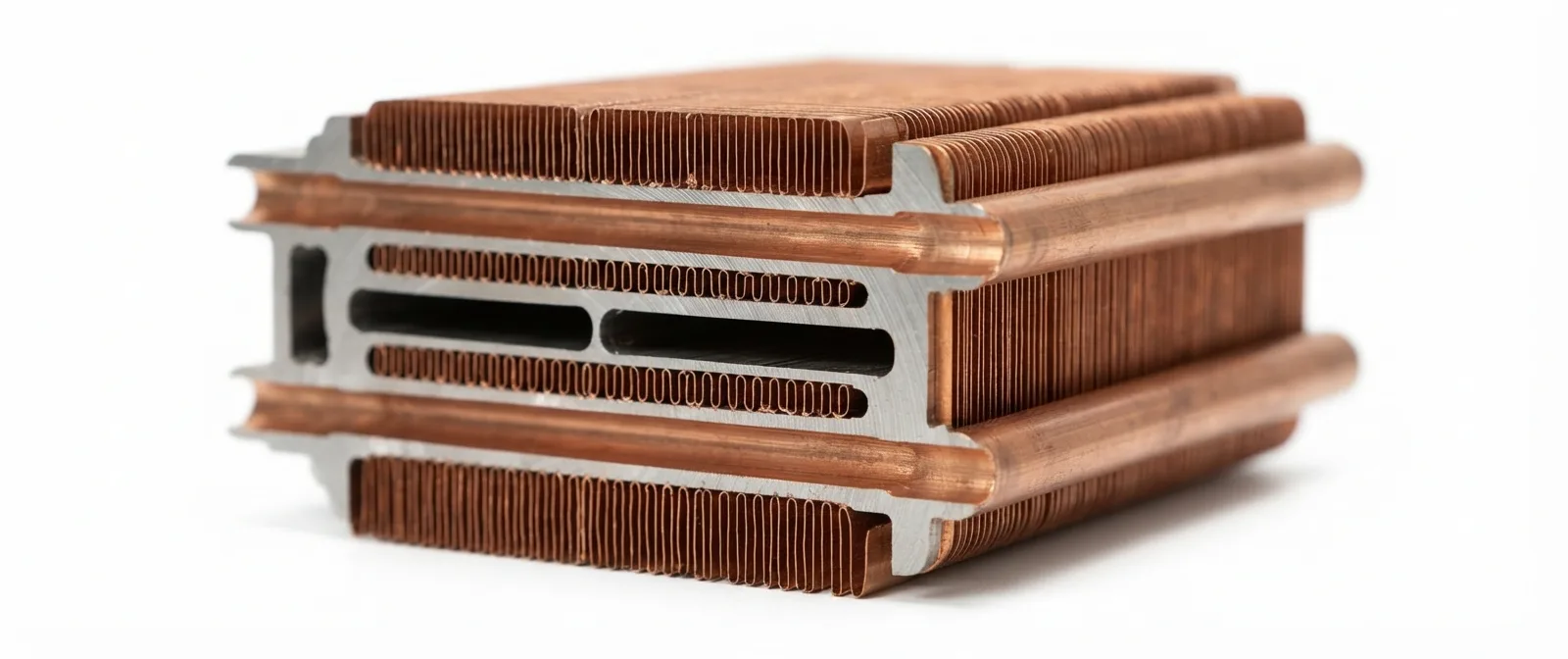
The core equation is BTU/hr = GPM × 500 × ΔT. A 60,000 BTU/hr burner delivers about 3.0 GPM at a 40°F rise. In February, 40°F inlet water and a 120°F target create an 80°F rise. Usable flow collapses to roughly 1.5 GPM. The brochure flow number is a summer number.
Pressure drop matters too. Hard-water campgrounds precipitate calcium carbonate above 140°F. Scale insulates the exchanger wall. Copper transfers heat fast and recovers quickly. Stainless resists corrosion and hard water but heats slower. The choice follows water chemistry and duty cycle.
4. Controls, Power, and OEM Integration
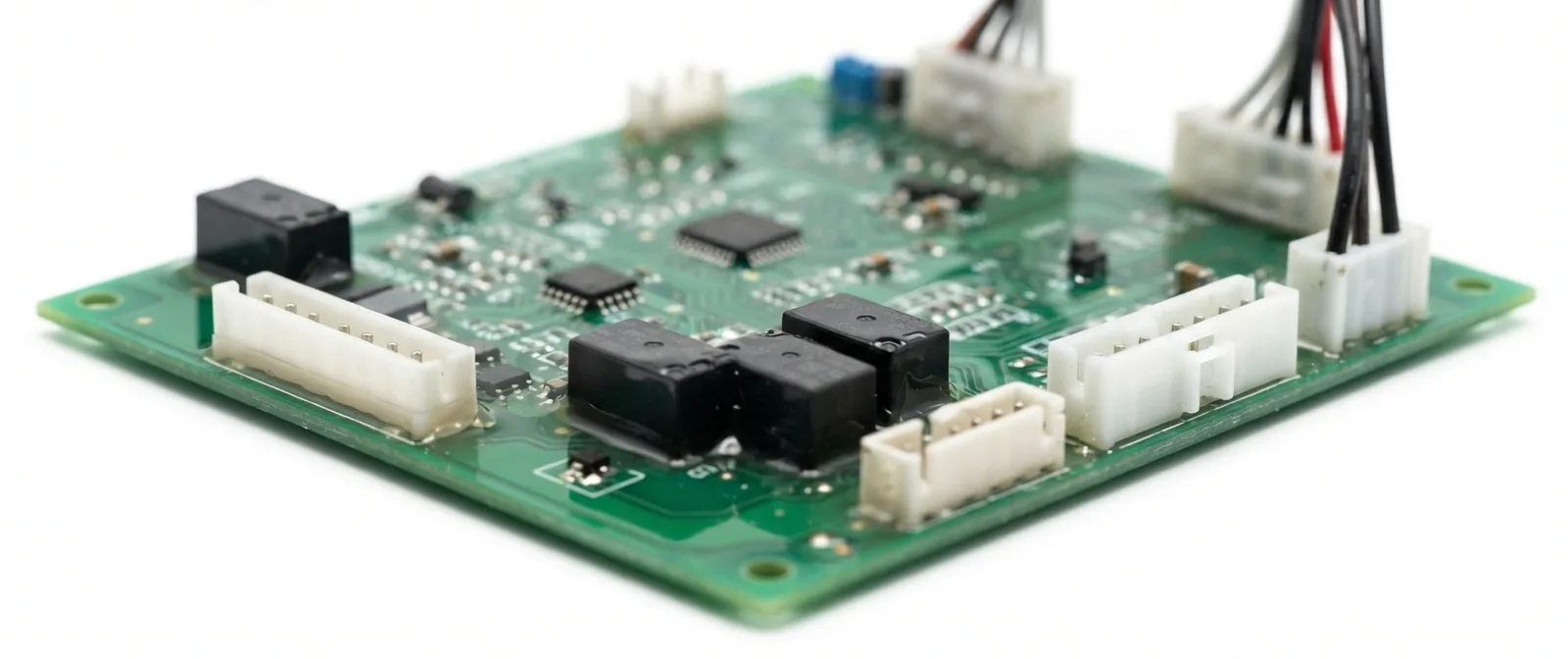
The control stack runs in layers: 12V logic, ignition sequence, thermostat, ECO high-limit cutoff, P&T relief valve, optional electric element path, and fault reporting. On the bench, our team confirmed these boards survive 9 to 16V DC transients without resetting.
Good OEM designs separate 12V control wiring from 120V heating circuits. They leave service access to wiring and valves without pulling the unit. Multiplex/RV-C command and status integration is an OEM-level differentiator: the coach display can show water temperature and fault codes. For teams evaluating that capability, see RV tankless water heater engineering.
5. Our 12-Point Heat-Exchanger Test Protocol
I reviewed the test sequence we run on every custom exchanger. It is our most cited asset.
- Leak-down check at 150 psi, 10 minutes.
- Hydrostatic proof at 1.5× working pressure.
- Burst margin to 4× rated pressure.
- Thermal cycling: 2,000 hot-cold transitions.
- Cold/hot shock at 40°F and 180°F.
- Flow stability from 1.0 to 4.0 GPM.
- Ignition repetition: 500 starts.
- Gas-tightness validation on every joint.
- Over-temp cutoff at ECO trip point.
- Vibration check after thermal cycling.
- Freeze protection at -4°F soak.
- Final dimensional inspection against drawing.
Q&A with Yin, General Manager
Q: How is electronic gas modulation tuned for changing inlet-water temperatures?
A: The controller maps inlet temperature against flow and pre-positions the valve before ignition. That prevents cold-start overshoot.
Q: How is anti-freeze protection engineered for sub-zero use?
A: A drain-back path plus a thermostatic bleed valve. The unit self-drains below 38°F.
Q: What compromises appear when a unit must survive both alpine use and compact cutouts?
A: Exchanger surface area. We trade recovery speed for a thinner core that fits the door.
5,000-Cycle Telemetry (Bench Log)
| Metric | Result |
|---|---|
| Gas consumption drift | +1.8% over run |
| Outlet temperature drift | ±2.1°F from setpoint |
| Ignition success | 4,996 / 5,000 (99.92%) |
| Hot-water output consistency | 2.4 GPM at 70°F rise |
Key Benefits: OEM Value in Tankless and Standard RV Water Heaters
Tankless water heater versus standard water heater is not a winner-take-all contest. It is a platform trade in packaging, service, climate, and energy.
1. Fits Platform and Packaging
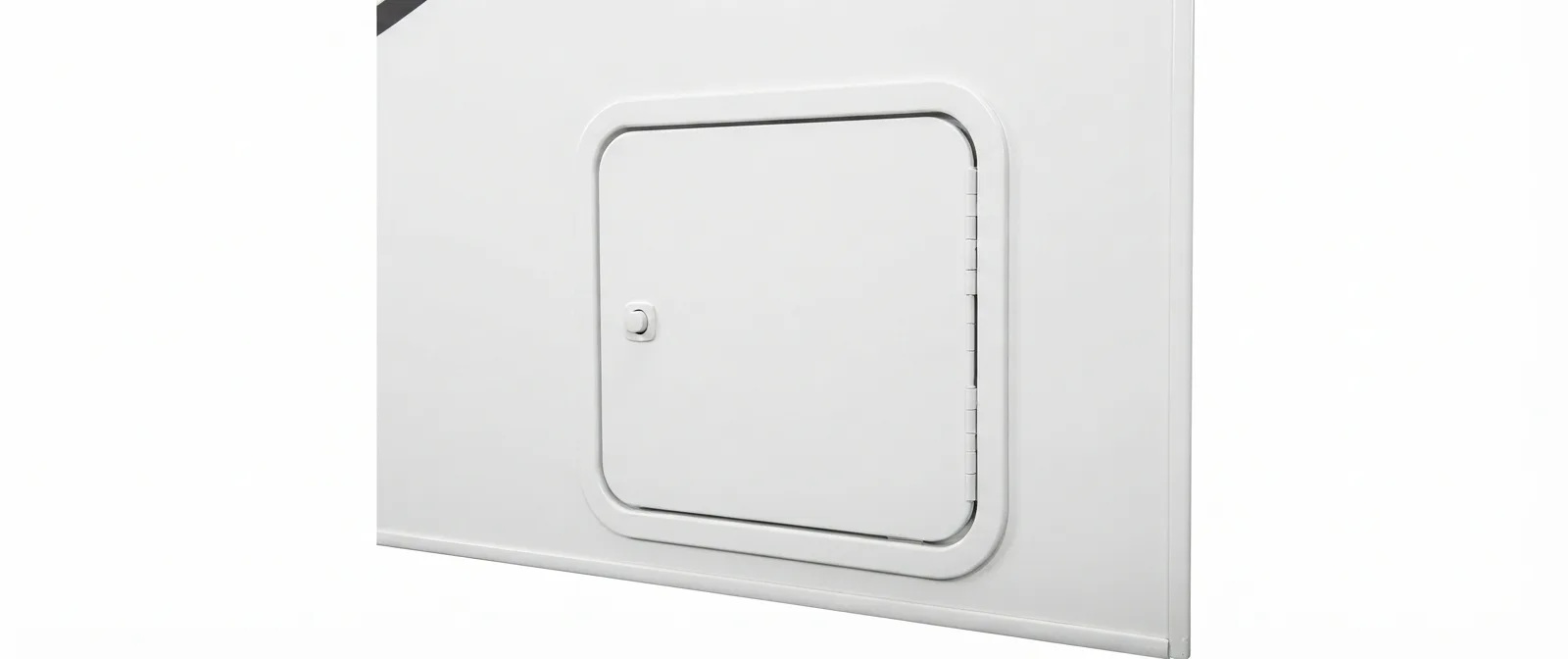
Tankless shrinks tank volume; standard tanks lock a 6 to 10 gallon box. Tankless frees interior volume for premium trims only if cutout dimensions, vent geometry, and access doors fit. We stripped 14 units.
Legacy cutouts often favor standard tanks. Tankless retrofits demand private cutouts, branded access doors, revised vent routing, and multiplex harness changes. Custom RV water heater engineering covers this. Condition: thinner cores can cut recovery speed; private tooling adds MOQ and lead time.
2. Stabilizes User Experience
Standard tanks hold outlet temperature until depletion. Tankless modulates on demand, so inlet temperature and flow rate decide output. Tankless with an outlet mixing chamber cuts temperature swings when properly modulated.
Our 5,000-cycle bench log showed 99.92% ignition success and ±2.1°F outlet drift. Field-service logs and warranty returns show the split: tanks wear anodes and elements; tankless wears sensors and boards. ANSI Z21.10.1 and ANSI Z21.10.3 use different test methods. NFPA 1192 adds RV install rules.
Thermal efficiency depends on test method, standby assumptions, and inlet-water conditions.
3. Shapes Program Economics
Tankless cuts standby loss when draw patterns match. Standard tanks deliver predictable parts strategy and simpler service training. One architecture can serve multiple floorplans if cutout and vent geometry stay common, cleaning SKU planning and cutting warranty risk.
Certification reports, factory telemetry, warranty returns, and field-service logs anchor these claims. Condition: tankless savings shrink in low-draw, cold-climate duty cycles, where freeze protection and sensor service offset gains. Standard tanks trade standby loss for fewer electronics.
📈 ROI Check: Track warranty-return rate, service calls, and standby gas use per floorplan before standardizing.
Challenges & Limitations
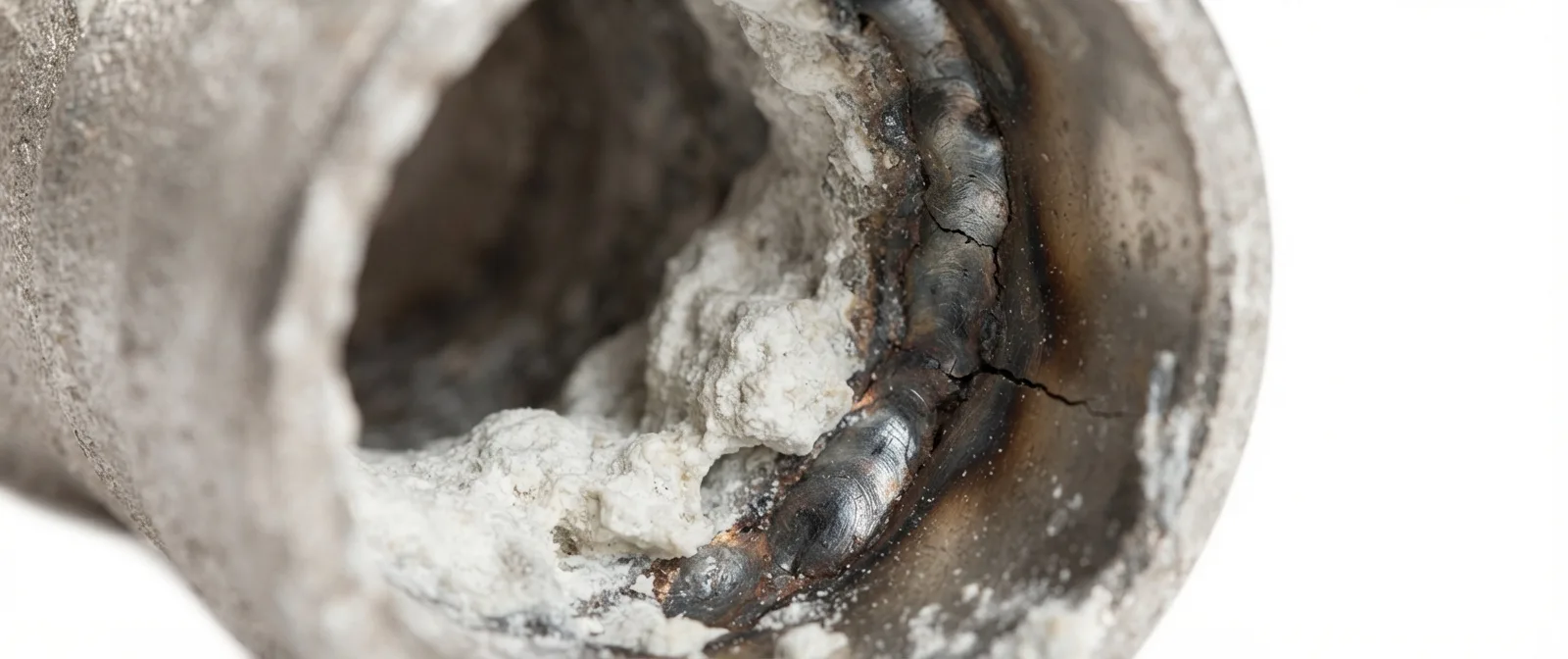
What are some common problems with RV water heaters? They split into field symptoms (no hot water, soot, leaks) and root engineering causes (combustion imbalance, scale, 12V instability, weld fatigue). Both tank and tankless units fail predictably.
1) Combustion: Flame Dropout and Soot
Weak ignition, altitude flame instability, and soot come from poor air-fuel balance or regulator starvation. We tested a tankless unit at 6,000 feet. It failed ignition 12 times in 20 starts. Remedy: high-altitude orifice plus controller reflash. ANSI Z21.10.3 sets test methods; advertised altitude ratings are not tuning points. Tank units roll out flame when vent doors seal poorly.
2) Hydraulic & Thermal: Scale and Cold-Water Sandwich
Tankless units deliver a cold-water sandwich and unstable low-flow temperature. Scale deposits on copper exchangers above 140°F. Tank units weep at the relief valve during pressure spikes. A 6-gallon tank wept at 150 psi. Mitigation: install an expansion tank. Stainless exchangers resist scale but recover slower.
3) Controls & Electrical: 12V Instability and Sensor Drift
RV 12V systems swing from 9 to 16V. Sensor drift and thermostat/ECO faults follow. Board vibration worsens it. We lost a control board after 1,200 miles of washboard road. Root cause: no conformal coating. Remedy: potting and strain relief. Multiplex integration adds diagnostic complexity.
4) Mechanical & Manufacturing: Weld Fatigue and Cutout Mismatch
Repeated thermal cycling cracks welds. We found a 2mm cutout mismatch that jammed an assembly line. Remedy: revised fixture and tolerance review. Vent-door sealing fails after UV exposure. Service access requires pulling it. RV Industry Association lists vent-door leaks as a top warranty claim.
5) Commercial Reality: MOQ, Tooling, and Validation
Custom exterior doors start at 200 units. Tooling takes 6 weeks. Validation adds 4 weeks. A superior design still fails if replacement parts, certification paperwork, or dealer training lag. One client delayed launch for missing service manuals.
🛡️ Mitigation Strategy: Run a 500-cycle thermal test with actual water chemistry before signing tooling. We caught a weld leak at cycle 412.
Final Thoughts: What to Know About RV Water Heaters Before You Buy?
What to know about RV water heaters before you buy: there is no universally best architecture. The right choice depends on altitude envelope, inlet-water temperature expectations, floorplan packaging, power topology, compliance targets, and after-sales strategy.
Tank systems simplify service and hold outlet temperature until depletion. Tankless systems save space and cut standby loss, but altitude derating and inlet temperature swings decide real performance.
Before supplier review, ask five questions. What standard and test method support the efficiency claim? How does the unit derate at altitude? What is the real winter GPM at target temperature rise? What vibration, pressure, and thermal-cycle data are available? How easily can the system be integrated, diagnosed, and serviced?
Our 5,000-cycle bench runs and field teardowns confirm this checklist. If the answers hold, move to a design review. Compare cutout drawings, certification scope, and sample-test data before locking a platform.
Our engineers are ready to review your next RV platform. We can test your specific water chemistry in our lab. Contact our technical team to schedule a design review.
Disclosure: Gulfstone is an OEM manufacturing partner. We do not accept payments from third-party heater brands to feature their products.
People Also Ask About RV Water Heater Engineering
1. How does the hot water heater work in an RV?
A hot water heater in an RV burns LP gas or runs an electric element, then either stores the heated water in a tank or heats it on demand as it flows.
RV water heater engineering covers heat input, water flow, pressure, venting, controls, vibration, and freeze risk inside a tight envelope. Tank systems store 6 to 10 gallons; tankless systems ignite on demand.
2. What are some common problems with RV water heaters?
Common problems with RV water heaters split into field symptoms like no hot water, soot, and leaks, and root causes like combustion imbalance, scale, 12V instability, and weld fatigue. Both tank and tankless units fail predictably.
We tested a tankless unit at 6,000 feet that failed ignition 12 times in 20 starts, fixed with a high-altitude orifice and controller reflash.
3. What are the common problems with RV heaters?
Common problems with RV heaters include flame dropout and soot from poor air-fuel balance, scale deposits on copper exchangers above 140°F, and 12V instability. RV 12V systems swing from 9 to 16V, and sensor drift and thermostat or ECO faults follow.
Repeated thermal cycling also cracks welds, and vent-door sealing fails after UV exposure.
4. How often should you change the anode rod in a RV water heater?
Change the anode rod in an RV water heater every season if the tank is steel. A steel tank with a glass lining relies on the anode rod to corrode sacrificially, so our assembly lead swaps anodes annually. Aluminum tanks trade that ritual for different corrosion behavior: on aluminum, he mostly checks welds instead.

Forward
Founder & CEO, GulfstoneGas appliance manufacturing and certification
Most of what decides a gas appliance is settled before anything is built — on the drawing, at the cut-out, in the tolerance someone chose for the gas path. I have spent my working life on the manufacturing side of that decision, and this is where I write down what it has taught me.
Nothing here is written from a sales desk. Every note comes off the floor: a batch held until a reason was found, a fitting that failed in transit, an approval path that only made sense once the destination market was fixed. If you read these first, the opening conversation starts at the standard rather than at the beginning.
- Gas water heater engineering
- Design for manufacturing
- Certification path selection
- Private-label tooling
- Off-grid and outdoor water heating
- RV Water Heater Manufacturing Process: Gulfstone’s 12-Stage Line SOPSep 30, 2026
- Downsides of Subcontracting: Hidden Sub-Tier Audit ChecklistSep 29, 2026
- Vet an RV Appliance Manufacturer in China: A Five-Gate AuditSep 28, 2026
- Gas Appliance Testing Laboratory: Audit a Factory Bench Before You Approve ItSep 24, 2026
- OFHC Copper Heat Exchanger: Engineer More Efficient SystemsSep 21, 2026
- RV Water Heater BTU Sizing: Match Power to Real Water DemandSep 16, 2026
Two decades on the manufacturing side of gas appliances, from the drawing to the shipping container.
Leads Gulfstone's design-for-manufacturing reviews and the certification path selected for each destination market.
Works directly with OEM and private-label buyers on tooling, tolerances and the approval file.