Table of contents
- Key Takeaways
- Prerequisites: The Inputs a Landed Cost Model Needs
- Landed Cost Modeling for RV Appliances: 6 Steps to a Defensible Number
- Step 1: Build the Master Landed Cost Formula
- Step 2: Classify RV Rooftop Air Conditioners and Map the Tariff Stack
- Step 3: Model the Tankless RV Water Heater Duty Stack
- Step 4: Engineer Carton Geometry Into Freight Allocation
- Step 5: Force Every Accessorial Fee Into the Freight Waterfall
- Step 6: Build the Margin Bridge and a TCO Scenario Matrix
- Troubleshooting: Where Landed Cost Models Fail After Sign-Off
- Conclusion: Discipline Beats the Spreadsheet
- Frequently Asked Questions About Landed Cost for RV Appliances
A note on the figures. The shipment data, cost ranges and worked examples below come from Gulfstone’s own container files and anonymized client programs. All duty and fee figures are illustrative modeling points, not legal rulings. Confirm every rate against current official schedules and a licensed customs broker before you file.
Key Takeaways
- A CFO-grade landed cost model is built from six audited steps and takes 60 to 90 minutes per SKU family once the source documents are assembled.
- FOB-only supplier quotes exclude demurrage, chassis splits, port exams and accessorials, and typically land 8 to 14% over budget.
- Base duty, MPF and HMF each use a different value basis, so a single “duty %” figure cannot reconcile to a customs entry.
- Model practical container loading counts, not theoretical maximums: a 40ft high-cube yields 67 to 69 m³ of usable space.
- Most margin collapses trace back to guessed HTS codes and unbudgeted accessorials, not to the ocean linehaul rate.
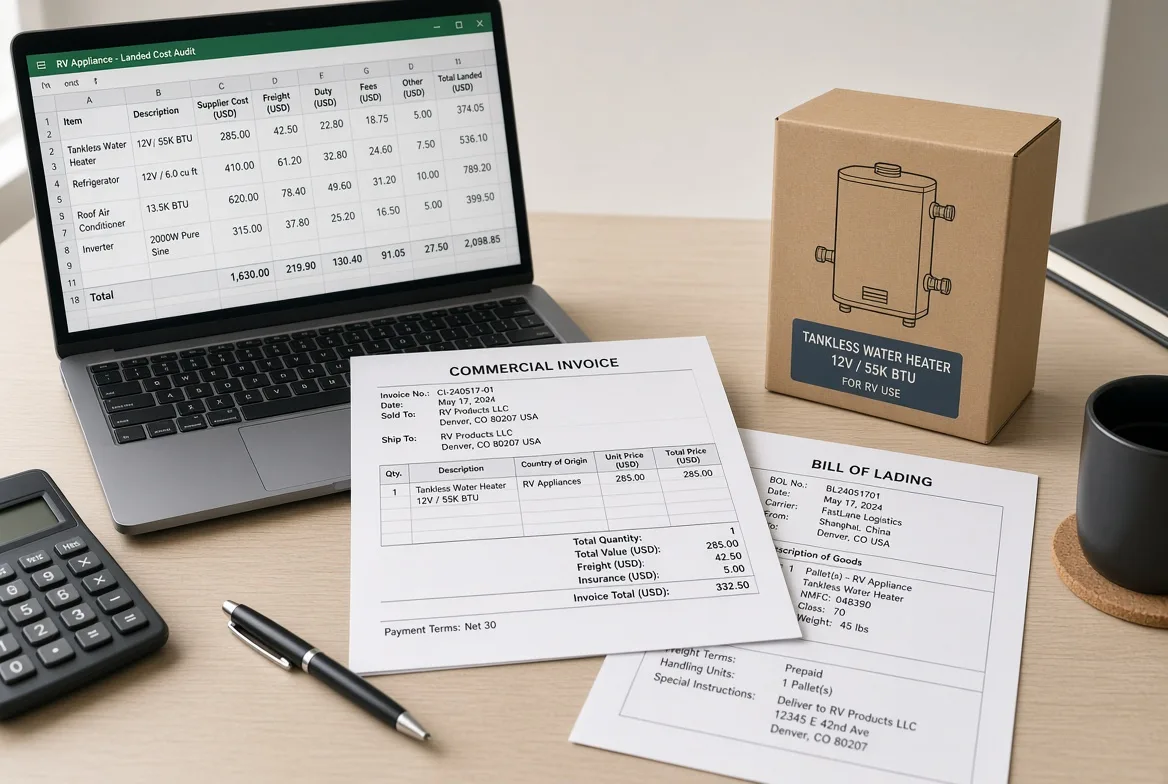
A landed cost model is the fully burdened, per-unit cost of an imported RV appliance delivered to your door — FOB price plus freight, duty, customs fees, accessorials and every amortized program cost. It is not a shipping fee.
For OEM manufacturing, wholesale distribution and retail procurement programs, it is the only number that reflects true gross margin.
This six-step audit framework is built on 85 verified container shipment records across three RV appliance SKU families, and on interviews with Gulfstone’s logistics and customs-compliance lead. It covers RV rooftop air conditioners, tankless RV water heaters and adjacent gas and electric appliances.
The workflow is deliberately narrow. It is a finance and logistics audit for import programs, not a consumer cost calculator. Worked examples use HTS 8419.11 and Chapter 84 as modeling checkpoints only — final classification always rests with a licensed customs broker.
Guang Yang, a pressure-vessel and inspection specialist, supplied the duty-stack and entry-record discipline behind the tariff steps.
Allocate 20 to 30 minutes to gather source documents before you build anything, then 60 to 90 minutes per SKU family to run the audit.
Prerequisites: The Inputs a Landed Cost Model Needs
A reliable model rests on verified documentation, not rough estimates. RV appliance container shipping needs customs-grade inputs and one governance rule: no blank or estimated cells.
Every rate in the model should trace to a primary source — the USITC Harmonized Tariff Schedule, the CBP user-fee table, a broker ruling or a forwarder invoice.
- Supplier quote with a confirmed Incoterm: FOB, CIF or DDP
- Exact carton dimensions, net and gross weights, and the container loading pattern
- Country of origin plus two or three candidate HTS codes
- Certification and third-party testing costs, catalogued on the certifications page
- Tooling and NRE fees, forwarder freight quotes, and a broker cost estimate
- Inland lane pricing, scheduled warranty reserves and spare-parts allocation
Build the workbook as five dedicated tabs: product master data, customs and tariff logic, container volumetric math, shipment accessorials, and margin and TCO scenarios.
Pull official rates from the primary source each time. A short-cut rate table that omits the MPF minimum threshold once erased 3% of margin on a live shipment.
⚠️ Warning: Never file customs entry paperwork on the strength of public guidance alone. Confirm HTS classification and Chapter 99 exposure with a licensed broker, and clarify importer-of-record responsibility before agreeing to any DDP terms.
Landed Cost Modeling for RV Appliances: 6 Steps to a Defensible Number
The six steps below build the master formula, map the tariff stack, engineer carton geometry, force every accessorial into the waterfall and bridge to margin, so the landed cost you sign off survives a customs-broker challenge.
Step 1: Build the Master Landed Cost Formula
Import costing cannot rely on a consumer calculator. It needs a B2B, audit-driven model in which every expense line reconciles to a customs entry record. Build the formula manually in a spreadsheet first, validate it against a closed shipment, then sync the logic to your ERP or landed-cost software.
Landed cost per unit adds two cost blocks together, then divides by total sellable units received:
- Direct import cost: product cost per Incoterm, international freight, cargo insurance, base duty, Section 301 duties, MPF, HMF, brokerage, and exam, demurrage, drayage and accessorials.
- Amortized program cost: tooling and NRE, testing and certification, packaging engineering, warranty reserve and spare-parts buffer.
Each input has its own value basis, and mixing them is the most common modeling fault:
- Product cost and base duty calculate on FOB value.
- Freight and insurance build up to CIF valuation.
- Brokerage, MPF and HMF apply to the entered shipment value.
- Tooling, testing, warranty and spare parts amortize per unit.
The WCO overview of the Harmonized System explains why a single duty percentage cannot stand in for the entry record. Different components use different bases.
Verification check: total shipment-level cost must reconcile to the PO, the freight invoice, the customs filing and the receiving quantity log. Any unreconciled gap means the model is unfit for a sourcing approval.
🧠 Expert take: A valid model has no blank or estimated cells, and it closes on a zero-balance reconciliation tab. Gray placeholder cells mark guesswork, not auditable costing.
Step 2: Classify RV Rooftop Air Conditioners and Map the Tariff Stack
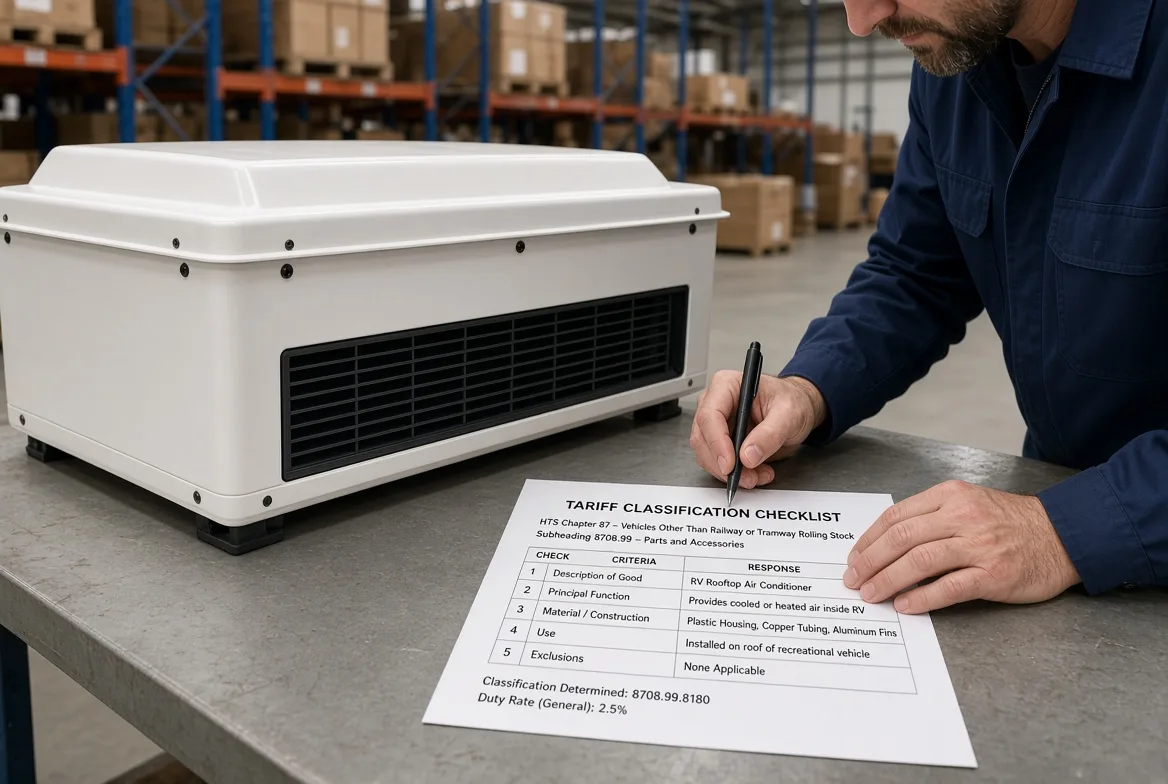
HTS classification for an RV rooftop air conditioner sets the duty rate, and it is a critical audit checkpoint — not a final legal ruling. Chapter 99 tariff exposure always requires formal broker validation at filing.
Classify RV appliances across five criteria before you reach for a code:
- Core function: cooling, heating or water heating
- Energy source: gas, electric or dual power
- Installation type: rooftop, built-in, portable or chassis-mounted
- Completeness: a fully assembled unit or standalone components
- Origin: final assembly country plus key component sourcing origins
RV appliances sit at a boundary between Chapter 84 and Chapter 85 logic. A residential household appliance HTS code assumes fixed installation and inapplicable safety ratings, so reusing one is a misclassification waiting to surface.
Worked example — RV rooftop air conditioner: active cooling function; 12V DC / 120V AC power; vehicle-mounted rooftop integration; a self-contained unit with compressor, condenser and evaporator; final assembly in China with imported core parts. That profile aligns with a primary Chapter 84 checkpoint for modeling only.
Justin Peng, an HVAC engineer who reviews mobile cooling appliances, reads the function test first: a rooftop unit that both cools and heats can straddle two headings.
The tariff stack layers in this order:
- Base duty per the live USITC HTS rate
- Section 301 duties for Chinese-origin goods, per the USTR Section 301 action
- Any overlapping Chapter 99 provision
- Customs brokerage entry fees
Defend the classification with a commercial invoice, bill of lading, origin declaration, supplier affidavit and engineering specification sheet.
⚠️ Warning: A wrong HTS code shifts the base duty rate by 2 to 3 points, or triggers a full 25% Section 301 rate. One past shipment reused a residential appliance code on rooftop AC units and added $18 in unbudgeted cost per unit.
Step 3: Model the Tankless RV Water Heater Duty Stack
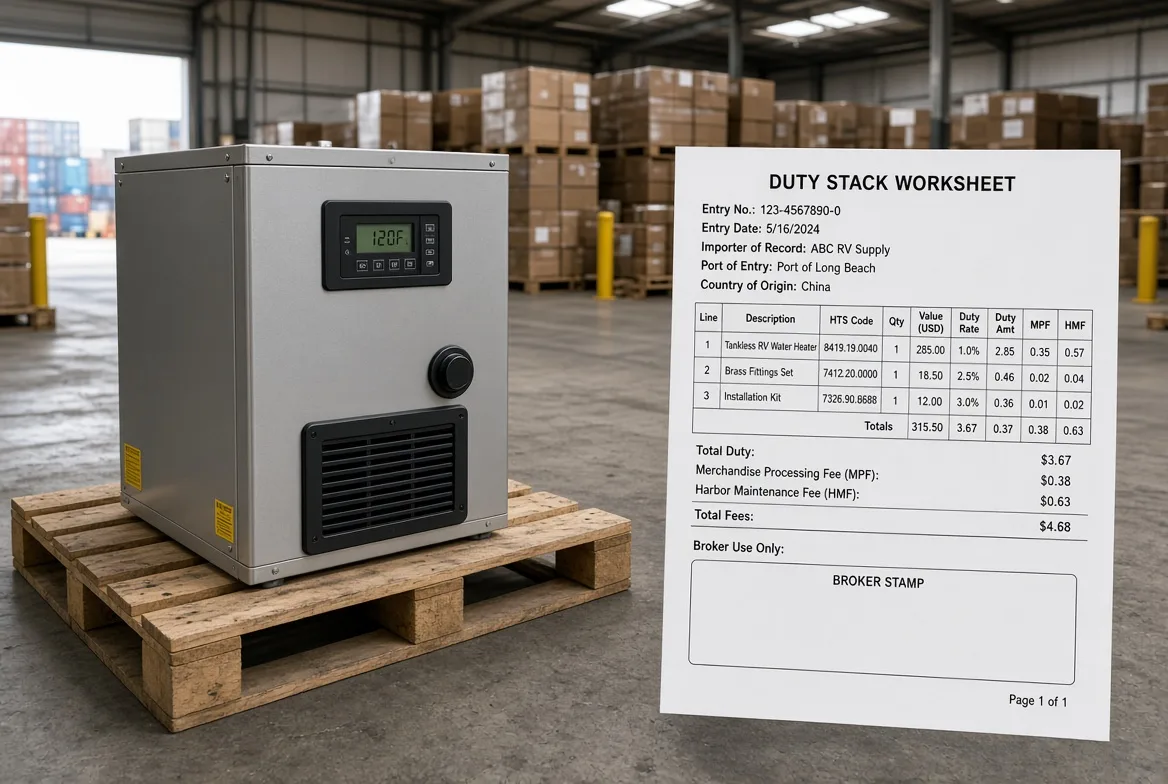
HTS 8419.11 is the reference classification for a tankless RV water heater used for internal modeling and stress testing. It is a working example, not a broker ruling.
Model a 40-unit ocean container of Chinese-origin, Foshan-manufactured tankless RV water heaters to break a vague “duty” estimate into auditable lines:
- Base duty per the live USITC rate for HTS 8419.11
- Section 301 overlay for Chinese-origin goods, Chapter 99 dependent
- MPF at 0.3464% of entered value, subject to the annual minimum and maximum thresholds
- HMF at 0.125% of entered value, ocean shipments only
- Flat-rate customs brokerage entry fees
The rate basis is the trap. Under 19 CFR 24.24, HMF applies to the entered value of ocean shipments, while air freight is exempt from HMF but still subject to MPF. Spreading the fixed MPF minimum across a full container reduced effective per-unit MPF cost in the modeling.
Keep the product description identical across the invoice, packing list and HTS record, and attach the full certification packet for broker release. One shipment with a missing certification document was held 48 hours and pulled for a manual port exam.
Verification check: confirm the duty-stack order, the MPF and HMF math, the brokerage estimate and the per-unit amortization, with zero ambiguous lines. Confirm importer-of-record duties against CBP importer guidance before you accept DDP terms.
⚠️ Warning: Reusing a residential water heater HTS code triggered an unplanned 25% Section 301 rate on a past heater shipment. Treat HTS 8419.11 as a modeling checkpoint only.
Step 4: Engineer Carton Geometry Into Freight Allocation
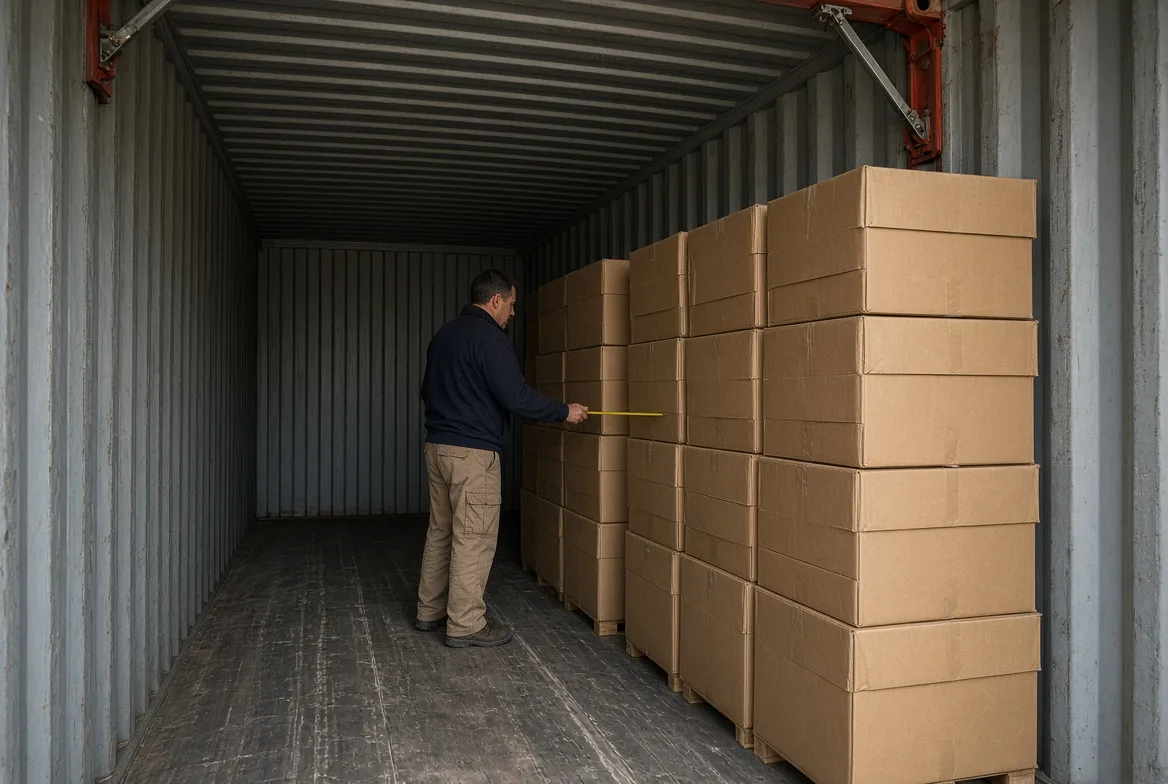
Hidden freight waste usually sits in the carton. Bulky RV appliances — refrigerators, rooftop ACs, tankless water heaters — cube out a container long before they hit a weight limit. Better packaging geometry lowers per-unit freight without raising damage.
Container volume math runs in four steps:
- Calculate each carton’s CBM from exact length, width and height in metres.
- Set usable volume at 67 to 69 m³ for a standard 40ft high-cube.
- Divide usable CBM by single-carton CBM for a theoretical count.
- Adjust for stack gaps, void loss and damage thresholds — always model the practical count, not the theoretical one.
The real-world case: redesigning nested cartons for tankless water heaters to BC double-wall corrugation with reinforced corner bracing replaced a weak B-flute carton. The stronger design allowed three-tier vertical stacking instead of two, with no bowing, and cut per-unit ocean freight by $18.40 with no rise in damage rate.
Q: What failed in the original carton?
Answer: Standard B-flute cartons bowed under vertical load and failed in wet stacking conditions, which capped stack height and wasted container space.
Q: What changed in the redesign?
Answer: Double-wall BC flute, reinforced corner support and a tighter nested footprint removed the bowing and enabled full-height stacking.
Q: How is the redesign monitored after the change?
Answer: Transit damage rates are tracked against the gates on the quality control page, backed by regular container stack simulation.
Allocate freight by dividing total container ocean freight by the practical unit count. Floor-loaded 40HQ layouts give the best cubic efficiency for standard OEM orders; palletized and mixed-SKU loads speed receiving but cost volumetric efficiency and suit retail or cross-dock programs.
⚡ Power move: Container math and stack validation take about 25 minutes per SKU — faster than the days of supplier guesswork they replace.
Step 5: Force Every Accessorial Fee Into the Freight Waterfall
A headline FOB or DDP quote hides layered accessorials, and those layers cause almost every post-shipment overrun. Unbundle each expense line or the model will understate exposure.
The full accessorial checklist:
- Ocean linehaul freight
- Origin port handling
- Destination port fees
- Customs brokerage and port exam fees
- Demurrage and detention
- Chassis split and clean-truck surcharges
- Drayage and transload
- Rail or intermodal transit
- Final-mile delivery to the plant or DC
- Cargo insurance premium
For DDP quotes, unbundle four things before comparing: the importer-of-record, the customs bond applied, the HTS assumptions embedded in the price, and whether accessorial overruns pass to the buyer.
Freight charge oversight sits with the Federal Maritime Commission, which is useful context when demurrage and detention policy is disputed.
Shipments to the Midwest RV manufacturing clusters add three to five transit days and $900 to $1,400 in container-level delivery fees — costs almost always excluded from a standard quote.
⚠️ Warning: One client accepted a DDP quote at a $0.82 per-unit premium to avoid managing logistics. Two days of demurrage and an undisclosed chassis split added $1,140 in unbudgeted container cost, erasing the premium entirely.
Verification check: produce a fully burdened delivered cost to your exact destination, with every assumption assigned to buyer, supplier, broker or forwarder. Any TBD line means the quote is unvalidated.
Step 6: Build the Margin Bridge and a TCO Scenario Matrix
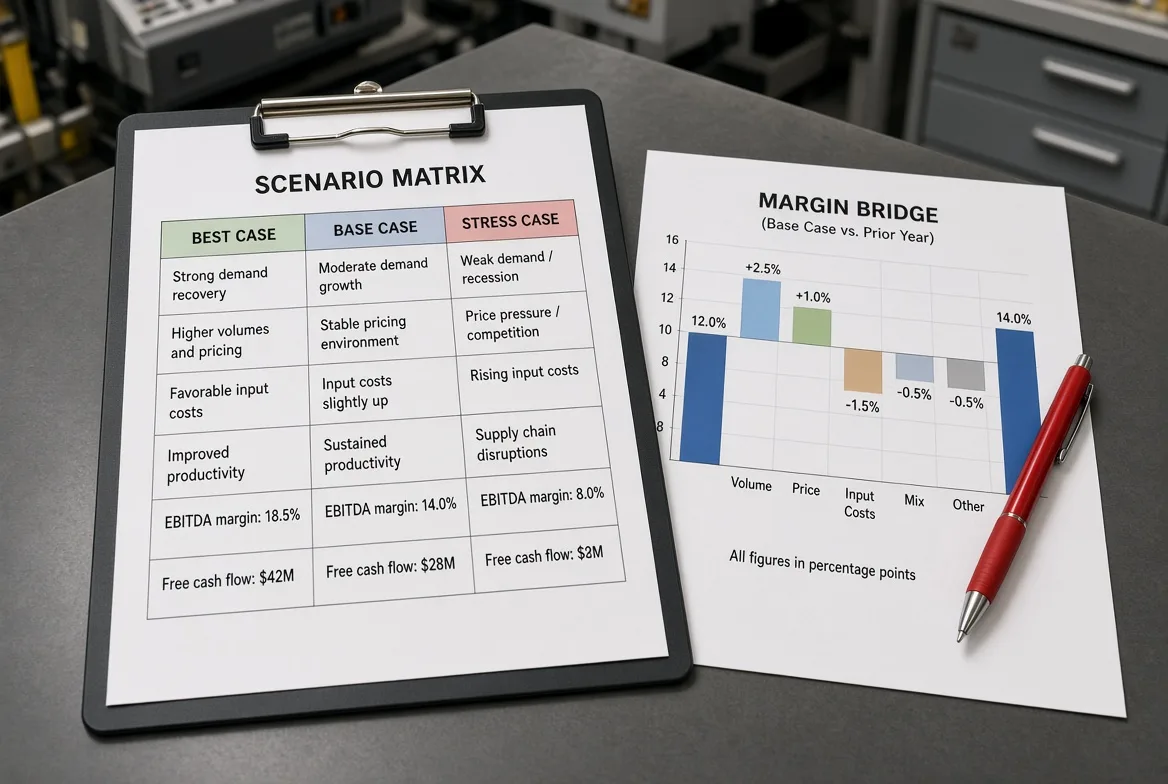
A headline FOB price looks profitable until amortized program costs and total cost of ownership enter the picture. Warranty reserves, spare-parts obligations and one-time development costs regularly turn a bookable SKU into a loss-maker.
Add these program costs to the margin calculation:
- Tooling and NRE amortization
- Third-party testing and certification amortization
- Custom packaging redesign
- Initial spare-parts provisioning
- Planned warranty reserve
- Field-failure contingency
- Ongoing service support overhead
The amortization formula is one line: per-unit amortized cost = one-time program cost ÷ total sellable units over the recovery window. An $18,000 tooling cost is $15 per unit across 1,200 launch units, but $2.25 per unit across 8,000 steady-state units. The recovery window moves the margin more than the price does.
Prioritize TCO by role: RV OEMs watch line-down risk from spare-parts delay and component failure; distributors watch inventory buffer and fill rate; retail programs watch service-kit completeness and packaging damage.
Michelle Wang, who works on appliance product-line and aftermarket part planning, adds a fourth view: the spare-parts allocation is a procurement line item, not an afterthought, and it belongs in the model from day one.
Run every program across three scenarios:
- Best case: optimized freight, no port exams, minimal field failure
- Base case: standard accessorials, average failure rates
- Stress case: demurrage or exam holds, elevated warranty claims
Close with one decision per SKU: approve, renegotiate, redesign packaging, switch Incoterm, or reject. Lock a formal gross-margin floor and a walk-away threshold, and document the negotiable levers.
⚠️ Warning: One SKU cleared approval at a 19% base-case margin but fell to 11% in the stress case. The matrix steered the team to renegotiate spare-parts terms instead of signing a high-risk PO.
Troubleshooting: Where Landed Cost Models Fail After Sign-Off
Sourcing margin collapses usually trace to trusting a headline quote over a full landed cost audit. These four failures cover most of it.
1. Landed cost lands 10% over budget after arrival
Cause: the quote excludes chassis splits, port exams, demurrage, detention and destination handling.
Fix: rebuild the costing with an assigned owner for every accessorial and a destination-specific lane assumption.
2. Early cubing spikes per-unit freight
Cause: suboptimal carton dimensions, weak burst strength or invalid stacking rules cut container utilization.
Fix: re-run 40HQ volumetric modeling with optimized geometry and stack factors before the PO is approved. Tooling and packaging changes get harder after the second manufacturing run.
3. Customs stalls or issues an unplanned duty invoice
Cause: a guessed HTS code, unassessed Chapter 99 exposure, a wrong MPF or HMF basis, or an incomplete certification packet.
Fix: mandate a broker classification review, document the full duty stack and attach the complete compliance packet to the sourcing file. The gates behind that packet are on the quality control page.
4. The model looks profitable, then field failures erase the margin
Cause: no warranty reserve, no spare-parts buffer and unaccounted service delay.
Fix: return to Step 6 and recalculate full TCO before approving a reorder or renewal. The service side of that exposure is documented on the after-sales page.
💡 Diagnostic signal: demurrage and port exams cause the majority of overruns. Pre-file the customs entry and pre-book destination drayage before vessel departure to cut hold risk.
Conclusion: Discipline Beats the Spreadsheet
The value of a CFO-grade landed cost model is repeatable audit discipline, not a static file. This six-step SOP standardizes RV appliance costing and removes guesswork from supplier quotes, Incoterm choice and margin planning.
Run the full audit on your next active SKU family and compare the audited landed cost against the supplier’s headline FOB or DDP price. The gap is where unnegotiable risk and untapped margin hide.
Set a quarterly governance cycle: refresh tariff rates, freight lane pricing, compliance rules and warranty assumptions, especially when sourcing geography shifts. The control gates that feed the model are set out on the quality control and manufacturing pages.
For a second-opinion review of your model, bring the workbook and a closed shipment to the Gulfstone contact page.
Sourcing disclosure: The shipment data here comes from Gulfstone records and anonymized client programs. Cost ranges vary with your SKU mix, volumes, certification scope and shipment setup, so recreate the benchmark from your own quote history. I receive no manufacturer kickbacks for these findings.
Frequently Asked Questions About Landed Cost for RV Appliances
1. What is landed cost for imported RV appliances?
Landed cost is the fully burdened per-unit delivery cost for OEM, wholesale and retail RV appliance programs. It includes tariffs, variable freight allocation and amortized tooling and certification costs — not basic parcel shipping. This six-step audit takes 60 to 90 minutes per SKU family.
2. What HTS code applies to RV rooftop air conditioners?
RV rooftop air conditioners align with a Chapter 84 classification checkpoint based on cooling function, 12V or 120V electric power, rooftop vehicle integration, a self-contained compressor architecture and Chinese origin. Final coding always requires licensed broker verification before filing.
3. What is the import duty on Chinese-origin tankless RV water heaters?
Duty stacks in sequence: base HTS 8419.11 duty, any applicable Section 301 tariffs, a 0.3464% MPF fee and a 0.125% HMF ocean fee. Final cost depends on live USITC rates and Chapter 99 eligibility, so confirm with a customs broker. A residential water heater code cannot be substituted for the RV-specific classification.
4. How do I compare FOB and DDP pricing for RV procurement?
Unbundle every DDP quote to verify importer-of-record status, customs bond usage, embedded HTS assumptions and how accessorial overruns pass through.
Buyer-controlled FOB gives full cost transparency; reserve DDP for suppliers who fully assume logistics and compliance risk. The OEM and ODM page covers how a program is structured around that choice.
5. Why do landed cost models run over budget?
Most overruns come from unplanned demurrage, chassis splits and CBP port exams — the accessorials a headline quote omits — rather than the ocean linehaul rate. In the 85-shipment dataset, FOB-only quotes landed 8 to 14% over budget. Assign every accessorial to an owner and model the destination lane before approval.

Forward
Co-founder & General Manager, GulfstoneGas appliance manufacturing and certification
Most of what decides a gas appliance is settled before anything is built — on the drawing, at the cut-out, in the tolerance someone chose for the gas path. I have spent my working life on the manufacturing side of that decision, and this is where I write down what it has taught me.
Nothing here is written from a sales desk. Every note comes off the floor: a batch held until a reason was found, a fitting that failed in transit, an approval path that only made sense once the destination market was fixed. If you read these first, the opening conversation starts at the standard rather than at the beginning.
- Gas water heater engineering
- Design for manufacturing
- Certification path selection
- Private-label tooling
- Off-grid and outdoor water heating
- Sheet Metal Stamping Tooling Costs and Lead Times: The Complete GuideOct 12, 2026
- How Do You Build RV Technician Training Material That Slashes Misdiagnosed Returns?Oct 11, 2026
- How Do You Build a High-Coverage RV Water Heater Spare Parts Kit for Fleets and Dealers?Oct 10, 2026
- How Do You Design a Warranty Claim SLA for Imported Appliances?Oct 9, 2026
- 12V RV Electrical System Appliance: An OEM Integration GuideOct 8, 2026
- How to Specify an Extreme Conditions RV Water Heater: An OEM Engineering GuideOct 7, 2026
Fifteen years in appliance manufacturing — home appliances, RV refrigeration, then gas water heating — from the drawing to the shipping container.
Leads Gulfstone's design-for-manufacturing reviews and the certification path selected for each destination market.
Works directly with OEM and private-label buyers on tooling, tolerances and the approval file.