Table of contents
- Key Takeaways
- What a Portable Outdoor Gas Water Heater Actually Is?
- How a Portable Propane Tankless Water Heater Works?
- The Safety and Control Stack Behind Every Unit
- Q&A with Gulfstone’s Head of Thermal Engineering
- Factory Acceptance Test: What Every Production Lot Must Pass?
- What Each Buyer Role Must Verify Before Ordering?
- Factory-Direct Sourcing Benefits That Survive an Audit
- Real-World Limitations and Their Root Causes
- Supplier Red Flags and the Audit Criteria That Catch Them
- Final Thoughts: Verification Beats Sales Copy
- Frequently Asked Questions About Portable Propane Water Heaters
- 1. Are portable propane water heaters reliable based on user reviews?
- 2. Is an electric instant water heater a better alternative?
- 3. Can portable propane water heaters run during a power outage?
- 4. How do I select a qualified outdoor water heater manufacturer?
- 5. What is a normal defect rate for portable propane water heaters?
A note on the figures. The defect rates, unit counts and factory findings below come from Gulfstone production and quality-control records in Foshan, plus teardowns of field-returned portable and RV water heater units. Client-identifying details are withheld, so read them as evidence of a pattern, not an industry benchmark.
Key Takeaways
- Qualify an outdoor water heater manufacturer on verifiable compliance files, standardized process control and real field-defect data, never on consumer reviews.
- Confirm the certification scope names the portable standards CSA 11.3 and ANSI Z21.96. CSA 4.1 covers only fixed tank-type units and cannot be substituted.
- Enforce a six-stage factory acceptance test that includes 150 PSI hydrostatic pressure testing and helium micro-leak screening on every brazed joint.
- Automated inline quality control held the outgoing defect rate below 0.18% across 45,000 mass-produced portable units.
- Mixed-container consolidation trims ocean freight 15–25% on bulk OEM orders, which usually outweighs the lowest ex-factory quote.
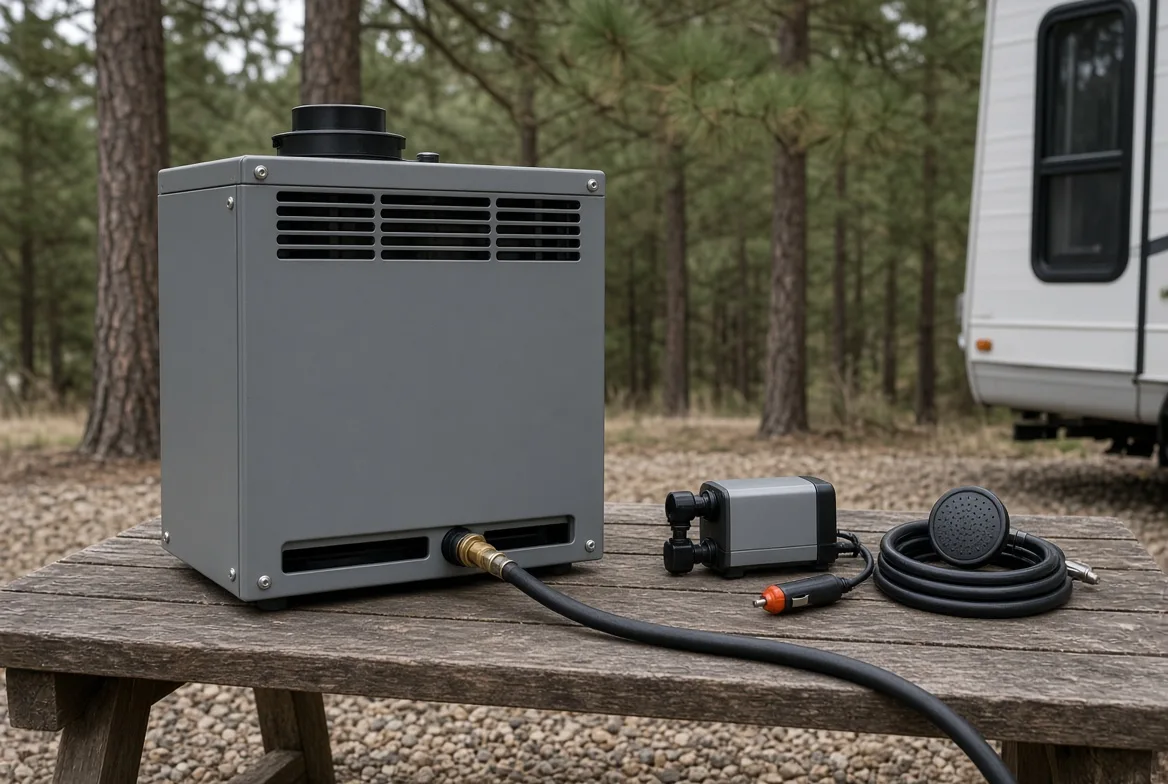
Customer reviews surface real field failures such as wind flameouts and freeze damage. They cannot verify factory welding precision, batch color consistency or customs eligibility.
A qualified outdoor water heater manufacturer earns a shortlist place through documented compliance, engineering controls and transparent failure-rate data.
This is a factory-level sourcing guide for OEM and procurement teams, covering portable propane tankless water heaters, off-grid hot water systems and professional OEM/ODM decisions. It does not rank consumer products.
Since 2018, Gulfstone has audited 60+ certified Guangdong factories and independently purchased sample units for teardown. Judgment rests on production and QC data, not sales materials.
One recent audit found a batch of field units developing surface rust within eight months, because the powder coating measured 42 microns against a 60-micron industrial specification.
Full product specifications and factory validation capability are set out on the portable gas water heater page.
What a Portable Outdoor Gas Water Heater Actually Is?
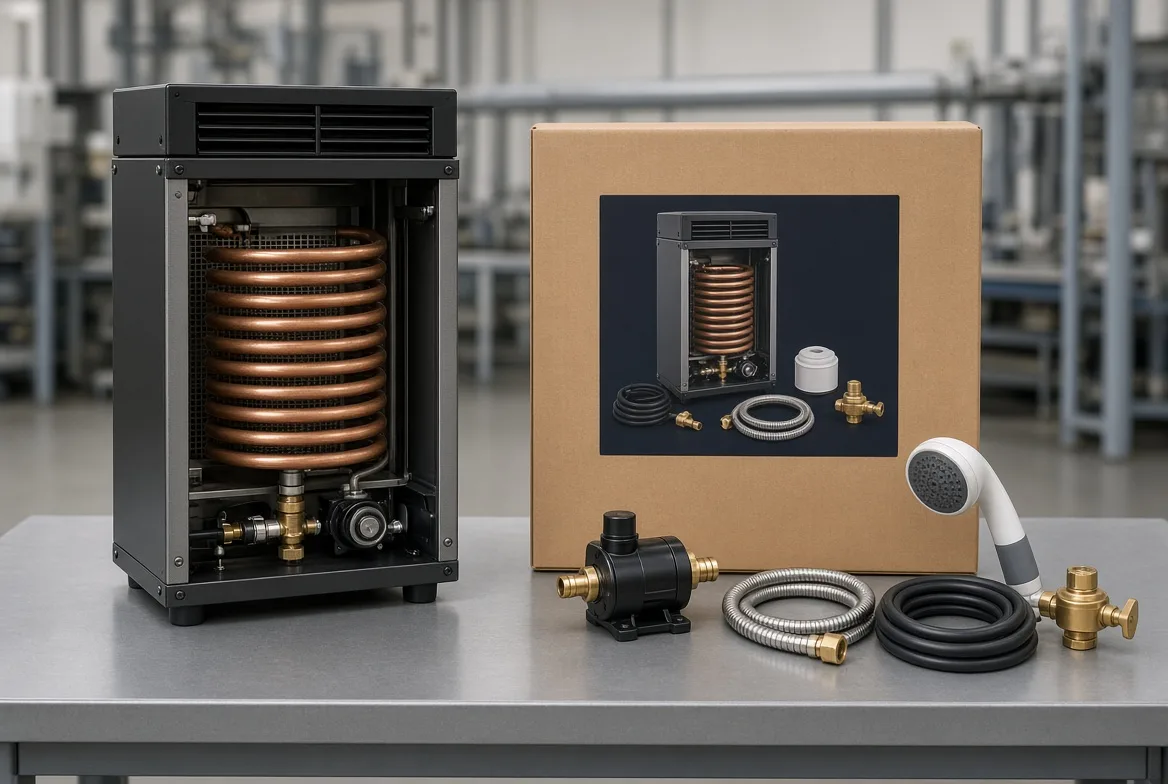
A portable outdoor gas water heater is a tankless, on-demand hot water appliance built for open-air operation, remote wash stations, RV hookups and off-grid showers. Product configurations fall into two categories: a standalone heater chassis, or an integrated pump-and-shower bundle.
Confirm the exact configuration before comparing quotes, because a chassis-only quote and a bundled-kit quote are not the same product scope.
Manufacturer, intermediary or assembly workshop?
Genuine manufacturers own the full production workflow: in-house testing facilities, BOM management, product traceability and official compliance documentation. Trading companies and sourcing intermediaries coordinate orders and inspections but do not control the lines, the test benches or the revision history.
A legitimate factory will volunteer welding procedure specifications and raw copper material certificates. An intermediary supplies a generic catalog and stock photos of a line it does not manage. For buyers who want a vetted channel rather than spot buying, the supplier partnership path sets out how a factory-direct relationship is structured.
Core product architecture
A complete system is a gas inlet regulator assembly, burner unit, heat exchanger, water circulation circuit, ignition and control system, exhaust structure and outer enclosure, plus matched accessories.
The heat exchanger is the core functional component. Most high-quality portable units use 99.9% oxygen-free copper for heat transfer and corrosion resistance. Lower-cost builds fall back to stainless steel (slower transfer) or aluminum (lightweight but prone to coastal pitting).
Ignition modules are the other differentiator. Wind tunnel testing shows low-grade modules fail frequently after 40 startup cycles, while certified units hold consistent ignition across variable outdoor conditions.
Bulk orders rarely ship as bare heater units. A complete configuration needs matched pumps, shower head assemblies, precision regulators, reinforced hoses, retail packaging and after-sales spares, and a missing accessory can halt an RV line for a full shift.
For an off-grid cabin project, dual-pump kit upgrades added two days of assembly time but cut field failure rates by half.
⚠️ Standard classification trap: Portable units sit under CSA 11.3 and ANSI Z21.96; CSA 4.1 covers only fixed tank-type heaters, so the scopes are not interchangeable. Verify the exact standard on every test report — customs detains shipments over a misapplied scope.
How a Portable Propane Tankless Water Heater Works?
A CSA-certified safety claim is credible only when the supplier provides valid, in-date certification file numbers, confirms alignment with the portable standards, and keeps production controls tight enough that shipped units match the certified sample. Gulfstone verifies all three before approving a quotation.
The operational sequence is straightforward. Cold water enters the unit and a flow sensor triggers ignition once the flow threshold is met. The gas valve opens to the burner manifold and combustion begins.
Heat then transfers through the heat exchanger coil, and the control board modulates gas and water flow to stabilize outlet temperature while safety monitors watch the cycle.
Thermal and fluid system architecture
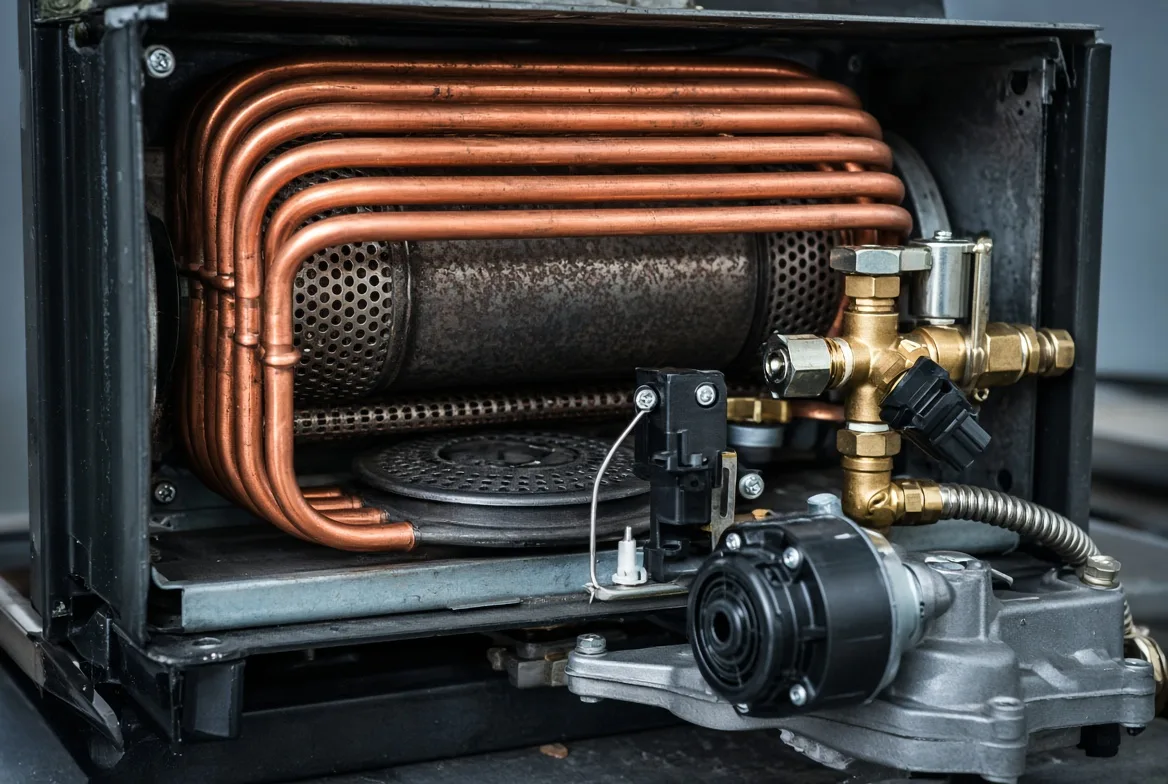
Oxygen-free copper is the preferred heat exchanger material: about 400 W/mK thermal conductivity, fast transfer and strong resistance to hydrogen embrittlement. Gulfstone enforces a 0.8 mm wall thickness for structural durability without sacrificing transfer.
Staggered multi-port burner layouts beat single-row burners by spreading flame evenly across the coil surface. Even distribution removes localized hot spots and extends heat exchanger service life.
The water circuit runs bottom-in, top-out so the coil absorbs heat gradually, and a built-in bypass valve mixes cold inlet water to suppress outlet temperature spikes.
Where does low pressure break the system?
Most portable units need a minimum 8 PSI inlet pressure and 0.5 GPM flow to wake the control board and ignite. Propane manifold pressure must hold 11 inches of water column; dropping below 9 inches destabilizes flame height and swings outlet temperature.
Thermistor response is the quiet failure point. Slow-response sensors once produced 25°F outlet swings during flow or inlet changes. Upgraded 10K NTC fast-response sensors paired with PID control logic hold fluctuation to about 6°F, without an oversized burner.
Incoming pressure and combustion quality are checked against the same gates used on the incoming inspection line.
The Safety and Control Stack Behind Every Unit
Portable water heaters rely on independent, chained safety mechanisms. Each one protects against a different failure mode, and none can be treated as optional.
- Flame failure protection. The system delivers 3–5 ignition sparks per second and shuts the gas valve within 8 seconds if no flame is confirmed, preventing unburned gas accumulation.
- Over-temperature cutoff. When outlet water exceeds 185°F, the thermistor triggers full gas valve shutdown and system lockout to prevent dry burning.
- Low-flow and dry-burn protection. The system shuts down within 3 seconds if flow drops below 0.3 GPM, or if the burner activates with no water circulation.
Sub-zero freeze protection
Premium units integrate a solenoid drain valve. When ambient temperature drops to 35°F, the solenoid opens and drains roughly 120 mL of residual water from the coil, preventing freeze cracking at the brazed joints. The valve stays closed during startup until stable flow is confirmed, which avoids false drains.
🧠 Expert insight: Copper thermal conductivity sets heating efficiency, but precision brazing quality is what prevents micro-leak failures. Every brazed joint should be inspected under 10× magnification before it leaves the bench.
Q&A with Gulfstone’s Head of Thermal Engineering
Q: Why prioritize oxygen-free copper for portable unit heat exchangers?
Answer: Oxygen-free copper brazes cleanly and resists hydrogen embrittlement. Its conductivity supports a compact coil while holding efficient transfer. Stainless steel alternatives add weight and cost with inferior thermal performance.
Q: What brazing clearance prevents micro-leaks without adding thermal resistance?
Answer: Gulfstone enforces a strict 0.05–0.10 mm joint clearance window. Overly tight gaps block alloy wicking, while excessive gaps create voids, and both cause long-term leakage. Every joint is validated by helium mass spectrometry.
Q: Which brazed joints are most vulnerable to vibration and thermal shock?
Answer: The burner manifold inlet and the coil return bend see the highest temperature differentials and vibration stress. Both are reinforced with strain relief loops and full fillet inspection.
Q: How does the anti-freeze solenoid behave at startup and shutdown?
Answer: On shutdown the solenoid runs for 90 seconds below 37°F ambient to drain residual coil water. It stays closed during startup until stable flow is detected, and the system raises a lockout fault if the solenoid sticks.
Q: What failure indicators demand a valve logic or sealing revision?
Answer: Water pooling in the burner chamber, freeze cracks near the coil return bends, solenoid current draw above 0.5A, and repeated lockouts after cold soaking. These point to degraded sealing or flawed control logic.
Factory Acceptance Test: What Every Production Lot Must Pass?
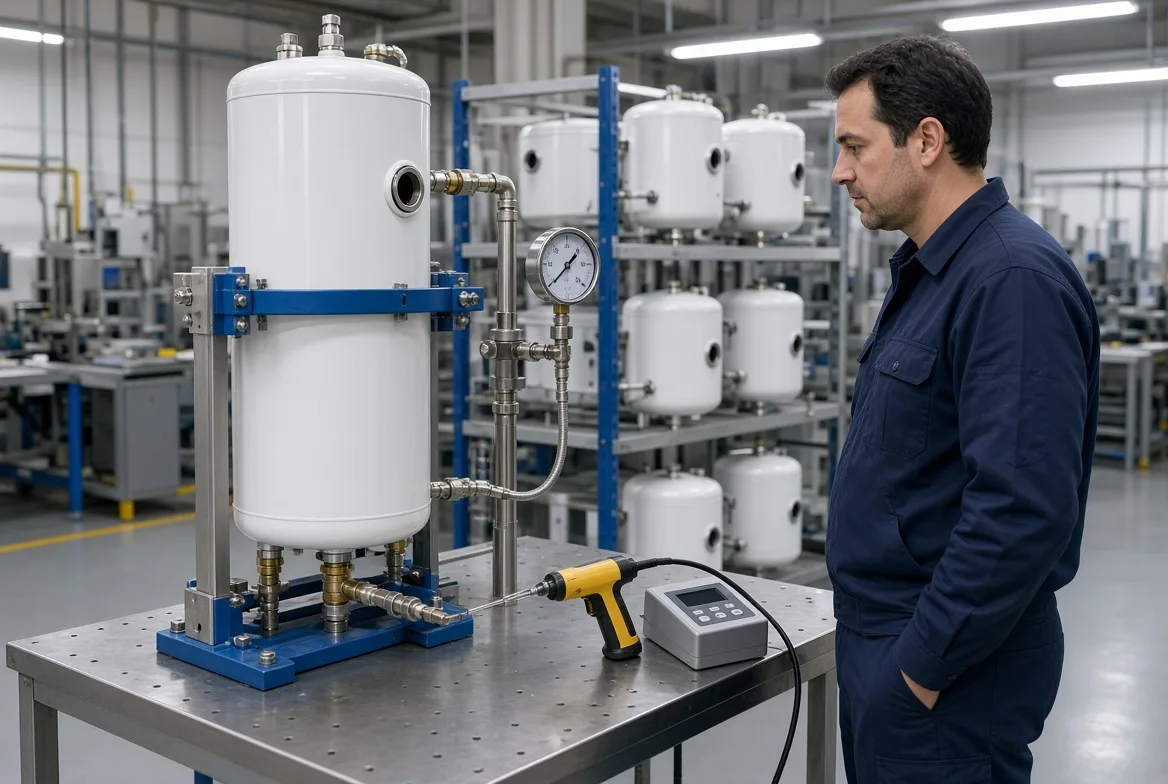
Trade-show samples do not represent mass production. Gulfstone runs every lot through a standardized six-stage factory acceptance test, and each stage is a pass/fail gate rather than a formality.
- Incoming material and dimensional verification. Inspect BOM authenticity, certification label accuracy and accessory completeness. A non-conforming label or a missing accessory halts lot release.
- 150 PSI hydrostatic pressure testing. Hold 150 PSI across the internal circuits for 60 seconds to screen for weak joints, thin-wall defects and assembly damage.
- Helium mass spectrometry screening. Vacuum-test every brazed joint to catch micro-leaks a standard gas sniffer will miss.
- Live fire safety verification. Validate ignition pulse stability, flame-failure shutdown, over-temperature protection and low-flow cutoff. Non-conforming units go to mandatory rework.
- 25 MPH wind tunnel testing. Simulate strong crosswinds to verify flame retention and automatic reignition under outdoor conditions.
- Final burn-in and lot release. Run full operational burn-in, calibrate control parameters, assign serial numbers, verify carton completeness and sign off the lot.
The protocol was rolled out with input from Justin Peng, an OEM manufacturing technical advisor on mass-production test protocols for gas-fired consumer appliances.
📈 ROI check: Pull 90 days of return data. If “ignition failure” and “missing accessory” are the top reasons, the problem is system integration quality at the supplier, not the field.
What Each Buyer Role Must Verify Before Ordering?
Different roles carry different verification burdens. A single checklist applied to all three wastes effort and hides the gaps that matter most.
- Sourcing executives request valid CSA file numbers, confirmed portable-standard compliance and a formal production control plan.
- Product engineers audit brazing tolerance data, thermistor response curves and complete FAT test logs.
- RV integration teams verify mounting hole layouts, anti-vibration data, plumbing thread specifications and freeze-drainage performance.
Michelle Wang, whose remit spans appliance product-line definition and aftermarket part planning, describes the same split from the portfolio side: buyers who audit the parts list and the service plan early reach a signed drawing faster.
Factory-Direct Sourcing Benefits That Survive an Audit
Factory-direct pricing only creates margin when the factory controls compliance, defect screening, accessory integration and container loading. A low unit price means nothing if the shipment is detained or the field warranty rate climbs.
1. Pre-shipment compliance risk is removed
Qualified manufacturers supply batch-matched certification files, current test reports, compliant label artwork and valid NRTL listing marks such as UL for every order. The full certificate set is catalogued on the certifications page.
Gulfstone cross-checks the certification scope line against current standard requirements before shipment. Most customs detentions trace to expired certifications or misaligned scopes, not physical defects.
2. Return and after-sales friction drops
Factory-integrated kits remove compatibility gaps between pumps, shower accessories and the main heater. Pre-calibrated low-pressure startup at a 0.5 GPM minimum cuts on-site setup error, which shows up directly in support tickets and returns. The service side of that work is covered on the after-sales page.
3. Real engineering customisation is available
Logo printing is entry-level. Qualified manufacturers deliver DFM-optimized mechanical changes: custom mounting patterns, thread adjustments and drainage path redesigns. Full ODM housing and control development supports RV OEM programs, with tiered tooling costs, lead times and MOQ rules stated up front.
4. Margin is protected through order structure
Tiered MOQs, 48-hour sample support and stable lead times improve capital turnover. Low-volume trial MOQs let a buyer validate a SKU before committing a full container. Mixed-container consolidation and accessory bundling trim freight 15–25%.
Itemized pricing tied to real-time metal indexes protects margin far better than a lump-sum lowball quote.
The defect-rate benchmark that changes the math
Across 45,000 mass-produced portable propane water heater units, automated inline quality control held the outgoing defect rate below 0.18%. That single figure stabilizes launch confidence, reduces retail chargebacks and lowers warranty reserve capital.
Against the 1–2% typical of manually inspected lines, a 0.18% outgoing rate delivers materially better batch stability. The control gates behind that number are documented on the quality control page.
Real-World Limitations and Their Root Causes
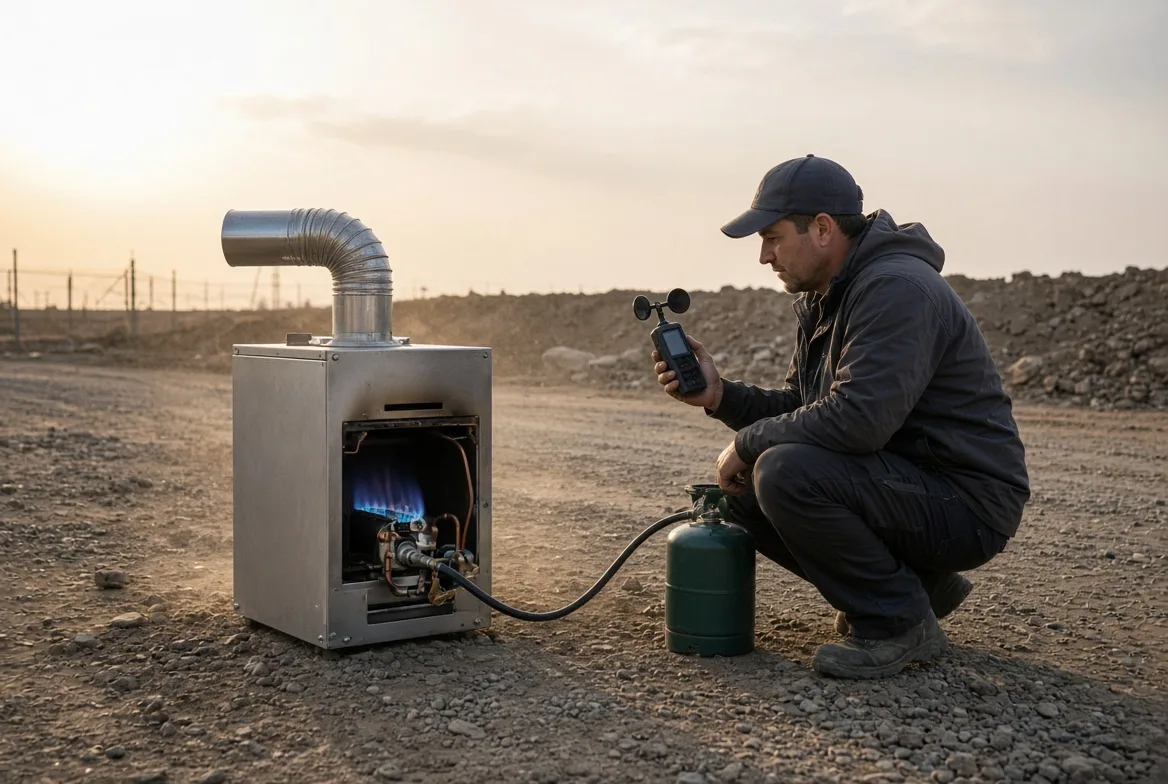
Portable propane water heaters carry inherent outdoor constraints: wind flameouts, freeze damage, temperature drift, ignition faults, sensor cutoff errors and compliance-related shipping risk. Gulfstone buys its own test samples and accepts no manufacturer incentives, so the failure analysis stays unbiased.
Wind, freeze and low-pressure instability
Open-air combustion enables portability but invites wind vulnerability. The 25 MPH wind tunnel test is a mandatory pass/fail gate, yet sustained extreme gusts can still cause flame lift and thermocouple dropout above 20 MPH.
Residual water left in the coils freezes below 32°F and cracks the brazed return bends irreversibly. Inlet pressure under 8 PSI prevents startup entirely. All field operations must also comply with NFPA 58 propane storage rules.
Temperature drift and battery runtime
The control board modulates gas and water flow to hold temperature, but fluctuating inlet conditions produce some output variation. Fast-response sensors resolve extreme swings. Integrated pumps run on battery power, so continuous runtime is capped and the system shuts down once the battery is depleted.
The root causes behind field returns
Across the 45,000-unit field dataset, failures cluster into two groups: ignition anomalies (module drift, electrode gap deviation) and thermal sensor faults (thermistor drift, blocked circulation).
Automated factory testing suppresses production defects to 0.18%, but freeze damage and setup error in the field remain outside the factory’s control.
The vibration, freeze and brazing failure modes above were reviewed during teardown work with Fugang Zhu, who runs failure analysis on gas heating assemblies.
Supplier Red Flags and the Audit Criteria That Catch Them
The fastest way to disqualify a supplier is to ask for documents an assembler cannot produce. A real factory has them on hand; an intermediary has to go and ask someone else.
- Vague certification claims with no verifiable file numbers.
- No wind tunnel validation records for flame retention.
- Missing helium micro-leak logs and hydrostatic pressure test reports.
- Undefined freeze protection operating procedure.
- No formal spare-parts replacement and after-sales plan.
🛡️ Mitigation strategy: Mandate a review of FAT logs, current CSA standard scope documents and a written freeze protection procedure before any deposit changes hands. Buyers who skip this step discover the gap at the port, not at the sample table.
💡 Diagnostic signal: A supplier who cannot produce a dated, lot-traceable FAT record has never run one. The absence is the finding.
Final Thoughts: Verification Beats Sales Copy
Gulfstone provides OEM and ODM customisation backed by verifiable compliance pathways, standardized process control, validated FAT protocols and complete after-sales readiness. Logo printing and color changes are not manufacturing support.
For a procurement team, the best partner is not the cheapest or the most marketable. It is the factory with engineering discipline and fully documented quality control. Shortlist against criteria you can audit:
- A clear product category definition under CSA 11.3 and ANSI Z21.96, with no misapplied tank-type certification.
- Valid, current certification file numbers and complete test reports.
- Direct factory ownership of production lines, test benches and revision history.
- Signed, dated, lot-traceable six-stage FAT records.
- Transparent component specifications: copper grade, wall thickness and brazing standards.
- Authentic defect-rate data from automated inline control.
- Reasonable MOQ tiers and predictable lead times.
Validate scope, audit FAT workflows, review failure data and confirm tooling and spare-part policy before the order is placed. The wider production discipline behind those records is documented on the manufacturing page, and the copper and brazing material rules are covered in the OFHC heat exchanger field note.
Since 2018, Gulfstone has audited 60+ Guangdong factories, bought its own verification samples and tracked quality data across 45,000 portable propane water heater units. As certification standards tighten, the suppliers that survive are the ones with fully documented production, testing and control.
Buyers who want to build a program on those records can contact Gulfstone directly.
I receive no manufacturer kickbacks for these findings. All sourcing guidance is independently factory-validated. References to CSA, ANSI, NFPA and UL serve operational clarity only, with no sponsorship from any certification body.
Frequently Asked Questions About Portable Propane Water Heaters
1. Are portable propane water heaters reliable based on user reviews?
User feedback reflects real field failure patterns such as wind flameouts and freeze damage. It cannot verify factory-level quality control like welding precision, batch consistency or customs compliance. Treat reviews as field performance signals, not supplier qualification criteria.
2. Is an electric instant water heater a better alternative?
Electric instant heaters remove propane handling risk but need high-power electrical support. Small tank heaters suit low-frequency use, and basic unheated wash systems fit sites where gas operation is restricted. Propane portable units remain the practical choice for regular off-grid hot water.
3. Can portable propane water heaters run during a power outage?
No. The ignition system and control board both need electrical power, and integrated pumps rely on a battery with limited runtime. The anti-freeze solenoid still protects the coil by draining residual water when power is cut.
4. How do I select a qualified outdoor water heater manufacturer?
Qualify on verifiable factory data rather than price. Confirm valid CSA 11.3 and ANSI Z21.96 certification files, complete six-stage FAT records with 150 PSI hydrostatic testing and helium leak detection, direct production ownership, and authentic mass-production defect-rate data.
5. What is a normal defect rate for portable propane water heaters?
Automated inline quality control holds the mass-production defect rate below 0.18% across 45,000 units. Zero field defects are unachievable, but that rate far outperforms the 1–2% typical of manually inspected lines, which shows up as better launch stability and lower warranty cost.

Forward
Co-founder & General Manager, GulfstoneGas appliance manufacturing and certification
Most of what decides a gas appliance is settled before anything is built — on the drawing, at the cut-out, in the tolerance someone chose for the gas path. I have spent my working life on the manufacturing side of that decision, and this is where I write down what it has taught me.
Nothing here is written from a sales desk. Every note comes off the floor: a batch held until a reason was found, a fitting that failed in transit, an approval path that only made sense once the destination market was fixed. If you read these first, the opening conversation starts at the standard rather than at the beginning.
- Gas water heater engineering
- Design for manufacturing
- Certification path selection
- Private-label tooling
- Off-grid and outdoor water heating
- Top 8 Outdoor Portable Gas Water Heater Factories in China for B2B BuyersNov 4, 2026
- Custom RV Appliance Industrial Design: An OEM Brief to a Validated PrototypeNov 3, 2026
- How to Build Custom Thermostat UI Design Software for OEM Embedded PanelsNov 3, 2026
- Top 8 RV Water Heater OEM Suppliers Canada: Vetted for Volume BuyersNov 3, 2026
- Top 10 Portable Propane Water Heater Manufacturers USA: A No-Hype Buyer ShortlistNov 2, 2026
- PPWR Compliance Checklist for EU Water Heater Packaging: The 10 Documents Before the Container LoadsNov 2, 2026
Fifteen years in appliance manufacturing — home appliances, RV refrigeration, then gas water heating — from the drawing to the shipping container.
Leads Gulfstone's design-for-manufacturing reviews and the certification path selected for each destination market.
Works directly with OEM and private-label buyers on tooling, tolerances and the approval file.