Table of contents
- Key Takeaways
- Prerequisites: Product Facts and Official Sources
- Gas Water Heater Imports: 3 Steps From Code Screen to Cleared Entry
- Troubleshooting Gas Water Heater Entries: Common Faults and Fixes
- Conclusion: A Clean Entry Is a Document Set, Not a Rate
- Frequently Asked Questions About Gas Water Heater HSN Codes
- 1. What is the HSN code for a gas water heater?
- 2. Do I need the ten-digit HTSUS code or just 8419.11?
- 3. What is the difference between an HSN code and an HTS code?
- 4. When does a gas water heater leave heading 8419?
- 5. What documents does CBP need for a formal entry?
- 6. Does DOE certification apply to imported gas water heaters?
- 7. How is clearance different for a whole RV with a heater inside?
- 8. How much does the tariff stack add to a gas water heater shipment?
Key Takeaways
- A gas water heater screens to heading 8419, subheading 8419.11, statistical line 8419.11.00. The live HTSUS shows the General rate as Free.
- The six-digit HSN is shared worldwide. The ten-digit HTSUS is what CBP files, and the last four digits turn on product facts and country of origin.
- Electric units leave 8419 entirely. CBP ruling H343451 put an electric water heater module in 8516.10.00 in October 2025.
- Free is not zero. Section 301, MPF and HMF arrive after classification, and each one uses a different value basis.
- An invoice line that reads only “water heater” is the most common cause of a demurrage bill on this product.
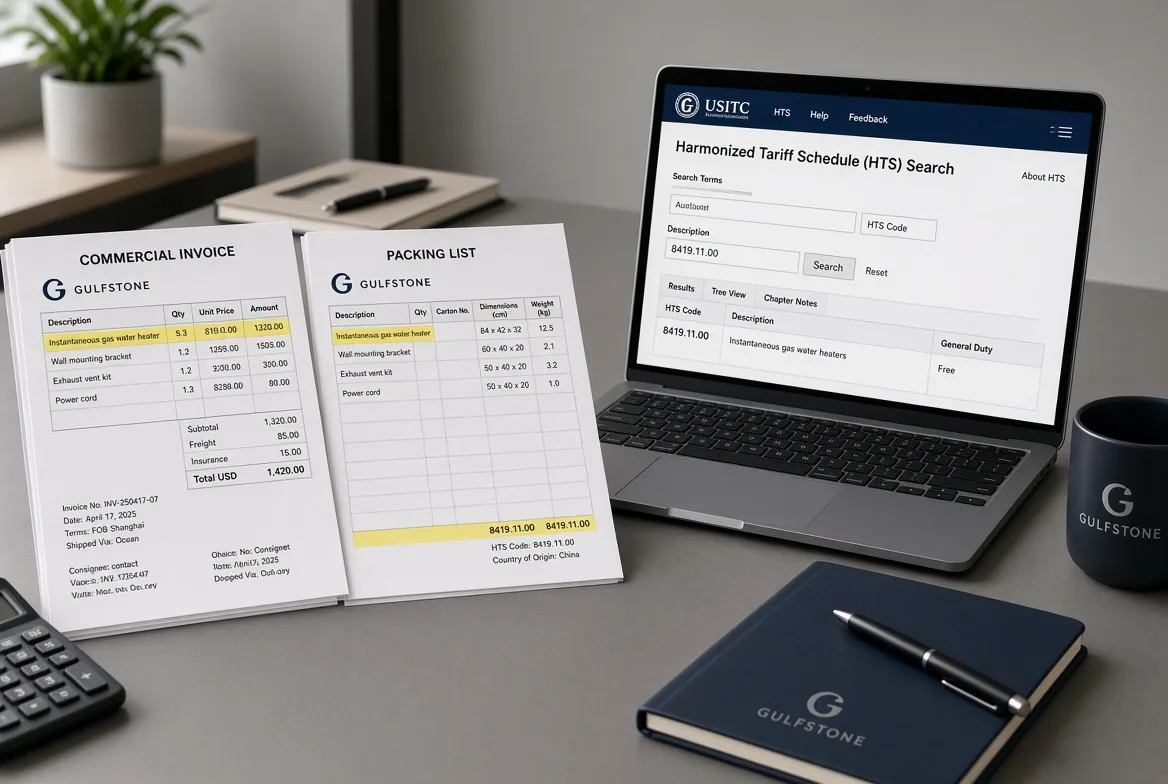
A gas water heater screens to one heading: 8419, subheading 8419.11, and in the United States the statistical line 8419.11.00. That is the starting point, not the answer. Everything difficult about the entry starts after you confirm it.
A wrong line changes the duty, the broker’s instructions and the landed cost you signed off on. A vague invoice line holds the container even when the duty is correct.
Gulfstone’s Shenzhen freight desk caught one of these before the vessel landed. A client’s invoice described the cargo as “gas water heater”. The broker filed three questions back the same afternoon.
The line was rewritten to “instantaneous gas water heater, tankless, LP gas”, the HTS line was confirmed, and the query closed. The alternative was roughly $4,500 in storage and demurrage.
Budget two to four hours of document work for a first shipment, and less for each shipment after that.
Prerequisites: Product Facts and Official Sources
Classification is a document exercise before it is a tariff exercise. Pull the spec sheet, the commercial invoice draft, the packing list and a photo of the nameplate. Without those four, you are guessing at a line that carries legal weight.
Gather these before you open the tariff schedule. Missing any one of them turns a ten-minute classification into a two-day email thread.
- Fuel type, heating method, and whether the unit is instantaneous or storage.
- Whether the heater ships alone or inside a complete RV.
- Country of origin, Incoterm, unit count and declared customs value.
- The supplier’s invoice draft and packing list draft.
- Nameplate and certification photos.
The official sources worth bookmarking are the USITC Harmonized Tariff Schedule, the CBP user fee table and DOE CCMS. CBP’s entry summary and vehicle import guidance are linked where each one comes into play.
What does HSN 8419.11 cover?
The six-digit code is the same in every country that uses the Harmonized System: 8419.11 reads “instantaneous gas water heaters”. The WCO explains the structure behind those digits. The USITC schedule adds the national digits, giving 8419.11.00.00 with a General rate of Free, a Column 2 rate of 45%, and “No.” as the unit of quantity.
Free at the General rate does not make the shipment simple. The same chapter carries a duty-free line for solar water heaters at 8419.12, and a catch-all at 8419.19.01 for non-electric water heaters that are not instantaneous gas. Two models that look alike on a spec sheet can land in different lines.
For an electronic check of the line, the USITC search returns the row directly. Screenshot it with the duty column visible, not just the description. Your broker may ask for the evidence months later.
⚠️ Caution: Electric water heaters are not 8419 products. CBP ruling H343451, issued in October 2025, moved an electric water heater module from 8419.89.95 to 8516.10.00 after a protest. The ruling also states that it does not address Chapter 99 additional duties. Read it before you assume an electric unit stays in 8419.
⚠️ Caution: Covered products need a DOE certification report filed through CCMS before the product is distributed in commerce. The importer owns that obligation, and it does not wait until the container arrives. The certification duties sit in 10 CFR Part 430.
♿ Accessibility: When you cite a screenshot in the import file, describe the row in words: “8419.11.00, description instantaneous gas water heaters, General column, Free.” Colour marks and highlights do not survive a screen reader or an exported PDF.
Gas Water Heater Imports: 3 Steps From Code Screen to Cleared Entry
The three steps below confirm the heading, price the tariff stack, and put both onto a sheet your broker can file, so the entry survives the first CBP query instead of answering it.
Step 1: Verify the Product Meets HTS 8419.11 Scope
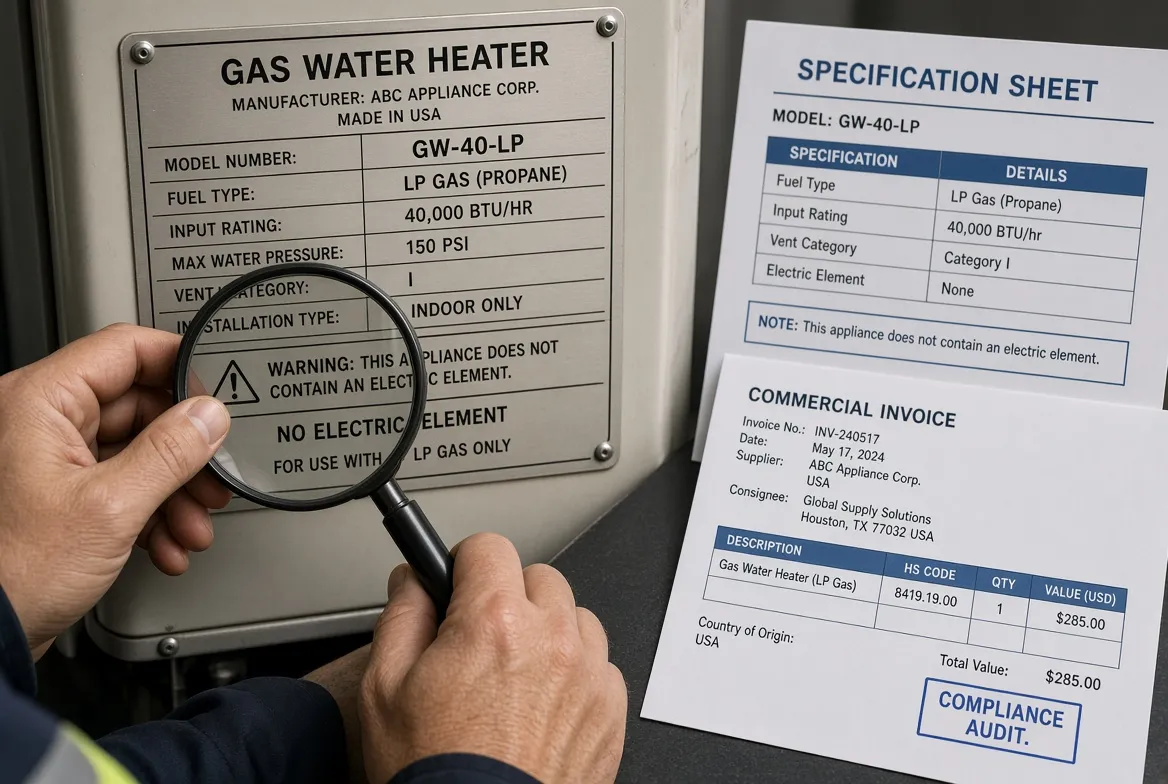
Start with the documents, not the tariff book. Read the spec sheet, the invoice draft, the packing list and the nameplate photo in that order, and check for exact wording: “instantaneous” or “tankless”, “LP gas” or “natural gas”, a flow rate in GPM, and a model family that matches across all four documents.
A line that says only “water heater” or “gas heater” goes back to the supplier. Those phrases force the broker to ask, and every question is a day.
Then run the exclusion check. If the sheet shows a heating element, 120V or 240V input, a storage tank, or a solar collector, 8419.11 is the wrong line. Storage non-electric units fall to 8419.19.01. Electric units fall to 8516.10.00. Do not let a sales name override the fuel type printed on the nameplate.
Inspector Wang handles nameplate checks on Gulfstone’s RV heater files. On a 2025 file, the spec sheet said “instantaneous gas water heater” but never named the fuel. The file stopped until the factory sent a photo of the rating plate. That photo settled the classification and took an hour to obtain.
🔬 Sensory check: A compliant nameplate shows the model number, fuel type, gas pressure, ignition type and input rating. It should carry no electric-heating language at all. The spec sheet should repeat the phrase “instantaneous gas water heater” and list a flow rate. The carton label should match both.
Write one scope sentence into the file before you move on: “Model X is a non-electric, gas-fired, instantaneous water heater using fuel Y.” Save it with the spec sheet, nameplate photo, invoice, packing list and the HTS screenshot.
When the nameplate and the spec sheet disagree, the nameplate wins, and the supplier confirms the difference in writing. The drawing and nameplate record in an OEM program is where that confirmation belongs, because it travels with the model into every later shipment.
If the facts are genuinely ambiguous, ask your broker about a binding ruling rather than guessing at a statistical suffix. A ruling takes time, but it removes the argument.
⚠️ Experience warning: In 2024 an invoice listed only “gas heater”. The broker asked three clarifying questions and pushed the filing back two days. The nameplate photo and the HTS screenshot existed the whole time; nobody had attached them.
Step 2: Screen the Tariff Stack and Assemble the Broker Packet
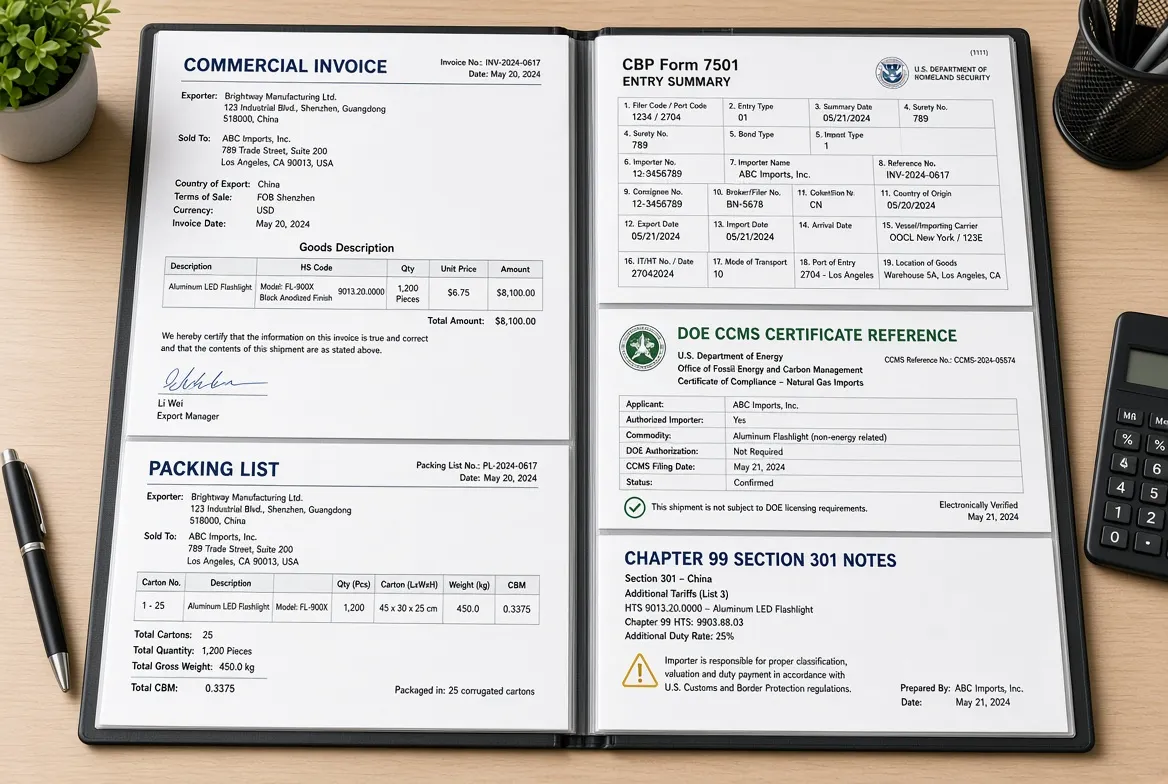
A correct heading is not a correct entry. Once 8419.11.00 is confirmed, screen the tariff stack, because this is where the surprise usually sits.
Start with country of origin. China-origin goods may carry an additional Chapter 99 duty tied to Section 301. The USTR Section 301 process and the Chapter 99 notes in the HTSUS are the source.
Read them on the filing date. A rate sheet from last quarter is stale by default, because the China-specific tariff programs have changed repeatedly since 2025.
For the origin side of the same workflow, this Hong Kong customs clearance practitioner works the China export filing ground.
Build the document packet in the order the broker will use it:
- Commercial invoice with classification and duty treatment.
- Packing list with carton count, quantity and weights.
- Bill of lading or air waybill data.
- CBP Form 7501 entry data.
- Customs bond for a formal commercial entry.
- DOE CCMS certification reference for covered products.
- HS-7 and FMVSS evidence if the heater ships inside a complete vehicle.
The invoice should carry the tariff line and the duty treatment used for entry, not only the price. Suppliers who resist this are usually copying last year’s template. Ask for the specific string: “HTS 8419.11.00, General rate Free, Chapter 99 line X, rate Y”, with the current values filled in.
⚠️ Caution: A missing CCMS certification number holds cargo. A container once sat at port for two weeks on a missing number while the factory insisted the paperwork was complete. Put the reference on the invoice itself, not in a separate email thread.
If the shipment is a whole RV rather than a loose appliance, the entry changes shape. A complete vehicle enters under HS-7 with FMVSS self-certification, and the heater inside it is not a standalone appliance line. Treat this as a branch in your workflow, not a detail you handle later.
For a standalone unit, the same packet feeds the RV OEM fitment file and the certification library. The quality-control process produces the inspection records that usually answer a broker’s first question before it is asked.
Manager Chen reviewed an invoice in 2025 that carried a 2019 Section 301 line. The rate had changed twice since. Filing it as written would have underpaid by about $3,200 and invited a penalty on top. The file went back to the supplier the same day.
📥 Download: Gulfstone keeps a commercial invoice and packing list template with the fields a broker asks for: description, HTS placeholder, model, quantity, origin and certification reference. Request it through the contact page and treat it as a starting point, not a source of live rates.
🔬 Sensory check: A clean packet reads as one document set. Model XT-200 appears with quantity 500, HTS 8419.11.00 and CCMS-12345 on the invoice; the packing list repeats the model and the quantity; the certificate reference matches every page. Nothing is highlighted, stickered or handwritten. When the lines reconcile, the broker files without a question.
Step 3: Build the Granular Landed-Cost Model
Classification and origin checks come first. Then the code becomes a purchasing tool, because the line item you just confirmed controls the duty math and the fee math that follows.
Build it in a spreadsheet first, then mirror the formula in ERP or landed-cost software once it reconciles against a closed shipment. Label every input cell with its source and date. The landed-cost audit walkthrough covers the full model; this section applies it to one product.
Run the lines in this order, because each one depends on the value above it:
- Customs value = FOB unit cost x quantity.
- Base duty = customs value x the confirmed line rate. For 8419.11.00 that is Free.
- Section 301 = customs value x the live Chapter 99 rate, if the goods and origin are covered.
- MPF = customs value x 0.3464%, subject to the current floor and ceiling.
- HMF = customs value x 0.125%, for ocean cargo.
- Freight, insurance, broker fee, drayage, chassis, ISF/AMS, inland delivery and a demurrage reserve.
Here is a 40HQ of 500 tankless RV gas water heaters at $180 FOB, with the Chapter 99 rate shown as an illustrative input rather than a quote:
| Cost line | Basis | Amount |
|---|---|---|
| Customs value | $180 x 500 units | $90,000.00 |
| Base duty | 8419.11.00, General rate Free | $0.00 |
| Section 301 | 25% illustrative Chapter 99 rate | $22,500.00 |
| MPF | 0.3464% of customs value | $311.76 |
| HMF | 0.125%, ocean cargo | $112.50 |
| Ocean freight | 40HQ quote | $4,200.00 |
| Marine insurance | quote date | $450.00 |
| Broker fee | entry and ISF | $175.00 |
| Drayage | port to CFS | $650.00 |
| Chassis | three days | $300.00 |
| ISF and AMS | filing | $125.00 |
| Inland delivery | to warehouse | $900.00 |
| Exam and demurrage reserve | contingency | $1,500.00 |
| Total delivered | 500 units | $121,224.26 |
That works out to $242.45 per unit delivered against a $180 sticker. The $62.45 gap comes from the Chapter 99 line and the accessorials together, and the reserve is there because an exam arrives whether or not the paperwork is perfect.
CBP publishes the MPF floor and ceiling on the user fee table. As of October 2026 the formal-entry band runs from $34.58 to $670.86, so the $311.76 above stands. Check the table again on filing day; the fee notice moves with the cost of living, not with your order cycle.
✅ Verification: The customs value used for duty, MPF and HMF must be the same number in every cell. If it is not, fix the basis before you trust the total.
📈 Actionable insight: Compare the FOB quote and the delivered cost side by side. The supplier’s price tells you who wins the order. The delivered number tells you whether the order makes money. For an imported whole RV, use the vehicle branch instead of adding the heater line to an appliance model.
⚠️ Experience warning: A planner once mixed an FOB number and a delivered number in the same column and hid a $9,000 gap until approval. Reconcile the basis before you look at the total.
Troubleshooting Gas Water Heater Entries: Common Faults and Fixes
Most held entries on this product fail in the same handful of places. Every one of them is visible in the paperwork before the vessel sails.
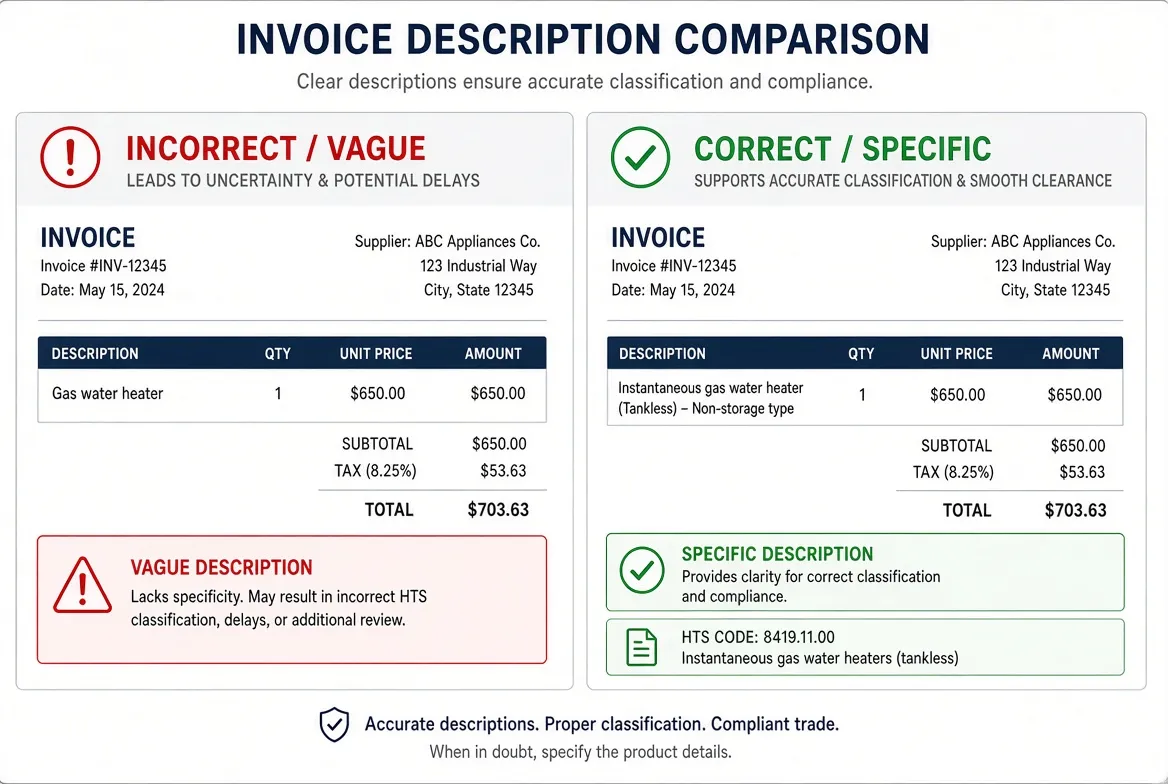
1. The invoice says only “water heater”
Nobody downstream can tell instantaneous gas from electric storage, so the broker cannot confirm the line. Rewrite the description to the exact product phrase, align the HTS line, and resend the packet before the cargo reaches storage.
2. The supplier sends a six-digit HS reference and stops
Six digits is a family, not a filing. Rebuild the classification from the spec sheet and the nameplate, and document why the product fits the line. Escalate to your broker, or pursue a binding ruling if the facts are genuinely novel.
3. Base duty is priced as the whole tariff stack
Free at the General rate is not a landed cost. Reopen the sheet and add Chapter 99 exposure, MPF, HMF and the demurrage reserve before the purchase order is approved.
4. An electric model is filed under 8419
This is the failure CBP ruling H343451 addresses. Electric instantaneous and storage water heaters belong in 8516.10.00, and the correction usually arrives as a protest rather than a courtesy.
5. DOE CCMS certification is missing at arrival
The importer carries this obligation. When the reference is absent at arrival, the fix is a supplier reissue and a delay, not a broker workaround. Add it before booking.
6. A complete RV is filed as a loose appliance
Branch the workflow. HS-7 and FMVSS evidence apply to the vehicle, and the heater travels inside that entry rather than on its own line.
🛡 Prevention: Keep the nameplate photo, the spec sheet, the invoice and the live HTS screenshot in one file per shipment. The broker files faster when the evidence already sits beside the claim.
Conclusion: A Clean Entry Is a Document Set, Not a Rate
The HSN code answers one question. The entry answers several, and the duty is only one of them.
Get the heading right, screen the tariff stack against live sources, and carry the evidence with the cargo. Send the invoice and the landed-cost sheet to your broker for a pre-flight review before the vessel arrives. That review catches the vague description and the stale Chapter 99 line while both are still cheap to fix.
For a second opinion on a classification or a supplier packet, the Gulfstone team reviews import files for OEM and private-label programs as part of onboarding.
Transparency note: Gulfstone builds gas water heaters under client brands and ships them from Foshan, so it has a commercial interest in how these products are classified. Rates in this article were read from the live HTSUS and CBP fee table in October 2026 and are illustrative, not a ruling. Classification remains fact-specific and should be confirmed with a licensed customs broker. I receive no manufacturer kickbacks for these findings.
Frequently Asked Questions About Gas Water Heater HSN Codes
1. What is the HSN code for a gas water heater?
For an instantaneous or tankless gas model, the six-digit HSN is 8419.11. In the United States that becomes 8419.11.00, which the live HTSUS lists with a General rate of Free. The six digits are only the family. Product facts and country of origin decide the full ten-digit line that CBP files.
2. Do I need the ten-digit HTSUS code or just 8419.11?
You need the ten digits. Brokers file the HTSUS statistical line, and 8419.11.00 is the line to confirm after the product facts match. A six-digit reference is a screening result, not a filing instruction.
3. What is the difference between an HSN code and an HTS code?
The HSN is the international six-digit classification maintained by the World Customs Organization and used by most trading nations. The HTSUS is the United States tariff schedule, which adds national digits, duty rates, statistical suffixes and Chapter 99 provisions on top of the same six-digit base.
4. When does a gas water heater leave heading 8419?
It leaves when the product facts change. Electric units go to 8516.10.00. Solar units go to 8419.12. Non-electric units that are not instantaneous fall to 8419.19.01. A sales description is not a classification.
5. What documents does CBP need for a formal entry?
A commercial invoice, a packing list, the transport document, the CBP Form 7501 data and a customs bond. Add the DOE CCMS certificate reference for covered products, and HS-7 evidence if the shipment is a complete vehicle. The invoice should show the tariff line and the duty treatment used for entry.
6. Does DOE certification apply to imported gas water heaters?
Yes, for covered products. The importer must file a certification report through CCMS before the product is distributed in commerce. The obligation sits with the importer of record, and it applies whether or not the supplier claims existing certification.
7. How is clearance different for a whole RV with a heater inside?
The vehicle enters as a vehicle, under HS-7 and FMVSS self-certification, rather than as a standalone appliance. Confirm that branch before arrival. Filing the heater on its own line while the vehicle clears separately creates two records that will not reconcile.
8. How much does the tariff stack add to a gas water heater shipment?
It depends on origin and current Chapter 99 coverage. A China-origin shipment at an illustrative 25% Chapter 99 rate adds $22,500 on a $90,000 customs value, before MPF at 0.3464% and HMF at 0.125%. Read the live rates on the entry date; the programs have changed repeatedly since 2025.

Forward
Co-founder & General Manager, GulfstoneGas appliance manufacturing and certification
Most of what decides a gas appliance is settled before anything is built — on the drawing, at the cut-out, in the tolerance someone chose for the gas path. I have spent my working life on the manufacturing side of that decision, and this is where I write down what it has taught me.
Nothing here is written from a sales desk. Every note comes off the floor: a batch held until a reason was found, a fitting that failed in transit, an approval path that only made sense once the destination market was fixed. If you read these first, the opening conversation starts at the standard rather than at the beginning.
- Gas water heater engineering
- Design for manufacturing
- Certification path selection
- Private-label tooling
- Off-grid and outdoor water heating
- Top 8 Outdoor Portable Gas Water Heater Factories in China for B2B BuyersNov 4, 2026
- Custom RV Appliance Industrial Design: An OEM Brief to a Validated PrototypeNov 3, 2026
- How to Build Custom Thermostat UI Design Software for OEM Embedded PanelsNov 3, 2026
- Top 8 RV Water Heater OEM Suppliers Canada: Vetted for Volume BuyersNov 3, 2026
- Top 10 Portable Propane Water Heater Manufacturers USA: A No-Hype Buyer ShortlistNov 2, 2026
- PPWR Compliance Checklist for EU Water Heater Packaging: The 10 Documents Before the Container LoadsNov 2, 2026
Fifteen years in appliance manufacturing — home appliances, RV refrigeration, then gas water heating — from the drawing to the shipping container.
Leads Gulfstone's design-for-manufacturing reviews and the certification path selected for each destination market.
Works directly with OEM and private-label buyers on tooling, tolerances and the approval file.