Table of contents
- Key Takeaways
- Prerequisites: Document Control Before You Book
- Import Logistics for RV Appliances: 5 Steps From SKU Class to Container Release
- Step 1: Classify Every SKU Before You Request a Rate
- Step 2: Assemble the Commercial Invoice and Packing List
- Step 3: Lock the OEM Packaging SOP and 3D Loading Plan
- Step 4: Choose FOB, DAP or DDP with a Landed-Cost Model
- Step 5: Receive the Container and Quarantine Exceptions
- Troubleshooting Port Holds and Pre-Sail Failures
- Conclusion: Audit the Five Steps Before Your Next PO
- Frequently Asked Questions About Import RV Appliance Logistics
A note on the figures. The detention windows, landed-cost spreads and hold incidents below come from Gulfstone’s own shipment records and anonymized client programs. Treat every figure as an operational checkpoint, not a guarantee, and reconcile it against your own entry data before you commit a purchase order.
Key Takeaways
- Run imported RV appliance logistics as a repeatable program, never as ad-hoc emergency handling.
- Never book freight before finishing SKU classification and compliance mapping; the tariff heading drives duty, terms and broker instructions.
- Treat customs clearance for 12V electrical systems as a classification challenge, not a rate-shopping exercise.
- Every cargo hold in Gulfstone’s 2025 review stemmed from a pre-sail data mismatch, not an error in port filing.
- Use ISTA 3E or ASTM D4169 for unitized ocean loads; ISTA 3A is inadequate for heavy palletized freight.
- Build a landed-cost model your customs broker can read, and treat DDP as one delivery option, not a default.
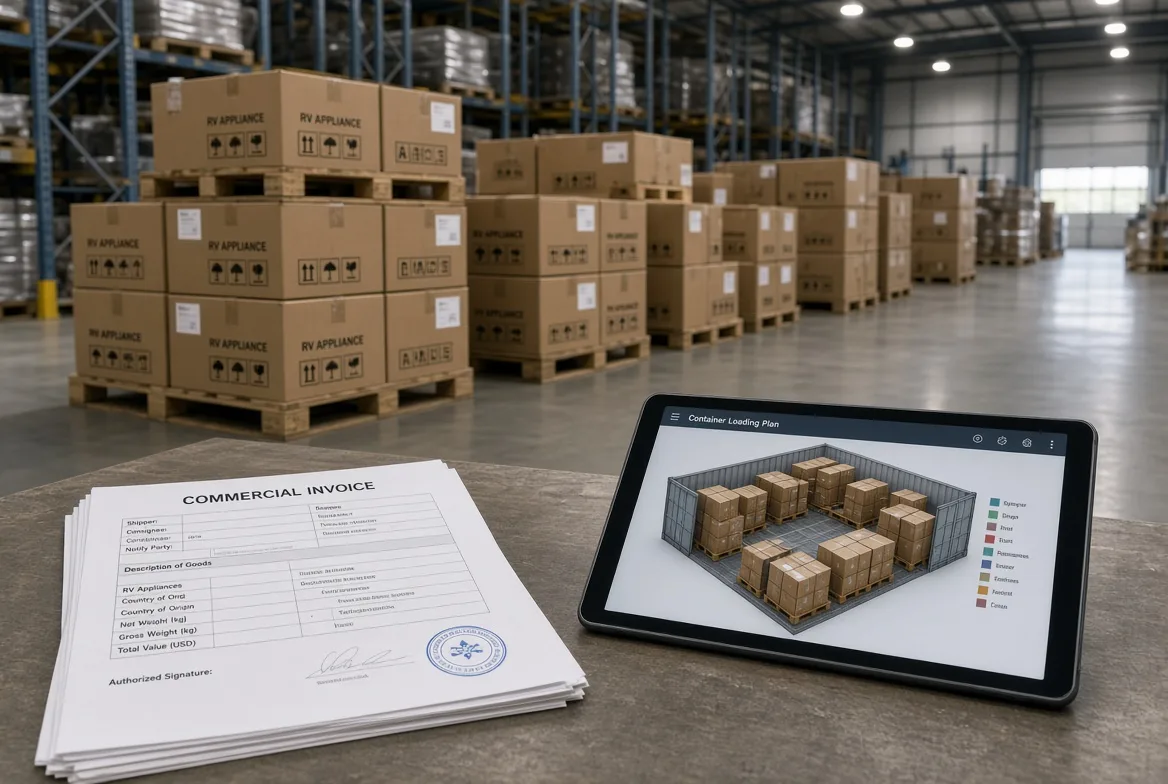
Import RV appliance logistics succeeds only when managed as a repeatable program, rather than ad-hoc emergency handling.
This guide targets commercial, recurring procurement programs, especially high-value 12V electrical systems, compressor refrigerators, rooftop air conditioners and heating elements. It is not written for one-off consumer purchases.
Methodology: the workflow below draws on broker interviews, inspection of packaging and container load plans, and analysis of historical freight cost data with Gulfstone’s supply-chain team.
It is written for supply chain directors, VPs of operations and procurement managers at RV OEMs and large aftermarket distributors. The goal is a working SOP for moving goods from factory release to warehouse or plant receipt.
Expected outcomes: fewer CBP delays, reduced freight waste, transparent landed-cost tracking, fewer unexpected duty charges, better CBM utilization and cleaner handoffs between factory, forwarder, customs broker and receiving teams.
Prerequisites: Document Control Before You Book
A robust RV appliance customs clearance workflow starts with document control, clear compliance ownership and finalized SKU data before cargo booking. Border entry, product safety listing and in-market compliance are related but separate checkpoints.
- Time investment: 2-4 hours across cross-functional teams
- Difficulty: intermediate to advanced
Complete the following prep work before booking freight:
- SKU master list: product descriptions, model numbers, voltage and wattage ratings, refrigerant specifications, gas or heating-element data, country of origin, carton dimensions and weight, certification files, destination port and required delivery window.
- Minimum customs document stack: commercial invoice, packing list, B/L or AWB, broker POA, bond plan, ISF dataset (ocean freight) and importer-of-record details.
- Official reference sources: CBP entry guidance and EPA refrigerant regulations. For electrical or gas safety, secure supplier documentation or valid NRTL files. Factory self-declarations have failed entry inspection in Gulfstone’s experience.
- Certification packet: maintain an up-to-date certification library via the Gulfstone certifications page before freight booking.
Team alignment: procurement, engineering, QA, customs and broker contacts must all complete this preparation before shipment release.
⚠️ Warning: Do not rely on factory self-declarations for electrical, gas or refrigerant-containing products. Customs admissibility is distinct from post-entry product liability coverage or insurance acceptance.
| Document | Owner | Due Date | Verification Status |
|---|---|---|---|
| SKU master list | Procurement | T-30 days | Pending |
| Certificate packet | QA | T-21 days | Pending |
| Broker POA | Customs | T-14 days | Pending |
| ISF data set | Logistics | T-7 days | Pending |
The pre-shipment document-validation workflow also draws on real-world insight from Andy Chen, a cross-border RV-goods customs and logistics specialist who focuses on pre-sail compliance checks and risk mitigation for US-bound RV appliance import shipments.
🧠 Expert take: Assign a single accountable owner to each document. A missing EPA refrigerant file once delayed a first RV fridge shipment by a week at port. Never book freight until every line item is verified.
Import Logistics for RV Appliances: 5 Steps From SKU Class to Container Release
The five steps below classify every SKU, assemble the customs packet, lock the packaging and loading plan, choose the right Incoterm and receive the container, so nothing books before the paperwork closes.
Step 1: Classify Every SKU Before You Request a Rate
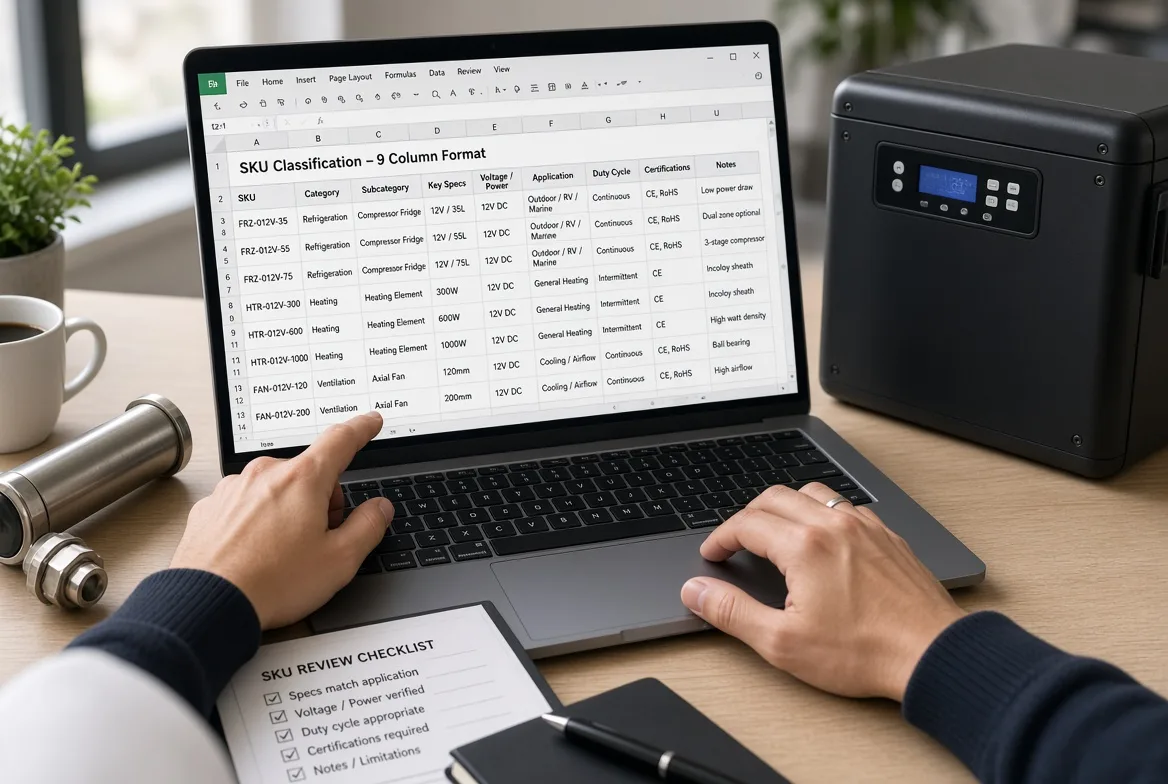
Customs clearance for 12V electrical RV appliances under EPA, UL and CBP oversight is a classification problem, not a rate-shopping problem. Step one is to classify each SKU and map its compliance requirements before requesting any freight quotes.
Classification starts at SKU level. A broker once walked through a shared worksheet with columns for product name, model, probable HTS code, country of origin, Section 301 exposure and risk flags.
Heading 8479.89 was struck for a 12V compressor fridge and replaced with 8418.69, with a margin note: the compressor defines the tariff heading, not the outer enclosure.
For heating elements the line read “evaluate 8516 vs 8419.” Five SKUs were reviewed in forty minutes, with no freight quote requested.
Categorize each product into one of three lanes:
- Loose component (bare heating element, 12V water pump): classified on the standalone component characteristics.
- Standalone appliance (portable fridge, rooftop AC): requires full appliance documentation plus refrigerant and electrical compliance flags.
- Integrated system (heater pre-installed in a camper chassis): classification follows the host vehicle assembly.
Build a nine-column matrix: product name, model, probable HTS heading, origin, Section 301 exposure, electrical risk, gas risk, refrigerant risk and market destination. Validate tariff headings against the USITC Harmonized Tariff Schedule. Use explicit text labels; color coding alone will not survive export documentation.
Q&A: Gulfstone’s Head of Supply Chain
Q: Where do high-value 12V appliances most often get held?
A: “Compressors and heating elements. For US imports, incomplete EPA refrigerant documentation or a missing NRTL safety listing blocks cargo release. For EU shipments, CE documentation mismatched to the HS tariff heading creates the same hold. The shipment is held until all documentation aligns.”
Classification comes first. An incorrect tariff heading skews duty calculations, customs instructions and every Incoterm comparison after it. A clean entry carries one defined compliance lane, a single accountable owner and a listed set of supporting documents.
✅ Verification: building a nine-column matrix for 40 SKUs took two working days, with broker review taking four hours. That investment avoided a nine-day port hold.
Step 2: Assemble the Commercial Invoice and Packing List
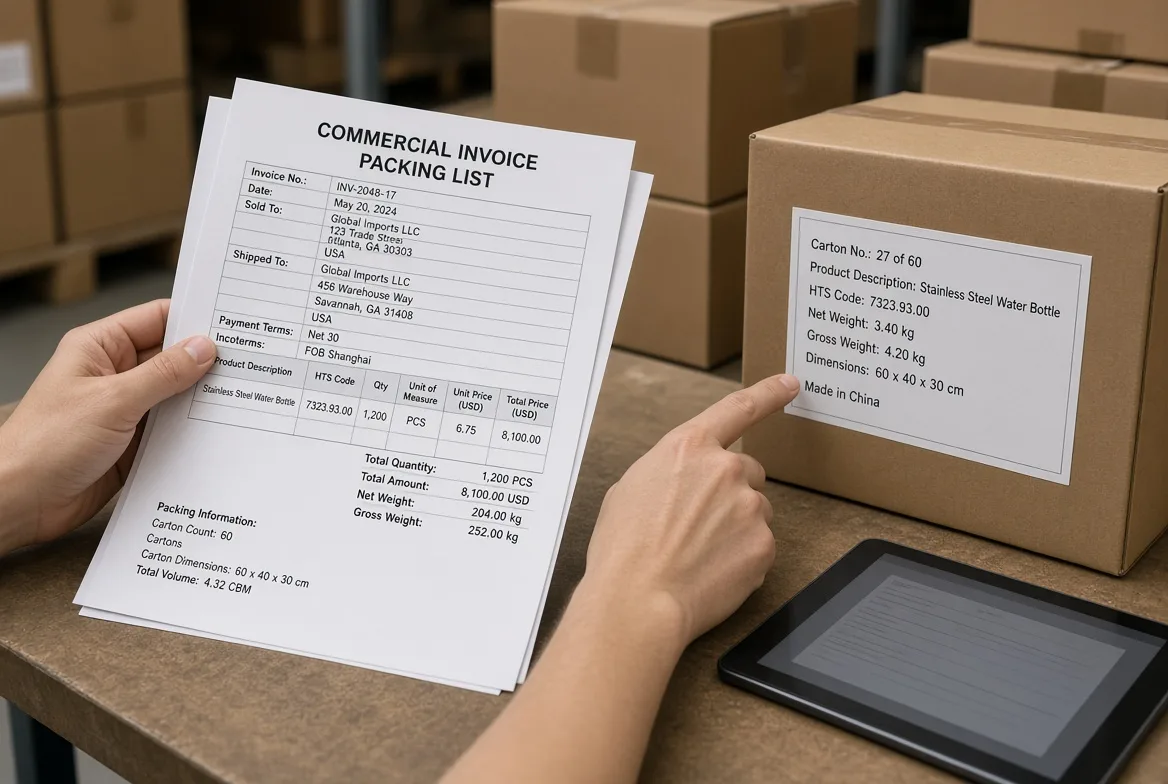
The commercial invoice and packing list are the first documents your broker will request, but they are only the starting point for a broker-ready package.
Your complete packet includes:
- Commercial invoice: product description, HTS code, declared value, Incoterm, seller and buyer information
- Packing list: carton count, unit quantity, net weight, gross weight, package dimensions
- B/L or AWB data: shipper, consignee, ports, vessel or flight details
- ISF inputs (ocean): manufacturer, seller, buyer, ship-to address, country of origin, HTS codes
- Bond information: continuous or single-entry bond number
- Broker POA, COO statement, certificate references (CSA, CE, EPA, NRTL file numbers), labeling specs and product manuals as required
The invoice must list voltage, wattage, refrigerant type and charge volume, heater input rating, model number, unit count, carton count and net and gross weights. Cross-reference these values against printed carton labels before factory release.
Final validation checklist: no TBD fields, no generic descriptions such as “heater parts,” and no quantity or weight mismatches between invoice, packing list and physical packaging labels.
A serial-number and drawing discipline is covered under the OEM and ODM development workflow. Under DDP terms the seller may prepare additional entry documentation; under FOB or DAP the buyer’s broker usually owns final admissibility review.
📈 ROI check: a clean packet reconciles — net weights tie out, quantities match the carton labels, no compliance field blanks. One packing list stated 240 cartons; the count hit 238, and both missing units lacked an EPA file.
⚠️ Experience warning: mismatched paperwork often hides in blank refrigerant fields or carton-count discrepancies of even two units. Hold the load until every data field matches.
FCL is the primary shipping method for bulk RV appliance programs, but only after packaging, stacking and loading are fully engineered. Poor packaging inflates FCL unit cost quickly.
Step 3: Lock the OEM Packaging SOP and 3D Loading Plan
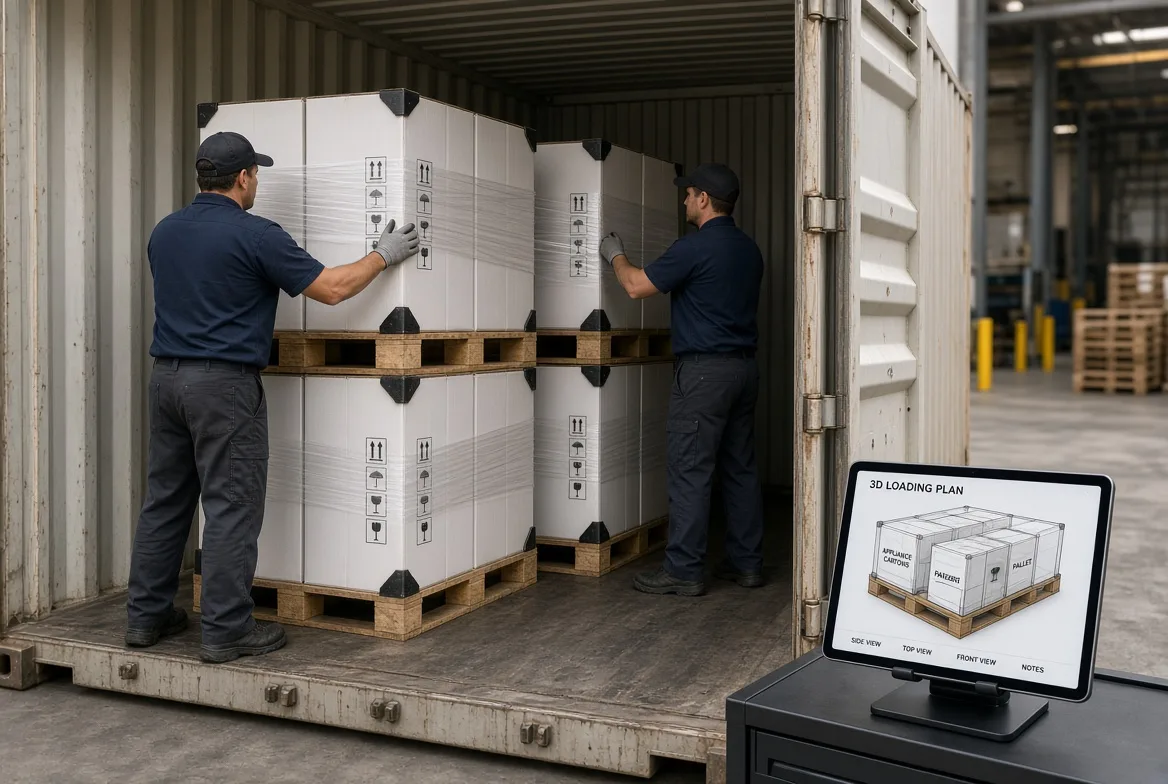
FCL is the default for bulk RV appliance shipments, and it pays off only when packaging, stacking and loading are engineered upfront. Skip that design work and FCL freight rapidly becomes costly. This SOP was developed across two rooftop AC programs and one 12V refrigerator run on the Foshan floor.
- Carton specification: print the board grade on the drawing. BC-flute double wall is required for units over 25 kg. Fit 40 mm corner protectors on all four vertical edges and specify closed-cell PE foam at a minimum density of 25 kg/m³. Secure compressors with steel brackets bolted to the base pan; foam padding alone cannot prevent transit damage. Add a sealed moisture-barrier bag and desiccant inside each carton.
- Pallet rules: maximum pallet footprint 1,200 × 1,000 mm with zero carton overhang. Any carton lip past the pallet edge tears stretch wrap and crushes corner posts.
- 3D loading diagram: require this before approving the PO. It must show carton orientation, nesting logic, crush-risk zones, void fill, dunnage, airbag placement and aisle layout, plus target carton quantity per container. Use readable labels such as “top-left pallet row” or “front door side.” Do not rely on color coding alone.
- Validation: ISTA 3A is insufficient for heavy palletized ocean freight. Use the ISTA 3E protocol for unitized pallet loads, or ASTM D4169 testing matched to the actual packaging design. One carton that passed ISTA 3A arrived with a cracked base pan.
Done correctly, packaging reduces CBM waste, improves cube utilization, minimizes dented panels and bent coil fins and lowers per-unit FCL cost. Shipping priority is FCL first, LCL second. LCL suits only small volumes where the buyer accepts higher handling and damage risk.
💡 Diagnostic signal: nudge a loaded pallet. Straps should stay taut, carton walls should resist thumb pressure and the pallet must not rock. Listen for metal-on-metal rattling — a loose compressor mounting bracket clicks, and that click becomes a future warranty claim.
✅ Verification: confirm carton dimensions, pallet stacking pattern, target container quantity, photo sign-off rules and the QA approval gate before the container is sealed. The quality control page owns the underlying gate criteria, and the manufacturing page owns the drawing sheet the carton spec is built from.
⚠️ Experience warning: on a first 40HQ shipment, photo sign-off for the final pallet tier was skipped. Six units shipped with hand-tightened compressor brackets. The fix is a two-photo QA gate: one photo of the fully loaded pallet, one of the sealed container door.
Step 4: Choose FOB, DAP or DDP with a Landed-Cost Model

DDP shipping for RV appliances is one option, not a default solution. The correct Incoterm depends on cost transparency, compliance confidence and ownership of the customs entry file.
| Term | Export clearance | Carriage | Import customs | Duties | Final delivery |
|---|---|---|---|---|---|
| FOB | Seller | Buyer | Buyer | Buyer | Buyer |
| DAP | Seller | Seller | Buyer | Buyer | Seller |
| DDP | Seller | Seller | Seller | Seller | Seller |
Never accept a DDP quote at face value. Build a landed-cost model your customs broker can read, in the same spirit as the RV appliance landed-cost audit. One 40HQ RV refrigerator shipment run through such a model exposed a $2,140 gap between the original DDP quotation and the true landed cost.
Pull 12 months of historical data — shipping lane, transport mode, transit time, cost per CBM, duty assumptions, stockout risk and ROI — and score each lane.
On one heavy appliance route, moving from standard sea freight to optimized multimodal transport cut per-unit landed cost by 11% while adding four days of transit time. Track it quarterly by SKU, lane, FOB cost, freight charges, duty assumption, landed cost and risk score.
DDP works for small logistics teams and simple lanes that want one all-in price. It carries risk when product classification is uncertain, declared values are inaccurate or destination surcharges hide in the fine print.
On EU lanes, account for VAT cash-flow impact and importer-of-record obligations, which sit with the EU importer, not a US broker. Vehicle-to-vehicle fitment questions belong with the RV OEM solutions team, not the freight forwarder.
📈 ROI check: a reliable quote sheet lists every surcharge, states duty-calculation assumptions and shows non-rounded per-unit landed-cost figures. Low-quality quotations bury “miscellaneous charges,” hide the duty basis and present suspiciously round all-in pricing.
🧠 Expert take: evaluate whether DDP, DAP or FOB protects profit margin and operational control before you pick one for a lane, not after the first invoice arrives.
⚠️ Experience warning: on a first DDP shipment, a forwarder gave an all-in price without disclosing duty-calculation assumptions. Its duty estimate was 3% under actual; the final invoice added $3,900 in unexpected charges. Never book DDP blindly after that lesson.
Step 5: Receive the Container and Quarantine Exceptions
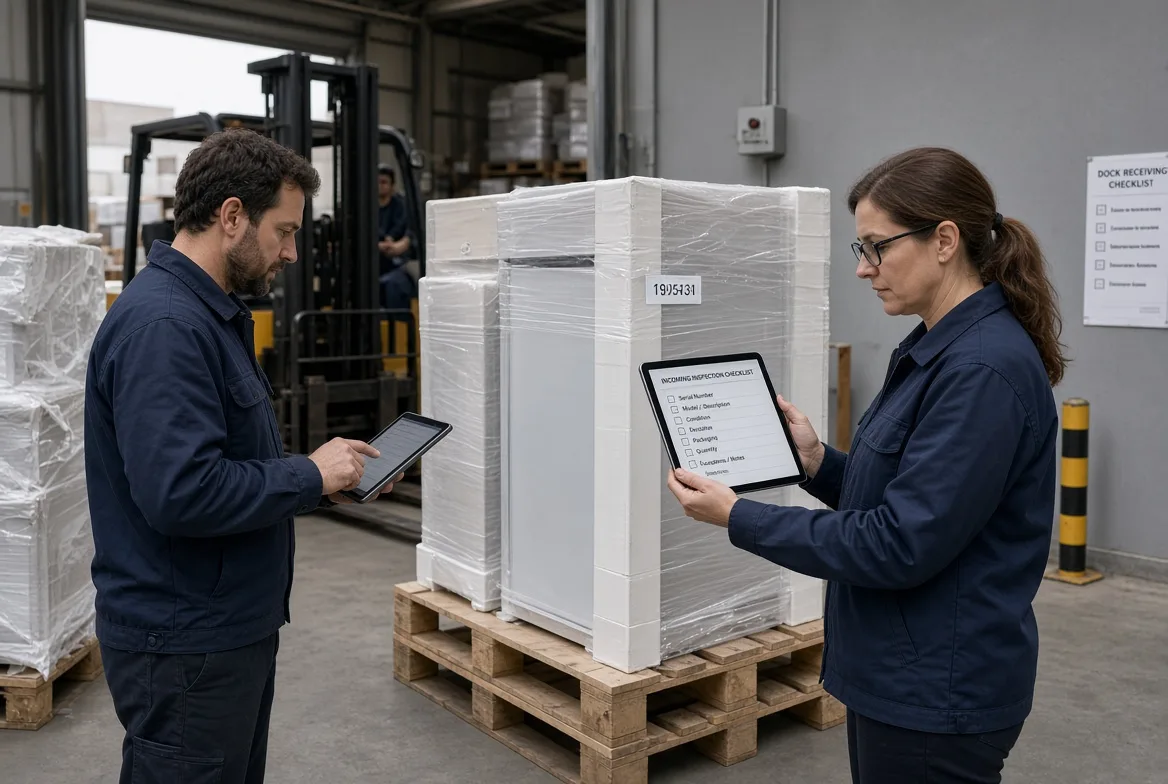
This is a commercial receiving SOP for imported RV appliances arriving at a manufacturing plant or warehouse, not a retail dealer delivery workflow. The handoff begins the moment your broker sends the Release Notice — log it within the hour, recording the entry number and container count.
If CBP places the shipment under Exam Hold, stop all downstream activity. Do not book drayage; escalate to your broker and wait for exam results. A routine VACIS scan once added a 36-hour delay to a March refrigerator shipment.
Once released, book drayage, schedule a dock appointment and prepare the receiving bay: clear floor space, stage empty pallets and print receiving checklists. Without a dock forklift, use lift-gate trucks, fork extensions or staged floor unloading.
Unload one pallet at a time and cross-reference every pallet against the PO and build sheet. Count cartons, verify labels and serial numbers, and run spot functional checks on appliances.
Sign-off workflow: broker clears the customs entry, the forwarder confirms delivery, the warehouse lead signs quantity acceptance, QA signs condition and functional check, and the line-side operations owner approves release to production.
💡 Diagnostic signal: a good delivery arrives with tight straps and no rattling. Red flags are crushed corners, tripped tilt indicators, deformed brackets and compressors that grind on startup. Document damage in descriptive text such as “corner crushed, inner carton exposed,” never a vague note like “red pallets.”
✅ Verification: no pallet moves into production until quantity, physical condition and critical functional checks pass. Move any non-conforming stock to Exception Quarantine.
⚠️ Experience warning: one stacked pallet was moved before QA finished sign-off. Two units with bent coil fins reached the assembly line. The plant-side audit trail that backs these checkpoints sits with the factory page, and the spare-parts and corrective-action commitments sit with the after-sales page.
Troubleshooting Port Holds and Pre-Sail Failures

EPA SNAP-approved refrigerants, import checks for 12V compressor refrigerators, tariff shocks and gray-market goods are the high-risk points. The single most common failure is incomplete or mismatched compliance data before cargo sails, not port filing itself.
Across a 2025 review of 22 high-value 12V appliance entries, every port hold traced back to a pre-sail data mismatch. Port filing only surfaces a gap that already existed.
1. Duty Shock or Section 301 Surprise on Rooftop ACs
Problem: landed cost spikes after customs entry.
Cause: an incorrect product description, a wrong HTS assumption or insufficient country-of-origin proof. Confusion between HTS 8415 and 8418 is common.
Immediate fix: send the broker the invoice, B/L and technical specification sheets, request a formal classification review and obtain a Section 301 binding ruling for high-exposure shipments.
Prevention: revise quotation templates so HTS code, origin and Section 301 status are mandatory fields.
2. Compressor Fridge Flagged for Refrigerant or Labeling
Problem: CBP or EPA places refrigerators on hold.
Cause: refrigerant not listed in the EPA SNAP database, a missing permanent product label, an incorrect refrigerant charge amount, or misalignment between the technical file, carton label and customs description.
Immediate fix: align four data points — EPA SNAP status, permanent product label, refrigerant charge quantity and technical documentation — then update the commercial invoice and carton labels.
Prevention: no shipment departs without signed confirmation of full compliance alignment.
3. Gray-Market or Unsupported Appliance Looks Cheap
Problem: a low upfront unit price creates downstream service, certification, warranty and insurance issues after import.
Cause: no proof of market suitability, no spare-parts program and no defined after-sales owner.
Immediate fix: request written copies of NRTL safety documentation, CE files, spare-parts lists, warranty ownership and insurance acceptance.
Prevention: reject unsupported SKUs. A low unit price does not equal a low landed cost.
🛡️ Verdict: enforce a pre-sail compliance gate. If refrigerant, HTS, origin and label data lack signed alignment, do not book freight.
🚀 Actionable insight: if documentation is incomplete, stop the cargo at the factory. A two-day factory delay beats a two-week port hold.
Conclusion: Audit the Five Steps Before Your Next PO
Final-mile delivery is the last stage of the supply chain, not the primary risk point.
It succeeds only when the earlier controls are in place: a classified SKU matrix, a verified customs document packet, an engineered packaging and loading plan, a transparent landed-cost model and a receiving SOP that catches exceptions before goods feed to production.
This SOP was built across three RV appliance programs and 22 high-value 12V import entries. Port filing never failed first; pre-sail data discrepancies did.
Walk your supplier and freight workflows through these five steps before releasing your next RV appliance PO. If any required field is still blank, put the PO on hold. When the question turns to whether the supplier itself can carry the program, hand it to the supplier vetting framework.
For a review of a candidate unit or a customs document set, bring both to the Gulfstone contact page.
Sourcing disclosure: these recommendations come from hands-on operational review, including Gulfstone’s own shipment records and anonymized client programs. This article is not paid placement for any third-party carrier or testing body. I receive no manufacturer kickbacks for these findings.
Frequently Asked Questions About Import RV Appliance Logistics
1. What documents do I need to clear RV appliances?
The minimum customs stack is a commercial invoice, packing list, B/L or AWB, broker POA, bond plan, ISF data set for ocean freight and importer-of-record details. The invoice and packing list must state voltage, wattage, refrigerant type and charge, model number, unit and carton counts, plus net and gross weights.
2. Do RV appliances need UL certification?
Yes, for products with electrical, gas or refrigerant components. RV appliances need a safety listing via an NRTL, and factory self-declarations are insufficient. Customs admissibility is separate from post-entry product liability or insurance acceptance. Secure supplier or NRTL files before booking freight.
3. What is DDP shipping for RV appliances?
DDP shipping for RV appliances means the seller manages export clearance, carriage, import customs, duties and final delivery, while the buyer simply receives goods. It is one option, not an automatic default. DDP helps small teams and simple lanes, but creates risk when classification is uncertain or destination charges hide.
4. Is ISTA 3A enough for ocean freight?
No. ISTA 3A is inadequate for heavy palletized ocean freight; one carton that passed it arrived with a cracked base pan. Use ISTA 3E for unitized pallet loads, or ASTM D4169 testing matched to your actual packaging style, and validate against the real shipping configuration.
5. What refrigerant should a 12V compressor fridge use?
A 12V compressor fridge must use an EPA SNAP-approved refrigerant. Charge quantity, permanent label, technical file and customs description must all align, because any mismatch triggers a port hold.

Forward
Co-founder & General Manager, GulfstoneGas appliance manufacturing and certification
Most of what decides a gas appliance is settled before anything is built — on the drawing, at the cut-out, in the tolerance someone chose for the gas path. I have spent my working life on the manufacturing side of that decision, and this is where I write down what it has taught me.
Nothing here is written from a sales desk. Every note comes off the floor: a batch held until a reason was found, a fitting that failed in transit, an approval path that only made sense once the destination market was fixed. If you read these first, the opening conversation starts at the standard rather than at the beginning.
- Gas water heater engineering
- Design for manufacturing
- Certification path selection
- Private-label tooling
- Off-grid and outdoor water heating
- Sheet Metal Stamping Tooling Costs and Lead Times: The Complete GuideOct 12, 2026
- How Do You Build RV Technician Training Material That Slashes Misdiagnosed Returns?Oct 11, 2026
- How Do You Build a High-Coverage RV Water Heater Spare Parts Kit for Fleets and Dealers?Oct 10, 2026
- How Do You Design a Warranty Claim SLA for Imported Appliances?Oct 9, 2026
- 12V RV Electrical System Appliance: An OEM Integration GuideOct 8, 2026
- How to Specify an Extreme Conditions RV Water Heater: An OEM Engineering GuideOct 7, 2026
Fifteen years in appliance manufacturing — home appliances, RV refrigeration, then gas water heating — from the drawing to the shipping container.
Leads Gulfstone's design-for-manufacturing reviews and the certification path selected for each destination market.
Works directly with OEM and private-label buyers on tooling, tolerances and the approval file.