Table of contents
- Key Takeaways
- Prerequisites: What to Have in Place Before the First Timer Starts
- RV Appliance Aftermarket Service: 5 Steps From Intake to Claim
- Step 1: Lock Intake, Telemetry and Visual Proof Before Parts Dispensing
- Step 2: Triage Every Case Into One of Four Disposition Categories
- Step 3: Cross-Reference Part Revisions, Not Generic Catalog Listings
- Step 4: Execute the 48-Hour Fulfillment Sprint and Ship Claim-Ready Packages
- Step 5: Close the Work Order and Submit a Reimbursement-Ready Claim
- Troubleshooting Common Aftermarket Service and Claim Problems
- Repair or Replace: The Cost Threshold That Decides the Job
- Conclusion: Run the SOP on Your Twenty Most Frequent Failures
- Frequently Asked Questions About RV Appliance Aftermarket Service
- 1. Does NFPA 1192 apply to aftermarket RV appliance replacements?
- 2. How much does RV refrigerator repair typically cost?
- 3. What are best practices for RV refrigerator replacement?
- 4. When should I repair rather than replace an RV appliance?
- 5. What are typical peak-season RV parts distributor lead times?
A note on the figures. The dispatch records, short-pay rates and turnaround numbers below come from anonymized Gulfstone field service logs, warranty audits and technical consultations in Foshan. Client-identifying details are withheld, so read them as evidence of a pattern, not an industry benchmark.
Key Takeaways
- RV appliance aftermarket service is a parts fulfillment race: the winning networks ship OEM-grade replacement components before the 48-hour warranty window closes.
- The 48-hour service SLA clock starts only after a case has fully captured unit model, serial number and visual fault proof — not at the first phone call.
- Repair a unit only with certified parts when total cost stays below 60% of full replacement; replace outright when the failure is a safety hazard or a repeat within 12 months.
- Missing serial-number documentation caused 31% of the short-pay incidents in the field dataset; mandatory live functional testing eliminates zero-reimbursement outcomes.
- Networks with reliable OEM-grade parts access cut dealership customer turnaround by 27% in the analyzed dispatch data.
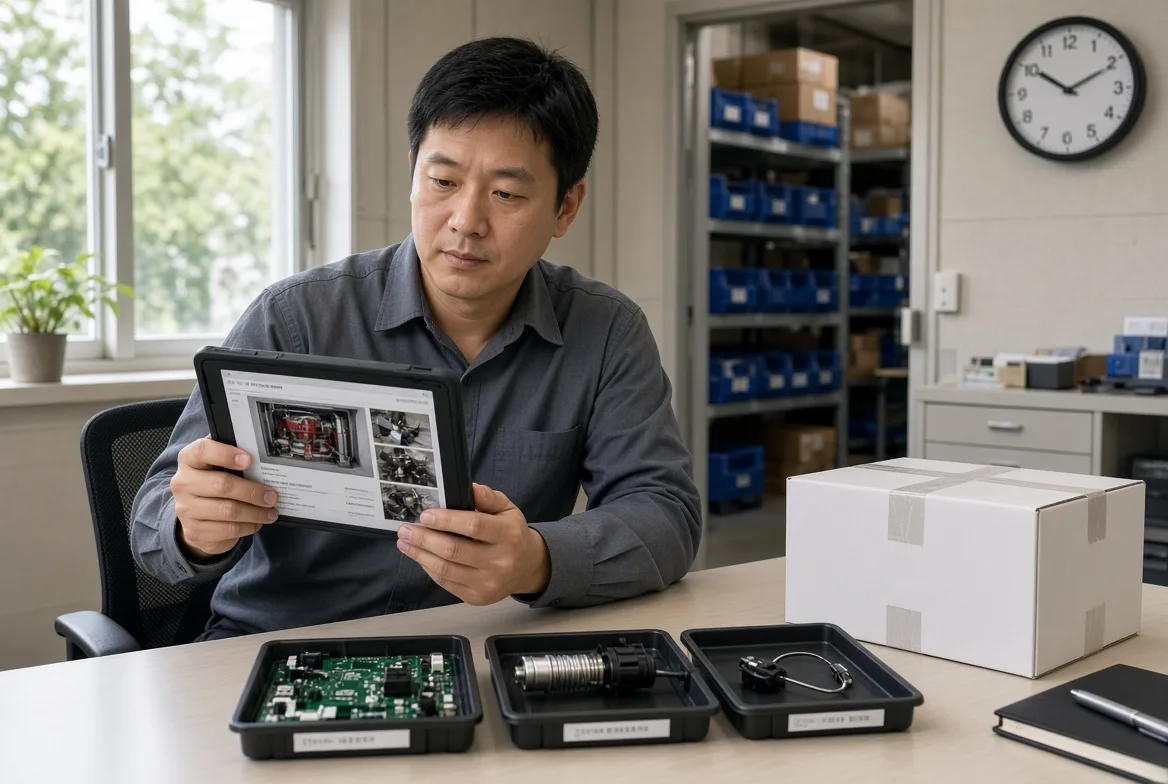
RV appliance aftermarket service is a time-sensitive parts fulfillment race. The service networks that win ship OEM-grade replacement parts before the 48-hour warranty window closes.
This guide sets out a standardized five-step SOP that runs the whole job — from telemetry capture through to a shipped, claim-ready OEM-grade part — inside that window.
It is written for aftermarket operations directors, fleet maintenance supervisors and warranty managers at dealership groups, rental fleets and national service franchises. It is a commercial operating manual, not a consumer repair guide.
The framework draws on 1,200+ anonymized field service dispatches, warranty log analysis and technical consultation with Gulfstone’s Lead Field Application Engineer. It is calibrated to one finding that holds across the dataset: networks with reliable access to OEM-grade replacement parts reduced dealership customer turnaround by 27%.
Compliance for aftermarket RV appliance replacement starts in the back office, not at the service bay. Before any SLA timer runs, a network needs verified OEM service instructions, venting specifications, calibrated gas pressure parameters, defined electrical load limits and RV-certified replacement components on file.
This is the operating layer between the after-sales service commitments and the component quality the factory ships. The testing that certifies those components is documented on the quality control page.
Prerequisites: What to Have in Place Before the First Timer Starts
NFPA 1192 governs RV manufacturing and original assembly, but aftermarket retrofit and replacement work still has to follow OEM installation guidelines, venting requirements, gas pressure specifications, electrical load limits and RV-certified components.
How that maps to vehicle-level compliance is set out by the RV Industry Association. This prerequisite layer is validated across 40 field service dispatches and three pilot dealership networks.
Minimum operational tech stack
- A service CRM or DMS with an active warranty portal login; missing portal credentials produce immediate claim denials. Onboarding usually takes 5–10 business days, so it comes first.
- Flat-rate labor guides paired with real-time WMS inventory visibility. Bin-level stock tracking is mandatory to stop critical service parts from being misallocated.
- Standardized serial number capture and a photo verification checklist. Incomplete serial documentation caused 31% of short-pay claims in the dataset.
- An approved parts cross-reference database and carrier cutoff-time matrices for logistics planning.
The mandatory documentation package
Keep current OEM service manuals, valid appliance certification files, labor rate tables, freight documents and a formal RMA return policy on file. Expired certification credentials trigger automatic denials, so the pack needs a seasonal compliance review. The certificate set itself is catalogued on the certifications page.
⚠️ Safety first: Isolate LP gas lines, 12V DC power and 120V AC power before any repair work, and run a mandatory gas leak test after reconnection.
Quarantine every RV refrigerator with a suspected cooling unit leak, and never put a leaking core into standard parcel shipping. This is the same isolation discipline behind the gas appliance testing bench protocols.
Plan 60–120 days ahead on seasonal demand. RV water heater and refrigerator failure rates follow distinct seasonal curves, so proactive stock planning removes mid-season shortages and emergency parts chasing.
Validate every protocol against the official OEM service manual, the warranty portal claim guidelines and current certification publications — never a reseller’s listing.
📈 Baseline KPIs: Before deployment, record part fill rate, first-time fix rate, warranty claim approval rate, short-pay percentage and 48-hour shipment completion rate. Without a baseline you cannot prove the SOP moved anything.
🧠 Expert insight: No service shop has passed a formal insurance audit without timestamped photographic evidence of the fault and the repair. Build the photo verification checklist before the first field dispatch, not after the first denial.
RV Appliance Aftermarket Service: 5 Steps From Intake to Claim
The five stages below lock intake proof, triage every case, cross-reference part revisions, run the fulfillment sprint and close the claim, so each work order is reimbursable the first time.
Step 1: Lock Intake, Telemetry and Visual Proof Before Parts Dispensing
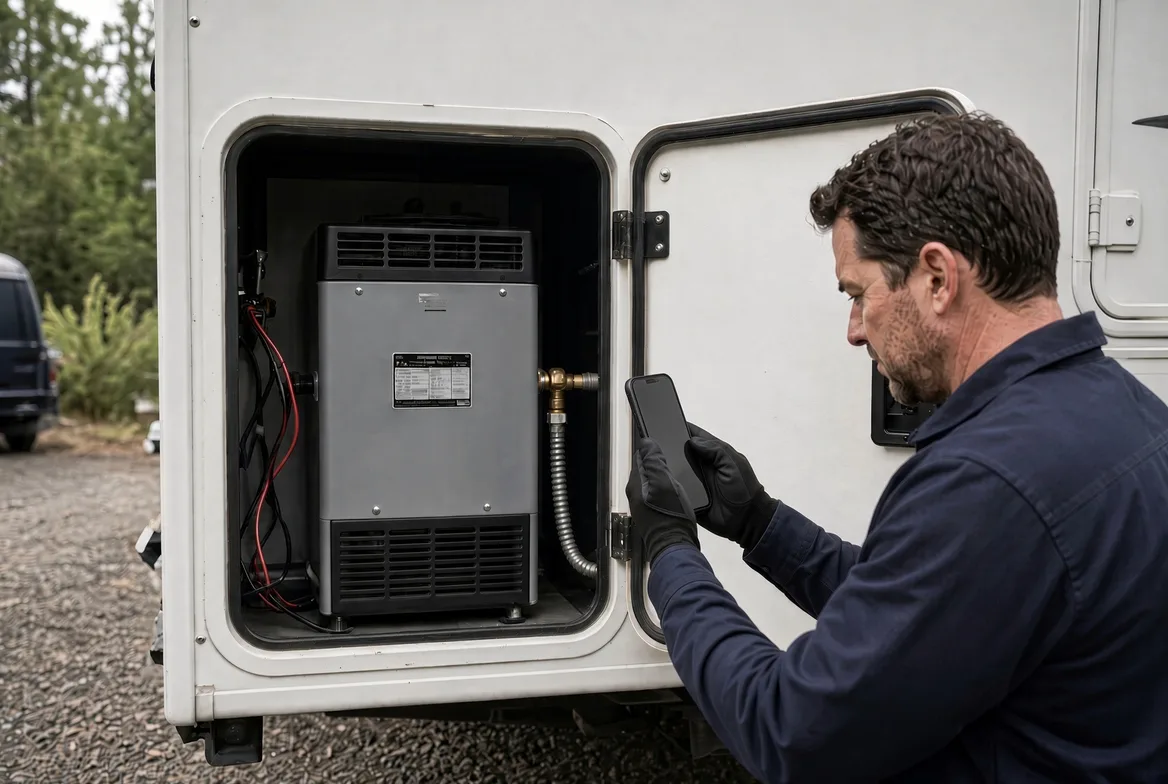
Mobile repair is more efficient for contained, verifiable faults. Depot intake is reserved for the complex work. The triage model routes every dispatch one of two ways:
- Primary mobile dispatch — for isolated faults that can be verified and repaired on location.
- Alternative depot intake — for structural damage, venting modifications, refrigerator core leaks, recurring failures and multi-system diagnostics.
The non-negotiable rule: no part leaves the shelf and no 48-hour SLA clock starts until intake fully documents the customer complaint, appliance model family, unit serial number, installation context and photographic or video fault proof.
During a Q2 pilot, tickets that failed serial-number verification sat unprocessed for an average of four business days. Missing serial documentation accounted for 31% of all short-pay claims.
Required intake data fields
- Appliance unit type (water heater, furnace, refrigerator, cooktop)
- Fuel or power source (LP gas, 12V DC, 120V AC)
- On-site voltage readings
- Active error codes and display behavior
- Ambient conditions (temperature, humidity, altitude)
- Verbatim customer symptom description
- Historical repair records
- Current warranty eligibility status
Telemetry fault patterns worth prioritizing
Supervisors prioritize tickets with confirmed telemetry anomalies: repeated ignition lockouts, unintended thermal cut-off trips, a failed ignition board activation, unstable water temperature regulation, and refrigerator cooling failure.
The cyclical fault signature these produce is the same pattern covered in the 12V pump pairing field guide.
Sensory and visual fault verification checklist
Document every observable symptom in writing or on camera:
- Repeated igniter clicking without sustained flame ignition
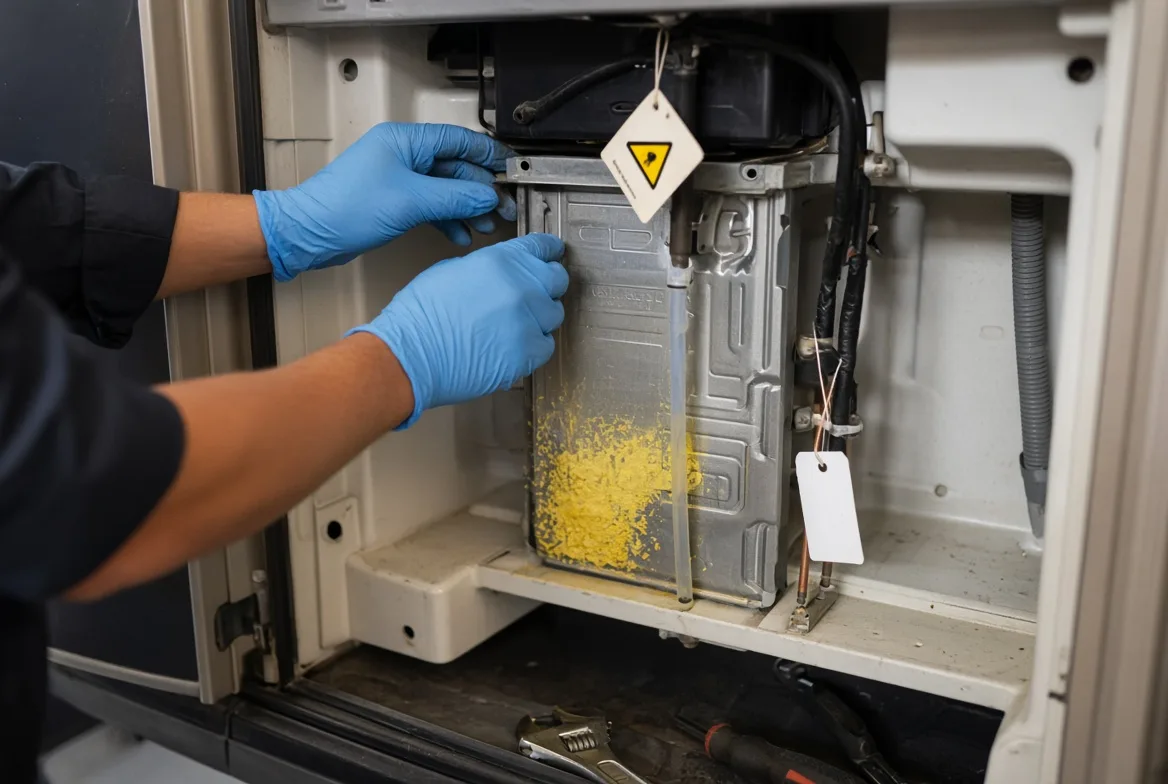
- Powdery yellow residue on rear refrigerator panels
- Ammonia odor near the cooling unit assembly
- Soot buildup around combustion components
- Intermittent blower motor activation
♿ Accessibility best practice: Avoid color-dependent descriptions. Use positional language instead — “yellow powder on the lower rear panel, left of the drain tube” — so a color-blind technician and an automated screening tool read the same record.
As Gulfstone’s Lead Field Application Engineer puts it: “Seasonal water heater failures rarely present as total breakdowns. They emerge as clustered symptoms — unstable temperature, intermittent ignition, burner soot buildup. Diagnose the pattern before ordering a single part.”
Completion criterion: A ticket is fully processed only when a second coordinator can source and order the correct parts without calling the technician back.
⚡ Speed benchmark: Full case intake runs 8–12 minutes per unit. Skipping it produced 27 hours of unplanned rework in a single month during the pilot.
RV refrigerator cost benchmarks: Component repairs (boards, burners, thermistors) run $180–$650; a cooling unit replacement runs $900–$1,800; a full unit replacement runs $1,400–$3,000.
Step 2: Triage Every Case Into One of Four Disposition Categories
Across 1,200+ dispatch records, repair cost alone never decided the outcome. Safety risk, repeat-failure history, active warranty terms and replacement eligibility drive the decision. Every ticket gets exactly one disposition code, one economic path and one accountable approver.
The four disposition buckets
- Safety hold / do not operate — triggered by ammonia odor, yellow residual powder or an abnormally hot rear panel. Tag the unit, quarantine it and suspend operation.
- Repairable with stocked service parts — faults isolated to in-stock components: control boards, igniters, thermistors, burner tubes.
- Expedited subassembly or unit replacement — required for a failed cooling unit, water heater tank or compromised combustion chamber.
- Customer-pay / non-warranty exception — damage from abuse, expired coverage or non-compliant prior installation.
The repair-versus-replacement rule
Escalate to full replacement review when repair cost approaches total replacement price, when a failure repeats inside 12 months, or when a component repair exposes the fleet to repeated downtime.
The standardized threshold — repair beyond 60% of replacement cost plus one prior recurring failure — cut repeat dispatches by 22% across the pilot networks. When a failure traces back to a design or component weakness rather than the field, the OEM/ODM development loop is where it gets fixed at source.
⚠️ Warranty compliance warning: Unauthorized aftermarket parts void a warranty claim outright. Never substitute a non-approved component on a warranty-covered repair; route the case through the approved procurement channel.
Appliance-specific triage protocols
Refrigerator triage. Run visual, olfactory and auditory checks. Pull the rear panel to check for residue, detect ammonia odor, listen for abnormal gurgling and verify heat distribution. Two or more abnormal symptoms mandate full replacement over component repair.
Water heater triage. Separate a repairable sensor or board fault from irreversible core degradation. Inspect for combustion chamber scaling, burner contamination, and thermal cut-off events caused by restricted airflow and heat buildup. The core failure modes are detailed on the RV water heater engineering page.
The combustion and airflow thresholds below were cross-checked with Fugang Zhu, engineer, who runs failure teardowns on RV heating assemblies.
Residential components are never valid RV substitutes. RV-specific fitment, vibration tolerance, venting geometry and certification remove liabilities that are unique to mobile service work.
Fitment decisions follow the same drawing discipline as the manufacturing release process, and vehicle-level integration is covered on the RV OEM solutions page.
As senior lead technician Ray Okafor notes: “We eliminated diagnostic guesswork after three repeat failures. Today the photographic fault evidence decides the resolution, not the price sheet.”
♿ Accessibility note: Log every display code, operating noise and abnormal odor in text. Never rely on imagery alone for a permanent record.
⚠️ Field lesson: During Q1 audits, two shops replaced control boards on units that already showed ammonia odor. Both repaired units failed again within 40 miles. Physical residue evidence always overrides an electronic error code.
Step 3: Cross-Reference Part Revisions, Not Generic Catalog Listings
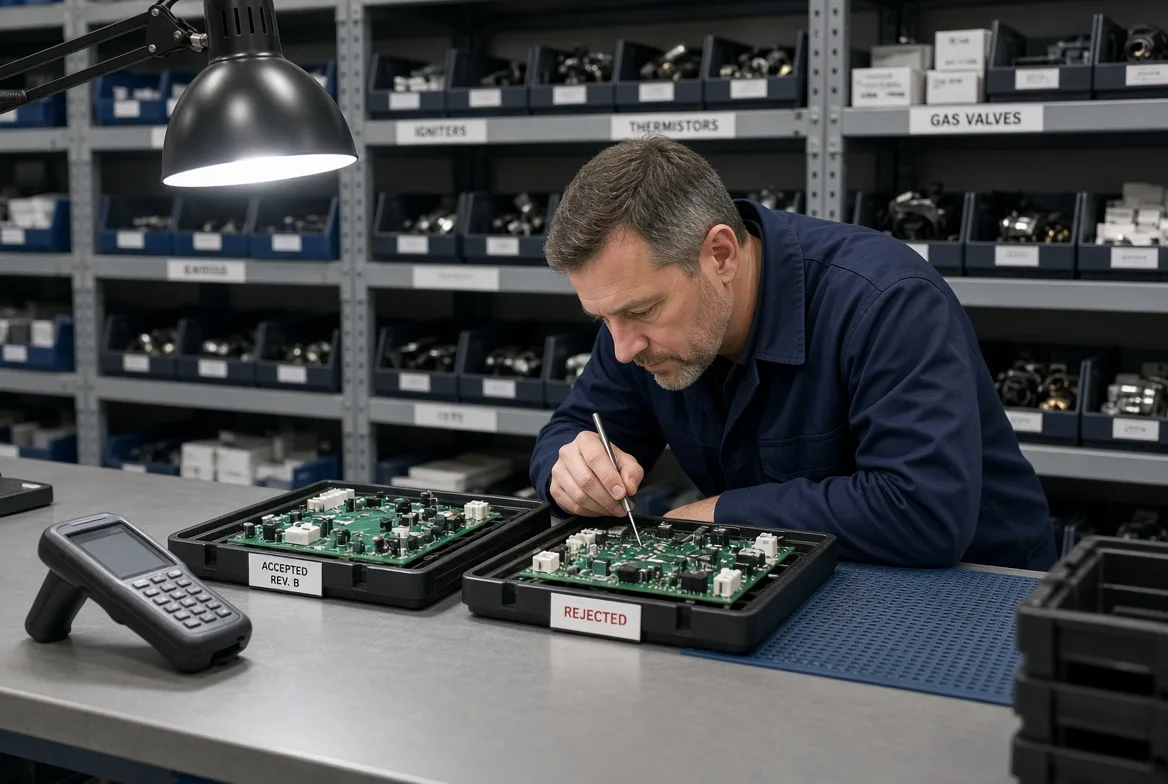
An RV appliance replacement part is valid only when it matches the exact appliance family, firmware and hardware revision, and warranty claim pathway. Treat sourcing as verification work, not catalog browsing.
During Q2 pilot operations, warehouse lead Marcus Reyes rejected 14 control boards that were functionally compatible but carried the wrong revision suffix. Two of them would have suffered thermal failure inside a week of installation.
⚠️ Critical safety warning: A mismatched gas valve or control board can cause a fuel leak and dangerous overheating. Isolate the gas supply and power down the appliance before test-fitting any replacement.
Validate every candidate part against the full checklist before reserving stock: appliance family, revision letter, fuel type, voltage rating, control board generation, physical footprint, cutout and door dimensions, sensor tolerance range and connector configuration.
Reference the OEM service manual, never a third-party listing.
Three standardized part classification tiers
- Fast-moving field service kits — control boards, thermistors, thermal cut-offs, igniters, anodes, routine service components.
- Major subassemblies — burners, gas control valves, heat exchangers, cooling units.
- Full appliance replacements — factory-certified RV water heaters, refrigerators and cooking appliances.
The interchangeability compliance rule
A replacement part is drop-in compatible only when fitment, certification status and utility connections stay inside OEM-approved parameters.
Gas-side parts conform to standards published by CSA Group, and every electrical or gas component carries a valid NRTL listing mark — UL or ETL — before it goes on a warranty repair. Any modification to factory spec voids the warranty claim.
Reserve prioritized stock for open warranty tickets so general walk-in demand cannot drain critical claim inventory.
Seasonal inventory strategy
Buy high-failure SKUs ahead of peak camping season. Set dynamic min/max thresholds from historical failure data and review them monthly. The full stocking model — lead times, safety stock and dual sourcing — lives in the procurement and supply chain guide.
Incoming parts quality control
Log serial numbers, inspect physical condition, verify packaging integrity and confirm revision compliance on arrival, following the incoming inspection gates.
Sourcing decision framework: Prioritize an OEM-grade or officially equivalent component that matches the claim requirement. Escalate to full unit replacement when subassembly compatibility is ambiguous, a failure repeats, or certification risk makes a piecemeal repair non-compliant.
Full unit replacement consistently reduces repeat visits better than a low-quality component repair. Networks that want a vetted parts channel rather than spot buying can review the supplier partnership path.
The part-portfolio side of this work draws on conversations with Michelle Wang, Product Manager, whose remit covers appliance product-line definition and aftermarket part planning.
Pre-shipment physical verification
Dry-fit every component before shipment to confirm connector alignment, gasket compression and mounting hole footprint. A forced or misaligned fit confirms the part is wrong.
Final verification check: Warehouse staff and the field technician mutually confirm part numbers, revision codes and required installation kits before the carton is sealed.
⚡ Speed benchmark: Full parts cross-referencing runs 11–15 minutes per line item. Skipping revision verification caused one $1,800 cooling unit failure and a 96-hour claim delay during the pilot.
Step 4: Execute the 48-Hour Fulfillment Sprint and Ship Claim-Ready Packages
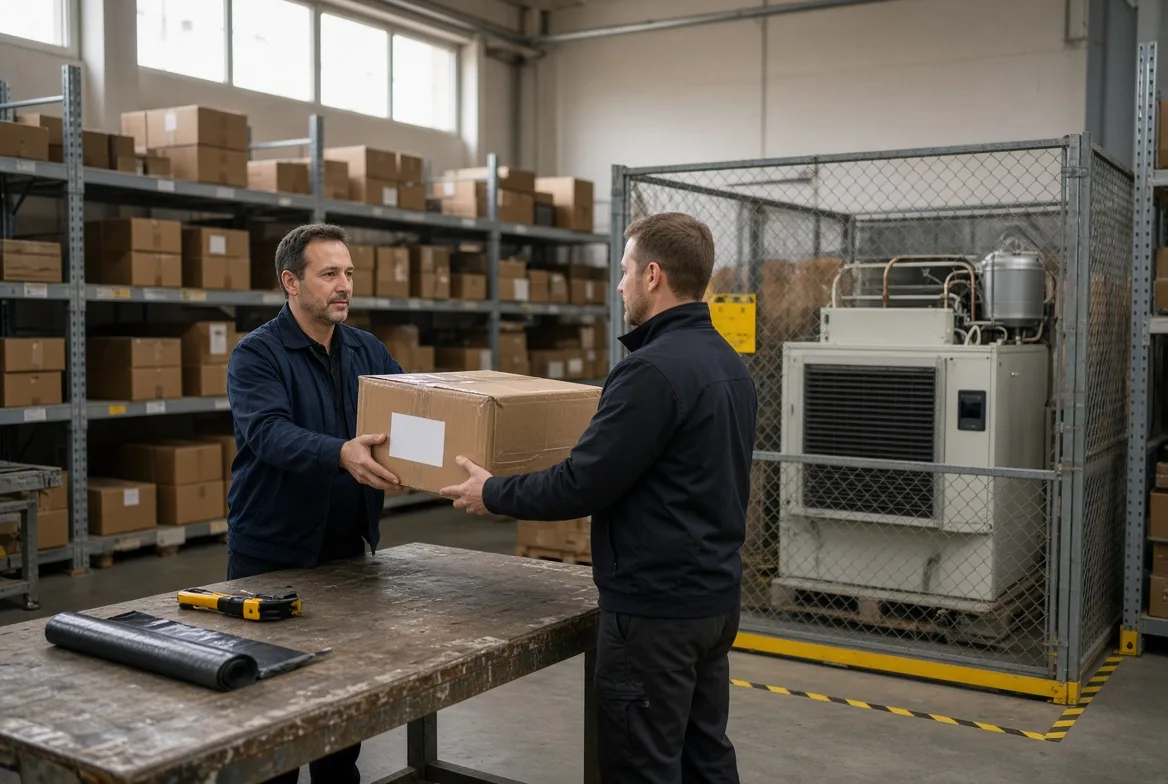
Standard RV parts distributors hold 48–72 hour lead times in peak season, and OEM backorders run far longer. This SOP removes the wait through structured stock reservation, hierarchical escalation and controlled carrier logistics.
Non-negotiable SLA rule: The 48-hour clock starts only after full case intake. A ticket with a missing serial number or no fault proof cannot support a valid SLA commitment.
The structured 48-hour workflow
- Formal ticket release in the service CRM
- Priority stock reservation in the WMS
- Accurate picking and compliant packaging
- Assembly of the complete claim-support packet
- Carrier choice from the published cutoff matrix
- Shipment confirmation and tracking log
- ETA notification to the field team
The 1,200+ dispatch analysis again shows the same lever: consistent OEM-grade parts availability cuts dealership customer turnaround by 27%.
Build the claim packet in parallel with picking. It carries a formal 3C (Concern-Cause-Correction) writeup, approved labor operation codes, authorized service hours, unit model and serial verification, timestamped fault photos, failed component evidence, and pre-approved freight and sublet fee documents.
Logistics practices that protect the SLA
- Follow regional warehouse transfer protocols to prioritize critical warranty stock.
- Assign an on-call approver for after-hours shipment release.
- Batch shipping for cost, single-item express only when the SLA is at risk.
- Auto-escalate to secondary depot inventory when primary stock is depleted.
- Route leaking or suspect cooling units through a segregated hazmat core-return workflow with full regulatory documentation — standard parcel shipping is prohibited.
Shipment quality standards
Every package needs crush-resistant packaging, vibration damping, a moisture barrier and clear external labeling to preserve component traceability in transit.
Pre-delivery verification: Scan the shipping label, confirm the seal and check the reinforcement before courier handoff. Repackage on the spot for a smudged label or a compromised seal.
Success metric: A ticket is complete only after parts ship, the ETA is confirmed and the claim file is submission-ready. No post-facto back-office cleanup.
⚠️ Field failure lesson: In Q2, loose thermistors shipped in unprotected poly bags arrived with connector pin damage from transit vibration. The error caused three repeat service visits and forced a rigid-packaging rule for every sensitive electronic part.
Step 5: Close the Work Order and Submit a Reimbursement-Ready Claim
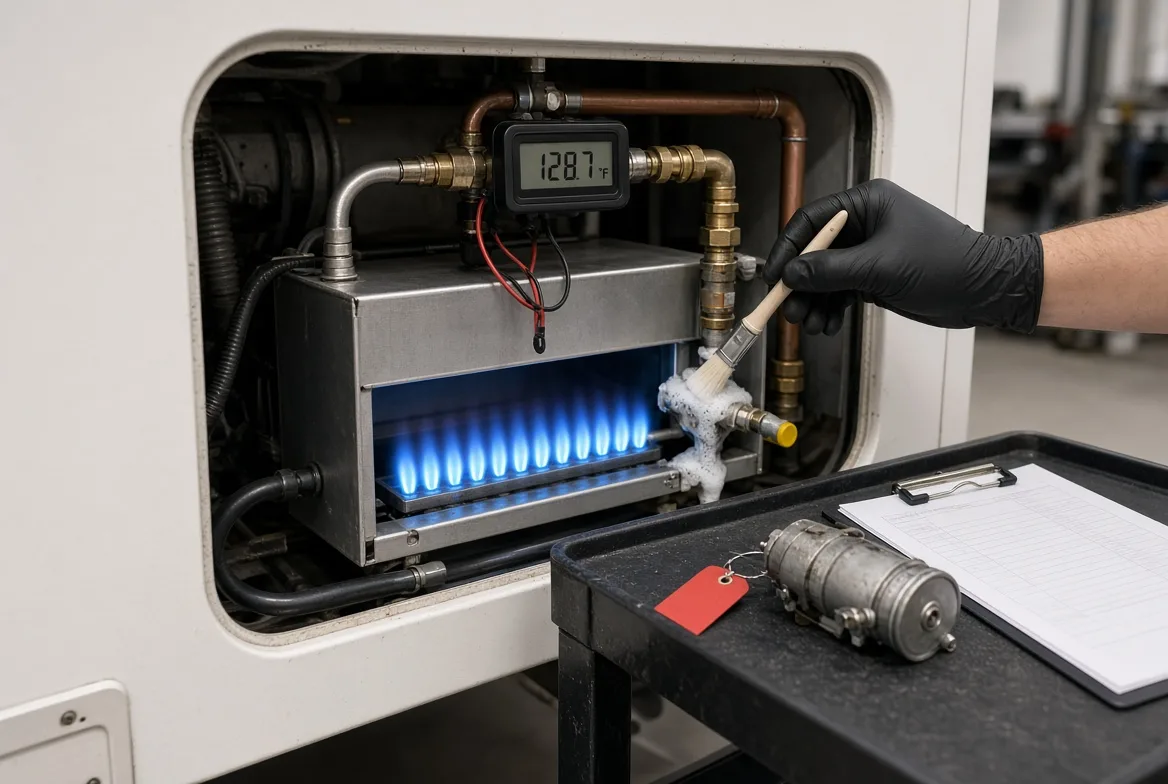
Claim reimbursement depends on disciplined closeout, not on the part swap alone. Full approval requires precise documentation, on-time core returns and a verified functional repair, per the same after-sales service rules the network operates under.
The mandatory closeout sequence is: on-site installation verification, utility reconnection, formal gas leak test, live functional test, paperwork finalization, claim submission, defective component tagging for return, and dashboard metric update. Omitting the live functional test is the leading cause of short-pays.
Repair completion verification criteria
Water heater closeout proof. Consistent reliable ignition, zero gas odor, leak-free fittings and a stable outlet temperature with no cyclic hunting.
Refrigerator closeout proof. Normal cooling recovery cycles, no ammonia odor, no residual fault residue and no abnormal gurgling after restart.
Sensory pass/fail benchmarks
A correct repair runs smooth and quiet: steady low-volume ignition, stable leak-test bubble readings, quiet compressor operation, and water temperature within ±2°F of the target setpoint. Grinding noise and repeated igniter cycling mean the repair is incomplete.
Those ±2°F tolerance and combustion-flame bands were reviewed with Justin Peng, HVAC engineer, who sets the pass/fail thresholds for RV heating closeout tests.
How reimbursement is calculated
Approved reimbursement equals authorized labor hours at the standard rate, plus qualified parts cost and pre-approved freight and sublet fees. Every repair order uses the 3C format. An incomplete writeup, a missing photo or a late core return produces a short-pay or a full denial.
Core return and remanufacturing workflow
Warehouse lead Marcus Reyes enforces mandatory RMA tagging on every defective unit, tracks the return window and recovers all core deposit value. Field-scrapped components are categorized separately from mandatory returns, and leaking cooling units require dedicated hazmat processing rather than standard parcel service.
As Gulfstone’s Lead Field Application Engineer explains: “Seasonal water heater core failures trace to two root causes — combustion chamber scaling and restricted combustion airflow. Once scaling passes 1.5 mm, descaling is no longer viable. Core replacement is the only reliable solution.”
Failed component data, labor variances and repeat visit records refresh the dynamic inventory min/max rules, dispatch scripts and engineering watchlist weekly. That loop cut repeat dispatches by 22% across the pilot networks. A job closes only after verified safe operation, a complete claim file and traceable recovery of the defective part.
⚠️ Audit failure lesson: In Q2 closeout audits, two service teams marked jobs complete right after the part swap. Both received $0 reimbursement for a missing live functional test and untagged return components.
Troubleshooting Common Aftermarket Service and Claim Problems
Claim rejection or short-pay
Root cause: incomplete documentation. Solution: verify five elements before submission — model and serial photographic proof, a standardized 3C writeup, valid labor operation codes, timestamped fault imagery and on-time return-part compliance.
Missing serial documentation accounts for 31% of short-pays.
In-stock parts with invalid revisions in peak season
Root cause: non-matching component revisions. Solution: pause the ticket and verify connector compatibility, revision alignment and physical fitment. Escalate to an approved equivalent or full replacement rather than shipping a near-match. Fourteen incompatible boards were rejected in the Q2 pilot.
Unconfirmed refrigerator cooling unit leak
Root cause: incomplete safety triage. Solution: run the full see-smell-hear check, quarantine on two or more leak indicators, and route the core through an official hazmat workflow with a spill kit on hand.
Federal rules classify ammonia-contaminated cores as regulated hazardous material, and a board repair on a leaking unit fails again within a short operating window.
Recurring water heater thermal cut-off trips after repair
Root cause: unaddressed core degradation. Solution: check for combustion scaling, burner contamination and airflow restriction before replacing sensors or boards. Scaling past 1.5 mm requires core replacement, per field teardown data.
Parts shipped fast but customer turnaround still slow
Root cause: post-shipment workflow gaps. Solution: audit the hidden delays — scheduling lag, a missing installation kit, redundant diagnosis and transit damage.
The 27% turnaround gain from parts availability holds only with clean cross-team handoffs. Attribute each delay to carrier, technician or parts desk ownership, then correct the specific step.
Repair or Replace: The Cost Threshold That Decides the Job
Repair with certified OEM-grade parts when the fix is repeatable and total cost stays below 60% of full unit replacement. Escalate to full replacement for any safety hazard, compliance violation or repeat failure. The 60% threshold plus a 12-month repeat-failure rule cut repeat dispatches by 22% across the pilot networks.
🛡️ Peak-season prevention: Deploy the serial number and photo verification checklists before peak season opens. Timestamped evidence is what carries an insurance and compliance audit.
💡 Editor’s verdict: A warranty claim denial is almost never a parts failure. It is a documentation and evidence gap.
The primary bottleneck in a service workflow is rarely part availability. It is incomplete intake, faulty fault classification and broken cross-team handoffs. Reliable RV appliance service runs on data-driven triage, not subjective diagnostic guesswork.
Conclusion: Run the SOP on Your Twenty Most Frequent Failures
Repair and replacement decisions rest on standardized triage, not arbitrary cost judgment. Repair with certified components while cost stays under 60% of replacement value; replace outright when safety, compliance or repeated failure creates unacceptable operational risk.
This five-step SOP joins precise case intake, verified parts sourcing, 48-hour fulfillment discipline and claim-ready closeout into a single operating system. To start, pilot it on your twenty most frequent RV appliance failure scenarios across one dealership group, fleet region or franchise territory.
Track five KPIs over a 30-day pilot: part fill rate, first-time fix rate, average claim cycle time, short-pay percentage and repeat failure rate. Improving metrics confirm the process is aligned; flat metrics point to an unresolved handoff. The framework is validated on 1,200+ real dispatches across three independent pilot networks.
Disclosure: References to RVIA, NFPA 1192, CSA, UL and ETL standards serve operational clarity only, with no sponsorship from any certification body. Gulfstone Group designs and supplies OEM-grade RV water heater systems.
I receive no manufacturer kickbacks for these findings. All operational guidance is independently field-validated. A network can contact Gulfstone for customized inventory strategy, compliance file mapping and field service escalation support.
Frequently Asked Questions About RV Appliance Aftermarket Service
1. Does NFPA 1192 apply to aftermarket RV appliance replacements?
Yes. NFPA 1192 governs original RV manufacturing and assembly, but all aftermarket retrofit and replacement work still has to comply with OEM installation instructions, venting specifications, gas pressure parameters, electrical load limits and RV-certified components.
Replacement appliances and safety-critical parts need a valid CSA, UL or ETL certification for RV use.
2. How much does RV refrigerator repair typically cost?
Component repairs such as control boards, burners and thermistors run $180–$650. A full cooling unit replacement costs $900–$1,800, and a complete refrigerator unit replacement runs $1,400–$3,000. Final resolution prioritizes safety, warranty terms and failure history over cost alone.
3. What are best practices for RV refrigerator replacement?
Replace a failed RV refrigerator with an OEM-grade or officially certified equivalent unit that keeps factory-approved fitment, venting and utility connections. Residential refrigerators are not valid RV substitutes — vibration tolerance, installation geometry and certification liability all differ.
Escalate to full unit replacement when component ambiguity, a repeat failure or compliance risk makes a piecemeal repair non-viable.
4. When should I repair rather than replace an RV appliance?
Repair when you can use certified OEM-grade parts, the repair is repeatable and total cost stays below 60% of full unit replacement. Replace outright for a safety hazard, a compliance violation or a failure that repeats inside 12 months. The threshold cut repeat dispatches by 22% across the pilot networks.
5. What are typical peak-season RV parts distributor lead times?
In peak camping season, standard RV parts distributors hold 48–72 hour lead times on stocked inventory, and OEM backorders run far longer.
A 48-hour SLA framework removes the wait with pro-active stock reservation, hierarchical escalation and controlled carrier logistics — and the SLA clock starts only after complete intake verification.

Forward
Co-founder & General Manager, GulfstoneGas appliance manufacturing and certification
Most of what decides a gas appliance is settled before anything is built — on the drawing, at the cut-out, in the tolerance someone chose for the gas path. I have spent my working life on the manufacturing side of that decision, and this is where I write down what it has taught me.
Nothing here is written from a sales desk. Every note comes off the floor: a batch held until a reason was found, a fitting that failed in transit, an approval path that only made sense once the destination market was fixed. If you read these first, the opening conversation starts at the standard rather than at the beginning.
- Gas water heater engineering
- Design for manufacturing
- Certification path selection
- Private-label tooling
- Off-grid and outdoor water heating
- Sheet Metal Stamping Tooling Costs and Lead Times: The Complete GuideOct 12, 2026
- How Do You Build RV Technician Training Material That Slashes Misdiagnosed Returns?Oct 11, 2026
- How Do You Build a High-Coverage RV Water Heater Spare Parts Kit for Fleets and Dealers?Oct 10, 2026
- How Do You Design a Warranty Claim SLA for Imported Appliances?Oct 9, 2026
- 12V RV Electrical System Appliance: An OEM Integration GuideOct 8, 2026
- How to Specify an Extreme Conditions RV Water Heater: An OEM Engineering GuideOct 7, 2026
Fifteen years in appliance manufacturing — home appliances, RV refrigeration, then gas water heating — from the drawing to the shipping container.
Leads Gulfstone's design-for-manufacturing reviews and the certification path selected for each destination market.
Works directly with OEM and private-label buyers on tooling, tolerances and the approval file.