Table of contents
- Key Takeaways
- Prerequisites: Product Facts, Official Sources and the Fuel-Source Call
- Four Steps From HTS Line to Resolved Duty
- Troubleshooting Section 301 Exposure: Where Entries Fail
- Conclusion: The Duty You Can Defend at the Broker Desk
- Frequently Asked Questions About Section 301 Tariffs
- 1. Is Section 301 a tariff?
- 2. Do Section 301 exclusions still exist?
- 3. What HTS code is an RV water heater?
- 4. Do gas and electric RV water heaters carry the same Section 301 rate?
- 5. How do I calculate landed cost for Section 301 goods?
- 6. Can a temporary import bond remove a Section 301 duty?
- 7. What documents should travel with a Section 301 shipment?
Key Takeaways
- A Section 301 duty attaches to one HTS line, one Chapter 99 heading and one entry date. It is not a flat China rate you can apply across a mixed invoice.
- A finished gas RV water heater classifies in 8419.11.00. Its parts line, 8419.90.10.00, sits on the same Section 301 list at 25%, with a Free base rate underneath.
- An electric RV water heater classifies in 8516.10.00, which sits on a different list at 7.5%. A gas unit and an electric unit in one container can carry two different Section 301 rates.
- Heading 9903.88.69 excludes specific products through 11:59 p.m. EDT on November 9, 2026. Neither water-heater line appears in that exclusion list, so the exclusion is not available to this product.
- The July 24, 2026 forced-labor action adds 12.5% for Chinese-origin goods under heading 9903.05.31. Model it as its own line, not as part of the older Section 301 rate.
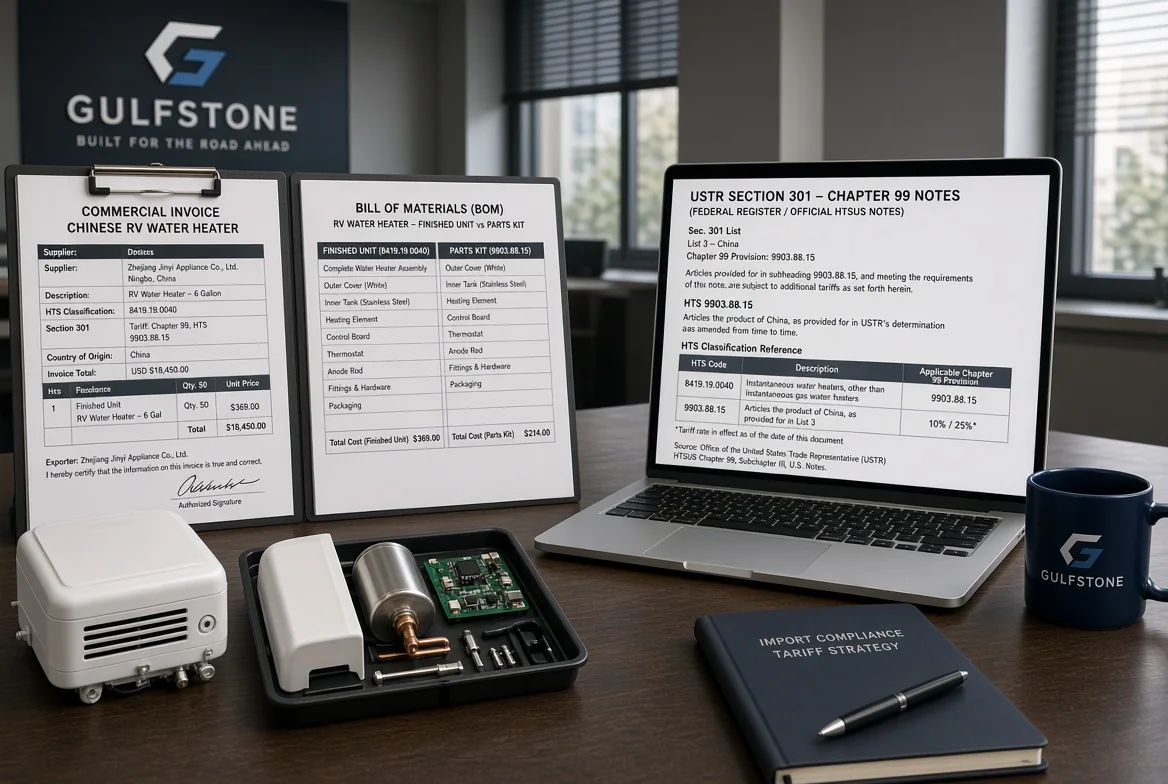
A Section 301 tariff is not a universal rate. It attaches to a specific HTS line, a specific Chapter 99 heading and a specific entry date, and it changes when any one of the three changes.
That is why two heaters in one container can carry different duty, and why a duty model built last quarter can understate or overstate a shipment by five figures.
Exposure is verified before a purchase order locks, in the order a licensed broker reads the file: classify, pair the Chapter 99 heading, then cost it. Budget 60 to 90 minutes for a first pass across one SKU family; the second shipment takes far less.
Prerequisites: Product Facts, Official Sources and the Fuel-Source Call
Section 301 screening is a document exercise before it is a tariff exercise. Gather the commercial invoice draft, the packing list, the spec sheet with a nameplate photo, and the exploded BOM with supplier declarations split by country of origin.
The sources worth bookmarking are the USITC Harmonized Tariff Schedule, the USTR Section 301 tariff-actions page and the CBP user fee table.
Start With the Fuel Source, Not the Sales Name
The decision that moves the most money is whether the unit is gas or electric. CBP ruling H343451 moved an electric water heater module from 8419.89.95 to 8516.10.00 after a protest in October 2025.
That correction changes the Section 301 list as well as the base line, because the two headings sit on different China lists.
⚠️ Caution: Do not claim an exclusion unless the ten-digit line and the product description in the exclusion notice both match. A generic “RV water heater” description is not a match. Neither is a neighbouring statistical line in the same subheading.
♿ Accessibility: When you cite a screenshot in the import file, describe the row in words: “8419.90.10.00, parts of instantaneous or storage water heaters, General rate Free.” Colour marks and highlights do not survive a screen reader or an exported PDF.
Four Steps From HTS Line to Resolved Duty
Each step produces a document the next one depends on, so keep them in order. A model built before the classification settles gets rebuilt anyway.
Split the item first, because a mixed “heater kit” forces two entry lines and two duty calculations.
Step 1: Classify the Finished Unit, Replacement Part or Subassembly Kit
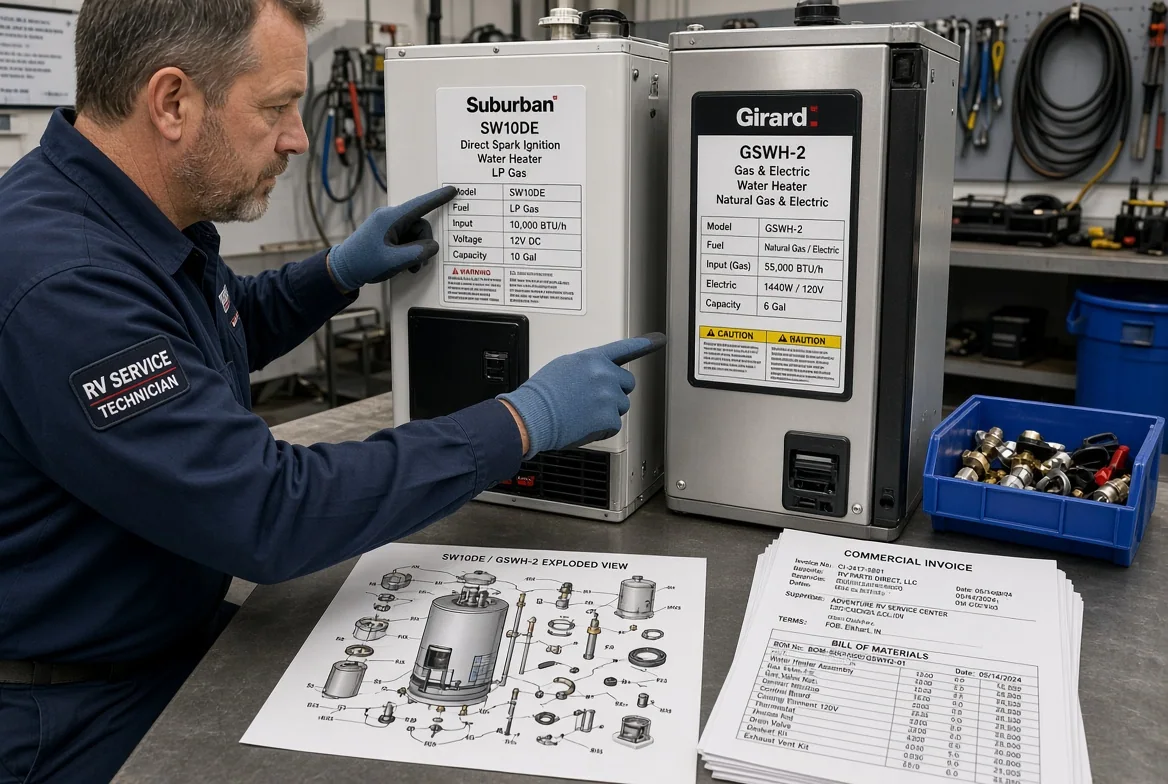
Start with the split, not the code. Every import file contains some mix of finished units, replacement parts and subassembly kits, and each one goes to a different line.
Read the nameplate before the spec sheet. It carries the fuel, the input rating and the model family, which are the facts CBP treats as physical.
Then apply the fuel-source call. Electric units leave heading 8419 for 8516.10.00. Parts of non-electric instantaneous or storage water heaters fall into 8419.90.10.00.
Run one check across the set: the HTS line, the invoice description and the supplier declaration must match in plain language. Read all three aloud, in order.
Gulfstone’s Shenzhen desk hit this on a 2026 file. The client had assumed every RV heater on the PO belonged in 8419. The corrected file split a gas parts line under 8419.90.10.00 from an electric unit under 8516.10.00, and the broker signed off on the split.
That is classification discipline, not gaming.
⚠️ Experience warning: An invoice that reads “heater kit” is not a classification. One reviewed kit contained a finished electric unit plus loose parts, which forced the entry into two lines after the cargo had sailed.
Write one scope sentence into the file before moving on: “Model X is a non-electric, gas-fired, instantaneous RV water heater.” Save it beside the nameplate photo and the BOM.
When the nameplate and the spec sheet disagree, the nameplate wins and the supplier confirms the difference in writing. That confirmation belongs in the drawing and nameplate record that travels with the model into later shipments.
For the code-side view of the same screen, see how to read the HSN code for a gas water heater. Use it when the product line is new to the buyer.
Step 2: Pair the Base HTS Line With the Correct Chapter 99 Heading

A correct HTS line is not a correct Section 301 result. The base line sets the ordinary duty. The Chapter 99 heading sets what China adds, and that is where most Section 301 tariff exposure on RV water heater parts is decided.
Open the Chapter 99 notes in the live HTSUS and find the U.S. note that lists your eight-digit subheading. The note letter identifies the heading, and the heading carries the rate.
For this product family the pairing works like this:
| Base line | Section 301 heading | Rate added | Base rate |
|---|---|---|---|
| 8419.11.00, instantaneous gas heaters | 9903.88.01, List 1 | 25% | Free |
| 8419.90.10.00, parts of water heaters | 9903.88.01, List 1 | 25% | Free |
| 8516.10.00, electric heaters | 9903.88.15, List 4A | 7.5% | Free |
Read the table again. The gas unit and the electric unit are both “RV water heaters” on the invoice, yet they land 17.5 points apart on Section 301. A model that applies one blended rate gets both lines wrong.
Two checks decide whether the pairing holds: confirm the article still sits on the list you think it does, and test the exclusion heading against the ten-digit line rather than the description.
The exclusions under heading 9903.88.69 were extended through 11:59 p.m. EDT on November 9, 2026, by the Federal Register notice of December 1, 2025. Extension is not coverage, so read the enumerated lines inside the notice.
The exclusion does real work for other products in the same chapter. Heat exchanger plates, cores and finned tubes under 8419.90.3000 are named in that list, which is why a parts supplier can legitimately hold a 9903.88.69 eligibility letter while a finished heater cannot.
Neither 8419.11.00, 8419.90.10.00 nor 8516.10.00 appears in the exclusion list. If a broker quotes 9903.88.69 as available for this product, ask for the page.
Anchor the screen to the entry event, not the quotation date or the purchase-order date, because entry timing decides which action and exclusion apply. Save a dated copy of every USTR notice you relied on into the shipment folder, so a question three months later has an answer already filed.
Gary Cao, who works the China-to-US tariff file, reviewed the Chapter 99 pairing logic in this workflow. The trade-compliance background is useful for buyers new to Chapter 99.
Step 3: Build the Duty Stack on Dutiable Customs Value
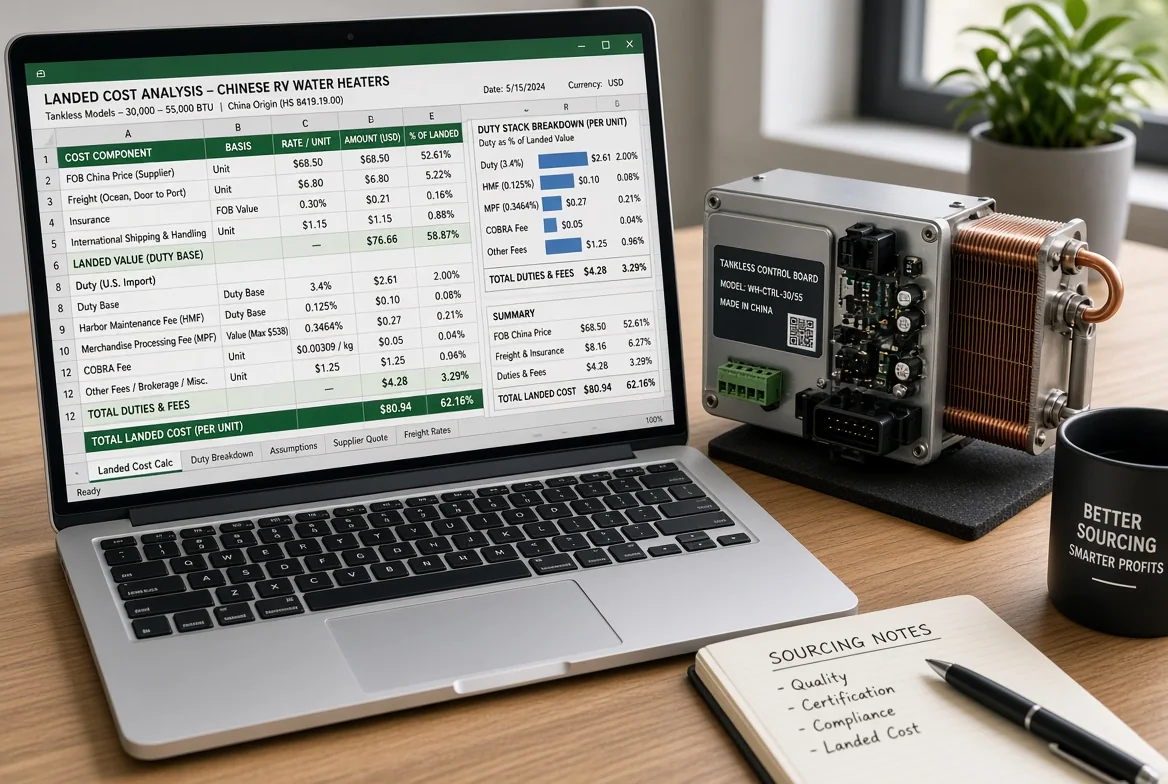
Every duty line rides on one number: dutiable customs value. Get that cell wrong and every row beneath it is wrong, even when the percentages are right.
Customs value is the invoice price plus dutiable assists and packing, with foreign inland freight excluded. Build it once, label the source, and point every duty and fee cell at it. The example is a 40HQ of 1,200 tankless gas RV water heaters at $95 FOB, with every input treated as a placeholder until your broker confirms it.
| Cost line | Basis | Amount |
|---|---|---|
| Customs value | 1,200 × $95, plus $4,000 assists | $118,000.00 |
| Base duty, 8419.11.00 | General rate Free | $0.00 |
| Section 301, List 1 | 25% under 9903.88.01 | $29,500.00 |
| Forced-labor Section 301 | 12.5% under 9903.05.31 | $14,750.00 |
| MPF | 0.3464%, inside the entry band | $408.75 |
| HMF | 0.125%, vessel cargo | $147.50 |
| Origin charges and ocean | 40HQ quote | $6,050.00 |
| Broker fee and ISF | entry filing | $220.00 |
| Drayage, chassis and warehousing | port to CFS, ten days | $1,545.00 |
| Inland delivery | to warehouse | $1,950.00 |
| Total landed | 1,200 units | $172,571.25 |
That is $143.81 per unit delivered against a $95 FOB price. The gap is almost entirely tariff, not freight.
The 12.5% line is conditional. The July 2026 forced-labor action applies to products of China under heading 9903.05.31 unless the line appears in the exemption lists, so verify your ten-digit line against the current notice before you model it. Holland & Knight’s analysis explains how the layers stack.
✅ Verification: The customs value used for base duty, Section 301, MPF and HMF must be the same cell in every row. If one row points at the invoice total instead, fix it before anyone reads the bottom line.
The full six-step audit, including accessorials and container loading counts, sits in the landed-cost model walkthrough. This section applies it to one product family.
Step 4: Assemble the Entry-Ready Packet and Make the Release Call
A clean duty model can still fail at the broker desk over one stale certificate. Document quality, admissibility risk and delay costs widen the gap between invoice price and true landed cost even when the math is perfect.
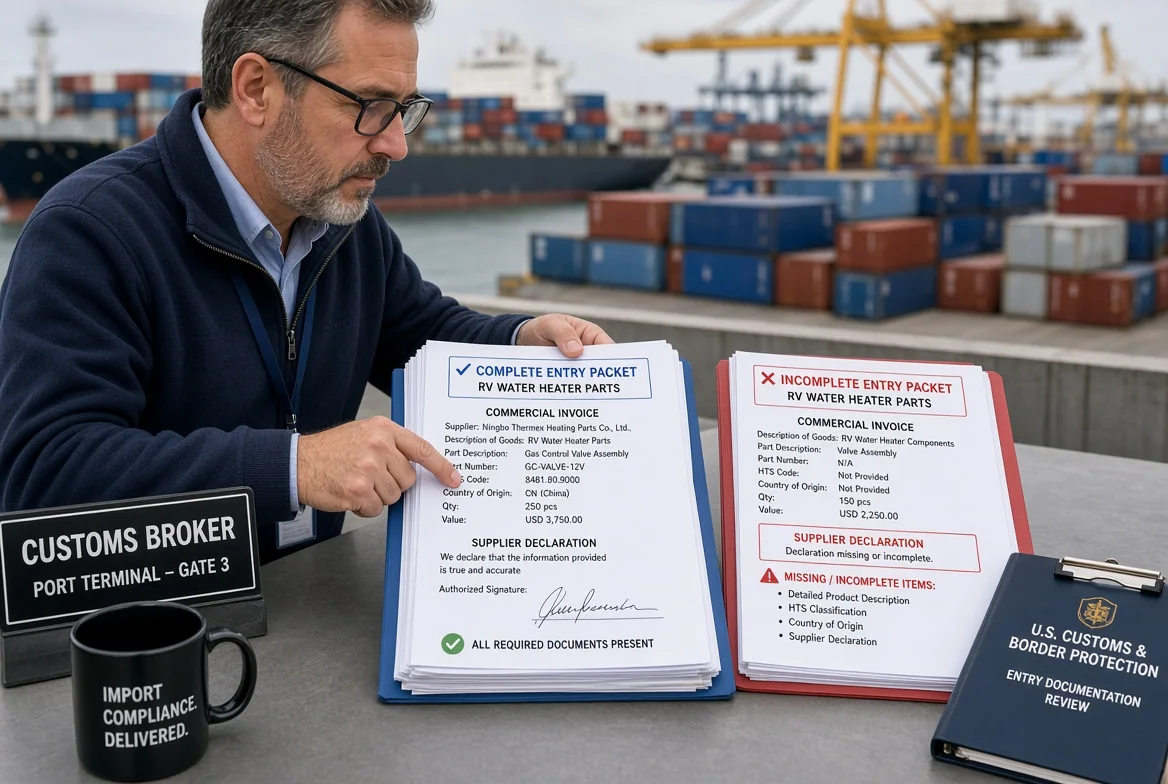
CBP expects a precise cargo description, and a missing or incomplete document set can trigger a review, an exam or General Order. One stale certificate can hold a container that the duty model already cleared.
Build the packet in the order the broker reads it: invoice with the HTS line and Chapter 99 heading, packing list, BOM by country, supplier declarations, certificates, and written broker instructions.
Then run one structural check. Ask how far upstream the origin map goes for aluminum, steel and wiring, and confirm it stops at the smelter, mill or wire drawer, with mill certificates behind it and kept in the factory record.
A complete packet feels calm. The broker files without chasing clarifications, the origin story matches across every page, and the folder reads as one narrative.
When the packet is complete, the release call is short: release the PO, reprice it, split the sourcing mix, or hold until the pack is finished.
🧠 Author’s take: A perfect duty model with a sloppy packet is a margin trap. Hold the PO for a missing mill certificate before trusting a lower invoice.
Troubleshooting Section 301 Exposure: Where Entries Fail
Most held entries on this product fail in the same places. Each one is visible in the paperwork before the vessel sails.
1. The team reuses last quarter’s HTS or exclusion logic
Section 301 treatment moves. A spreadsheet built before the July 2026 action may pair the wrong heading to the right line.
Fix: re-run the classification, the Chapter 99 pairing and the exclusion check for every quote and every shipment. Date the sheet.
2. The model applies one blended Section 301 rate
A mixed container of gas and electric units cannot carry one rate. The gas line sits on List 1 at 25% and the electric line on List 4A at 7.5%.
Fix: split the invoice by line before you build the model, and carry the heading next to each row.
3. A trade program is treated as an exemption
A temporary import bond or a free-trade zone moves cash flow. It does not erase a Section 301 duty that still applies to the goods.
Fix: read the CBP guidance before promising relief, and show the duty in the model even when the bond defers the payment.
4. The packet cannot support the claim
Missing supplier declarations, untranslated certificates or a vague description stall clearance. If the file is not resolved, cargo can go to General Order.
Fix: keep one indexed evidence folder with translated records, supplier declarations and a precise part description for broker or CBP follow-up.
💡 Diagnostic: Open last quarter’s spreadsheet only after you have opened the current USTR notice. The notice is the source; the spreadsheet is only ever a copy of it.
Conclusion: The Duty You Can Defend at the Broker Desk
A defensible Section 301 number is a classification, a live Chapter 99 pairing, an exclusion check and a fee calculation working from one customs value. It is not a single cell.
Three actions lock the file before the next booking window. Re-run the duty lines against the entry date. Send the classification and Chapter 99 instruction to your broker in writing, with the exclusion-status field never blank. Escalate any genuinely ambiguous SKU for a ruling before mass production.
Then make the commercial call. Reprice, dual-source, consolidate or stay with the current supplier, but only after the landed number clears your margin threshold.
For a second opinion on a classification or a document packet, the Gulfstone team reviews RV appliance import files before a PO commits. The product certificate file and the quality documentation answer the broker’s first question in Step 4.
Transparency note: Gulfstone builds these heaters under client brands, so it has a commercial interest in the classification. Rates were read live in October 2026 and are illustrative, not a ruling. Confirm with a licensed broker. I receive no manufacturer kickbacks for these findings.
Frequently Asked Questions About Section 301 Tariffs
1. Is Section 301 a tariff?
Yes, and it is an additional duty rather than a single rate. It attaches to a specific Chinese-origin article, its HTS line, its Chapter 99 heading and the entry date. Two products in the same shipment can face different Section 301 outcomes.
2. Do Section 301 exclusions still exist?
Yes, and heading 9903.88.69 runs through 11:59 p.m. EDT on November 9, 2026. It covers only the products whose ten-digit lines and descriptions appear in the exclusion notice. RV water heater lines are not in that list, so the exclusion does not apply here.
3. What HTS code is an RV water heater?
There is no single answer. A non-electric instantaneous unit classifies in 8419.11.00, its parts in 8419.90.10.00, and an electric unit in 8516.10.00. Split finished units, replacement parts and kits before choosing a line.
4. Do gas and electric RV water heaters carry the same Section 301 rate?
No. Under the current lists, 8419.11.00 sits at 25% and 8516.10.00 sits at 7.5%. The base rate is Free for both, so the entire difference comes from the Chapter 99 layer.
5. How do I calculate landed cost for Section 301 goods?
Build the duty stack on dutiable customs value, then add fees and logistics. Use invoice price plus assists and packing, and exclude foreign inland freight. Using the invoice total as the base overstates every duty row.
6. Can a temporary import bond remove a Section 301 duty?
No. A temporary import bond defers cash flow, but the additional duty still applies to goods that are covered. Treat the bond as a financing tool, not an exemption.
7. What documents should travel with a Section 301 shipment?
The commercial invoice, packing list, BOM by country, supplier declarations, certificates and a written broker instruction. Each one should use the same product description and the same HTS line as the entry.

Forward
Co-founder & General Manager, GulfstoneGas appliance manufacturing and certification
Most of what decides a gas appliance is settled before anything is built — on the drawing, at the cut-out, in the tolerance someone chose for the gas path. I have spent my working life on the manufacturing side of that decision, and this is where I write down what it has taught me.
Nothing here is written from a sales desk. Every note comes off the floor: a batch held until a reason was found, a fitting that failed in transit, an approval path that only made sense once the destination market was fixed. If you read these first, the opening conversation starts at the standard rather than at the beginning.
- Gas water heater engineering
- Design for manufacturing
- Certification path selection
- Private-label tooling
- Off-grid and outdoor water heating
- Top 8 Outdoor Portable Gas Water Heater Factories in China for B2B BuyersNov 4, 2026
- Custom RV Appliance Industrial Design: An OEM Brief to a Validated PrototypeNov 3, 2026
- How to Build Custom Thermostat UI Design Software for OEM Embedded PanelsNov 3, 2026
- Top 8 RV Water Heater OEM Suppliers Canada: Vetted for Volume BuyersNov 3, 2026
- Top 10 Portable Propane Water Heater Manufacturers USA: A No-Hype Buyer ShortlistNov 2, 2026
- PPWR Compliance Checklist for EU Water Heater Packaging: The 10 Documents Before the Container LoadsNov 2, 2026
Fifteen years in appliance manufacturing — home appliances, RV refrigeration, then gas water heating — from the drawing to the shipping container.
Leads Gulfstone's design-for-manufacturing reviews and the certification path selected for each destination market.
Works directly with OEM and private-label buyers on tooling, tolerances and the approval file.