Table of contents
- Key Takeaways
- What Does a Water Heater Bill of Materials Actually Control?
- Why Does an RV or Tankless BOM Differ From a Household Parts List?
- The Module Breakout: What Does Each Level 1 Line Carry?
- The 12V Ignition Chain: From Flow Signal to Flame Sensing
- Manufacturing QC Gates That Tie the BOM to Approval
- Pressure and Leak Testing: The Gate a Certificate Cannot Replace
- How Does the BOM Travel Down the Assembly Line?
- Key Benefits: Which BOM Lines Should You Lock First?
- Challenges and Limitations: Where a Strong BOM Still Fails
- Conclusion: A Control Document, Not a Quotation Attachment
- Frequently Asked Questions About Water Heater BOMs
Key Takeaways
- A bill of materials for a water heater is a manufacturing control document. It records approved suppliers, material grades, inspection points, MAWP and AQL, not a homeowner price list.
- The tested configuration is the certified configuration. A swapped valve, board or seal compound can leave a CE or CSA approval standing on paper only.
- RV units add vibration, freeze exposure and tight cutouts, so fasteners, seals and harness routing carry more weight than they do in a household unit.
- Lock the heat exchanger, gas valve, control board, blower, sensors, harness and seal kit first. Those lines gate certification and carry the longest lead times.
- A clean BOM still fails on unapproved substitution, missing service parts and voltage faults mistaken for board failures.
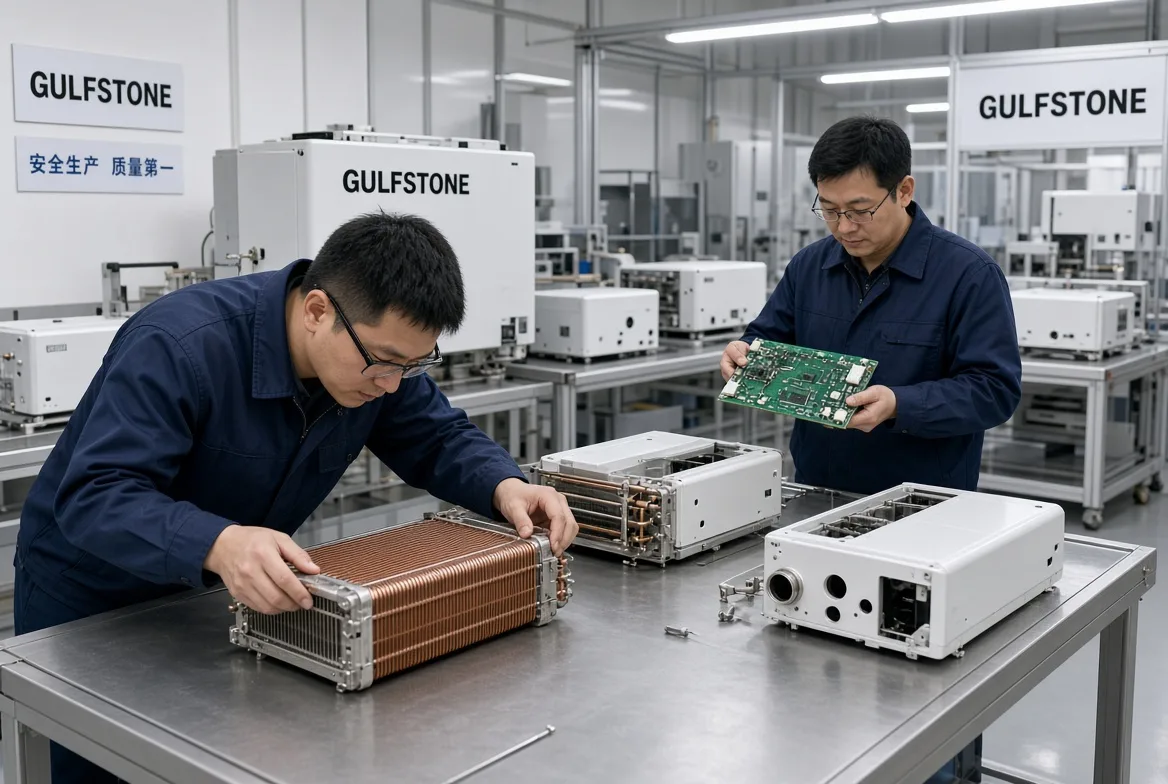
A bill of materials for a water heater lists the parts, materials and inspection points behind one approved design. Buyers often receive something else: a price sheet, or a spare-parts list copied from a catalogue.
On the Gulfstone line in Foshan, QA Manager Jingjing Lu checks material certificates at the receiving bay before a coil reaches assembly. Technician Wang then measures burner port spacing and housing fit-up at the bench.
Procurement, engineering and after-sales read different parts of the same file. Sourcing managers want approved suppliers and lead times. Engineers want interface dimensions and tolerances. Service desks want part numbers that match what actually ships.
What Does a Water Heater Bill of Materials Actually Control?
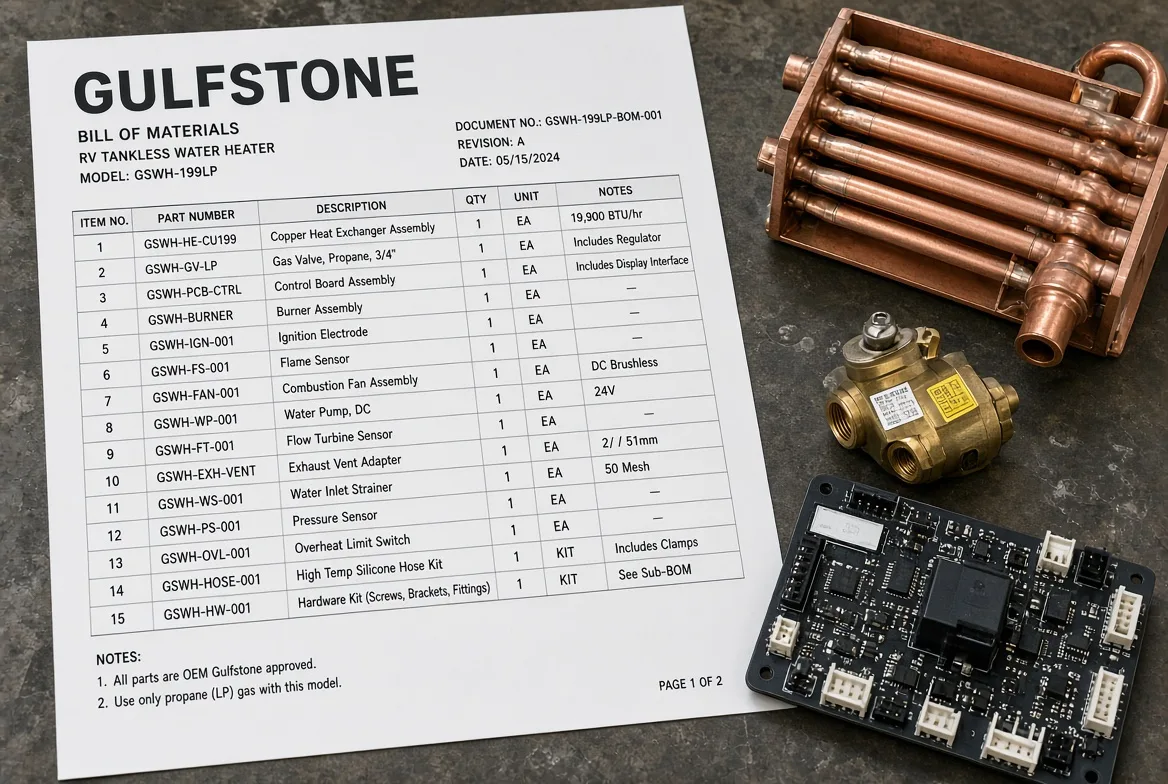
A bill of materials is a hierarchical record of every assembly, subassembly, part, raw material, fastener, label and packaging item in a finished unit. Gulfstone numbers it in five levels so a question can be answered at the right depth.
- Level 0 is the finished, approved unit.
- Level 1 is the module layer: casing, burner, heat exchanger, gas train, control assembly, venting, harness, seals.
- Level 2 is subassemblies inside a module.
- Level 3 is purchased or fabricated parts.
- Level 4 is raw material specification.
A components list is the Level 1 view: the major assembly families an RV water heater splits into. It is not a cross-brand spare-parts catalogue, and it is not interchangeable between models.
What separates a manufacturing BOM from a catalogue list is the data beside each line. The file names OFHC copper for the heat-transfer path, 304 or 316L stainless where corrosion matters, and the energy cut-off switch that backstops over-temperature.
It also records maximum allowable working pressure (MAWP), hydrostatic test pressure and the AQL inspection level for each lot. Those entries are what quality control audits against when a build comes up for review.
NFPA 1192 sets the installation and safety requirements for LP-gas appliances in RVs. A BOM that cannot point each requirement at a named part and an inspection step leaves the approval to chance.
💡 Key Insight: Procurement can trace an approved supplier and engineers can confirm a replacement dimension in the same file. That shared vocabulary is the real function of the document.
Why Does an RV or Tankless BOM Differ From a Household Parts List?
Household units sit on a fixed foundation with room around them. RV units travel, run on a 12V house battery, and install into a cutout the buyer cannot change once the cabinet is built.
An RV BOM leans on vibration-resistant fasteners with thread-lock, silicone or EPDM seals rated for thermal cycling, and brackets stiff enough to survive road shock. Hardware that passes a bench test can still crack a weld on a mountain road.
Tankless designs add a second pressure: compact geometry. Heat exchanger, burner and blower share a small enclosure, so tolerances tighten and the 12V control chain becomes the critical path.
Tank-style units prioritise pressure containment and standing heat loss instead. Their BOM carries anode rods, tank liners and thermal cut-outs, and module priorities follow the water vessel rather than the control board.
⚙ Technical Detail: Altitude and freeze exposure push spec decisions earlier. A unit validated in Foshan at sea level still needs a documented derating path for a buyer operating in the Rockies or the Andes, as the high-altitude specification work shows.
The Module Breakout: What Does Each Level 1 Line Carry?
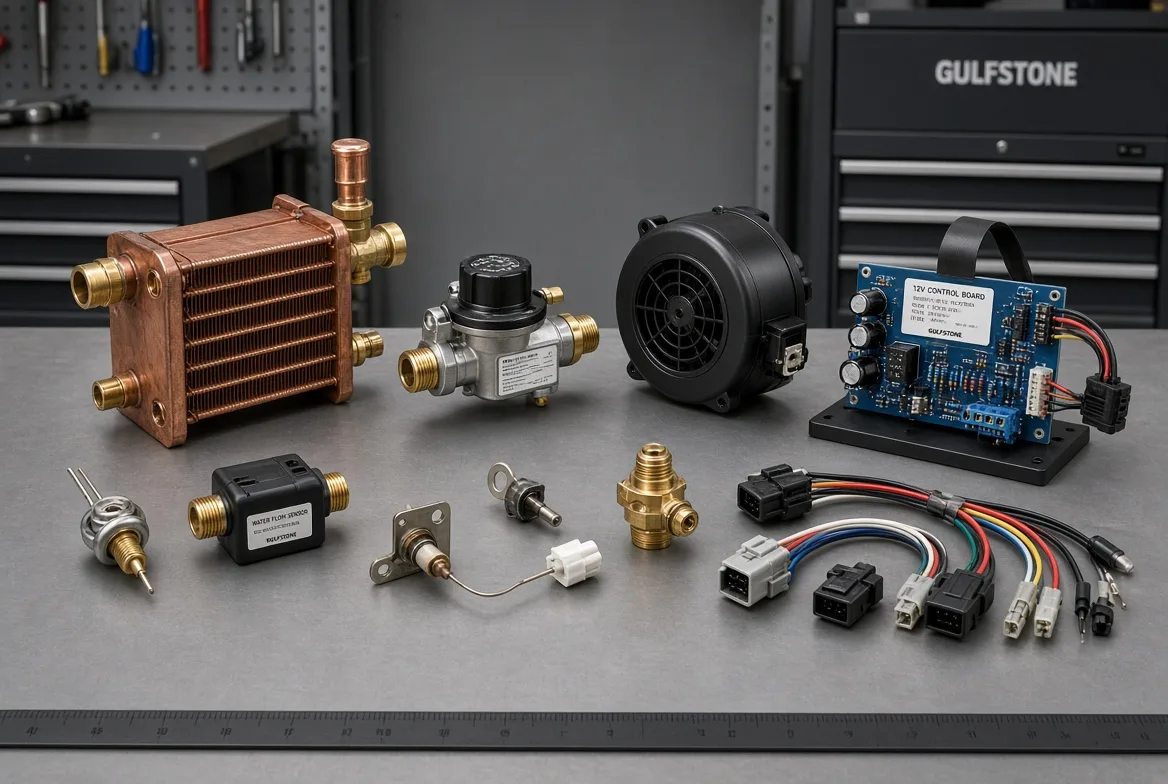
The breakout below is a Level 1 map of a flagship RV tankless unit. Each row carries a material grade, an inspection dimension and an engineering reason; drop any one and the row becomes a guess.
| Level 1 module | Material and spec | What inspection checks | Why the line exists |
|---|---|---|---|
| Outer casing and front panel | Sheet steel or aluminium to drawing | Flatness, hole alignment | Transit vibration cracks welds and loosens fasteners |
| Combustion chamber and burner | Stainless steel to drawing | Weld penetration, burner port spacing | An uneven flame raises carbon monoxide risk |
| OFHC copper heat exchanger | Oxygen-free copper tube to drawing | Wall thickness, bend radius | Thin walls transfer heat fast but must survive thermal cycling |
| Water inlet and outlet manifold | Brass or stainless to drawing | Thread pitch, O-ring groove depth | Leak-free connections under pressure |
| Gas valve train | Proportional valve and solenoids from the approved supplier | Gas-tightness, approval paperwork | Modulation control and a clean shut-off |
| Ignition and control assembly | 12V control board, spark electrode, flame sensor | Connector locking force, board standoff height | Vibration works connectors loose |
| Vent and flue set | Aluminium or stainless flue pipe | Wall thickness, joint fit | Correct draft and exhaust sealing |
| Wiring harness | Stranded copper, high-temperature insulation | Crimp pull force, strain relief | Voltage drop and chafing cause ignition faults |
| Seals and isolators | Silicone or EPDM to drawing | Durometer, compression set | Silicone handles heat; EPDM resists water and ozone |
| Mounting and packaging kit | Vibration-resistant fasteners with thread lock | Torque, packaging drop test | Road shock and shipping damage |
Material grades and tolerances belong in the file only when a factory record confirms them. A drawing revision, a supplier certificate and an incoming inspection report are the three documents that make a BOM line real.
Copper tube is a good example. The mill certificate states the grade and the wall thickness in millimetres, and ASTM B88 defines the tube standard the drawing cites. A certificate that cannot be matched to that string is a held lot, not a paperwork delay.
✅ Verification: No module leaves inspection until the measurement matches the drawing and the certificate chain for its material is complete.
The 12V Ignition Chain: From Flow Signal to Flame Sensing
The chain runs in a fixed order, and a fault at any step stops the ones after it. That is why the sequence is worth writing down once and testing in the same order every time.
- The 12V DC input or converter supplies power.
- The power switch closes the circuit.
- The flow sensor detects water movement.
- The control board wakes and starts the blower.
- The board checks the energy cut-off and high-limit safety.
- The spark electrode fires.
- The gas solenoid or proportional valve opens.
- Flame sensing confirms ignition and holds the valve open.
Low voltage sits underneath all of it. If battery or converter output drops below the operating threshold, the board may reset or refuse to open the gas valve, and the symptom looks exactly like a failed component.
That is the most expensive misdiagnosis in the category. A technician replaces a healthy board, valve or sensor, the unit works because the battery was recharged in the bay, and the same fault returns at the campsite a week later.
⚠️ Caution: Require a voltage log before any component swap on a no-start unit. Ten minutes with a multimeter is cheaper than a warranty claim on a part that was never faulty.
Manufacturing QC Gates That Tie the BOM to Approval
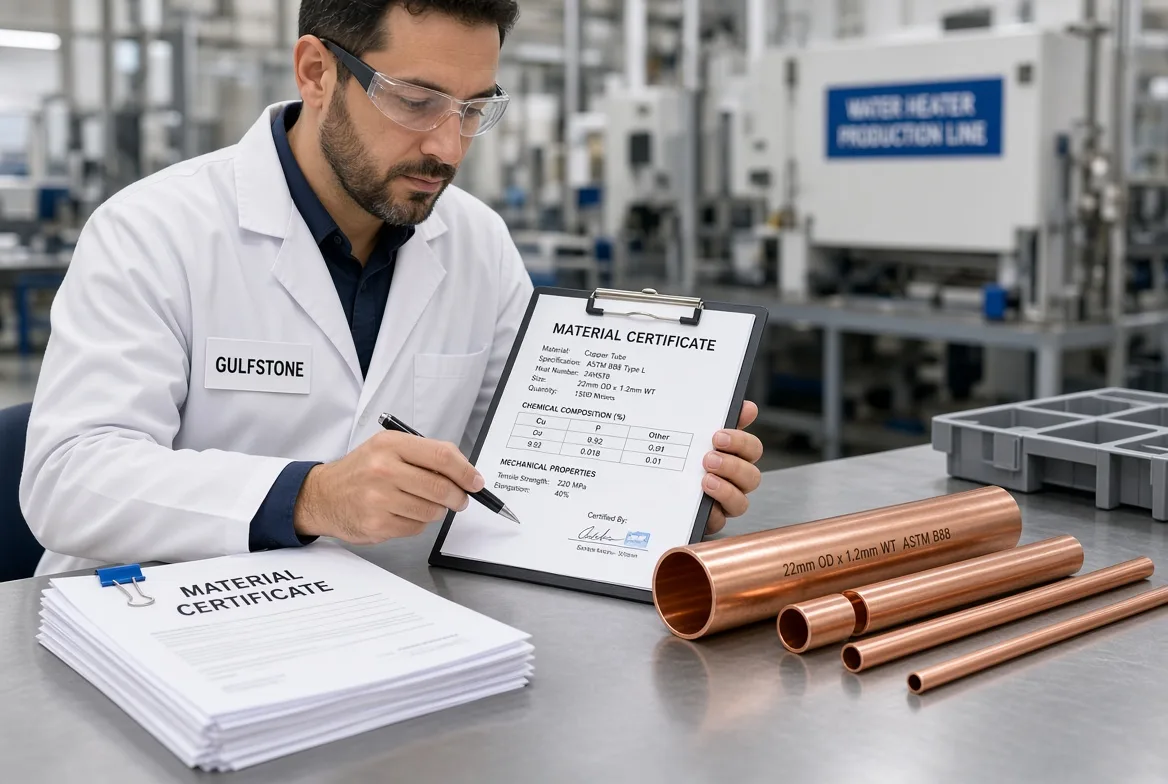
Approval is not a single test at the end. It is a chain of gates, and each gate answers a question the next one assumes.
Gate one is incoming material verification. Copper tube, gas-train parts and control boards arrive with mill certificates and approval paperwork, and the lot is held until the certificate matches the grade on the drawing.
Gate two is in-process fit: wall thickness, weld penetration and burner port spacing measured against the drawing while the unit is still open. Gate three is hydrostatic testing, and gate four is an air-decay leak test on the gas train.
The certification file is the record that all four gates ran. CSA Group and UL approvals attach to a tested configuration, so the build sheet, the test report and the certificate revision have to stay together.
Pressure and Leak Testing: The Gate a Certificate Cannot Replace
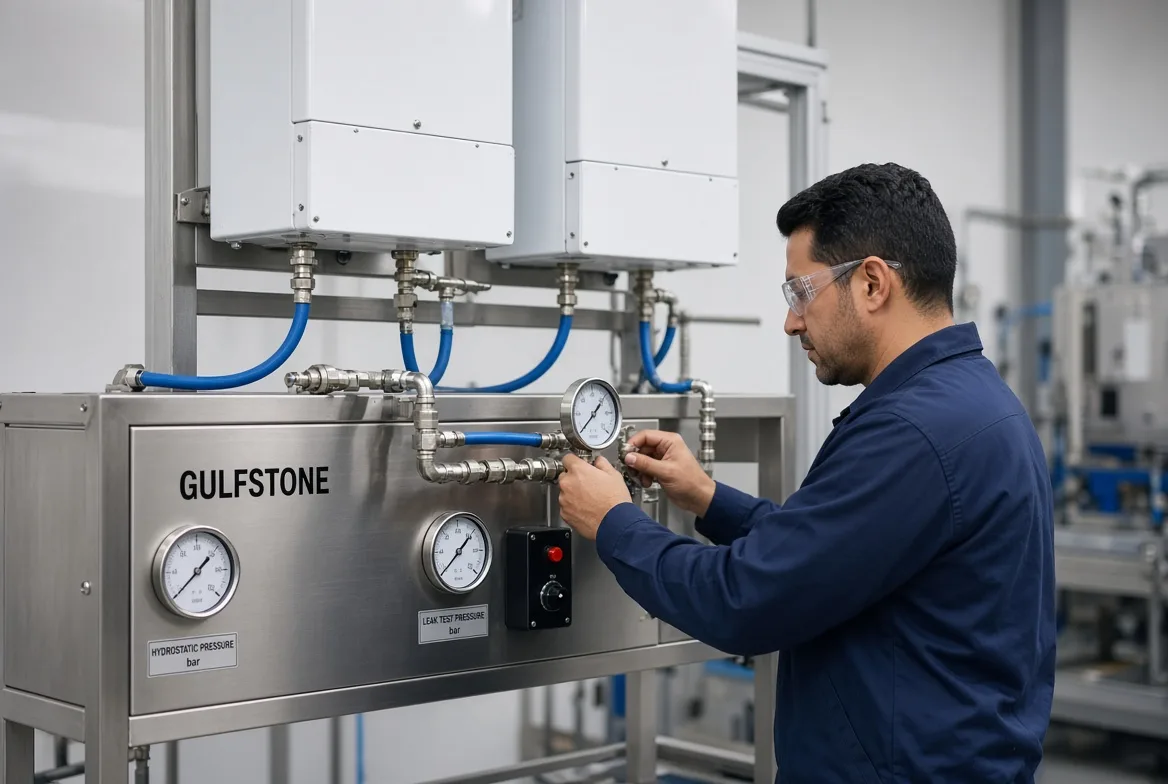
Hydrostatic testing runs at roughly 1.25 to 1.5 times MAWP, held long enough for a pressure drop to show. The test verifies the water path, not the gas path, and the two are never signed off from the same reading.
Gas-tightness is proved separately with dry air or nitrogen in an air-decay test. A soap-bubble check on a finished unit catches gross leaks; a decay test catches the ones that open only after a thermal cycle.
Both results are recorded per serial number. When a field failure comes back, after-sales can pull the pressure and leak records for that unit before the claim is accepted or refused.
How Does the BOM Travel Down the Assembly Line?
A BOM only controls a build if the line reads it at every station. Kitting pulls the approved parts for a serial, torque stations confirm the fasteners the file specifies, and the harness carries a label so a technician can trace a connector later.
The assembly floor is where a drawing either survives contact with production or quietly drifts. A substituted fastener that the line accepts without a hold is the point where the BOM stops describing the product.
End-of-line test closes the loop: burn test, voltage check, pressure and leak decay, then packing against the drop-test spec in the mounting kit line. A unit that fails any gate returns to the station that owns that spec.
Key Benefits: Which BOM Lines Should You Lock First?
For an OEM buyer, the first question is which lines to lock. The answer is the parts whose failure costs the most to fix after launch: heat exchanger, proportional gas valve, control board, blower, approved sensors, wiring harness and seal kit.
Every one of those lines carries a certification dependency. Swap a sensor supplier without re-testing and the approval packet goes stale, which turns a cost saving into a re-test budget and a delayed launch.
They also carry the longest lead times. Buyers who qualify these suppliers a quarter before the launch window protect the schedule. Buyers who wait tend to air-freight valves in the final month at spot prices.
Seal kits deserve the same treatment even though they cost least. A spare-parts kit built from the same BOM keeps service parts matched to what shipped, and the RV OEM fitment file keeps cutout and mounting logic in one place.
📈 ROI Check: Track rejected-lot rate, warranty claims per 1,000 units and lead-time variance month over month. A BOM change that improves one and worsens two is not a saving.
Challenges and Limitations: Where a Strong BOM Still Fails
1. Unapproved substitution voids the approval
A supplier swaps a solenoid or an O-ring compound between lots. The unit still builds and still passes a quick functional check, but the approval no longer covers what shipped.
CSA and CE marks attach to the tested configuration. During an incoming-lot audit, Gulfstone found an O-ring at the wrong durometer, ordered against a drawing that specified the correct one. The lot was held.
2. Tooling volume sets the real lead time
Custom heat exchangers and stampings need tooling, and tooling needs volume. A buyer who wants 50 units meets a minimum built for thousands, and that gap is where launch dates slip.
On one program, first-article lead time ran from 45 to 90 days while tooling approval sat in review. The OEM development path works better when the drawing is frozen before the tool order, not after.
3. Field failures start small and multiply
After 200 hours of vibration testing, harness connectors had backed out of their sockets. Thread-lock fixed it and added roughly 4% to the harness cost. The alternative was a callback at the dealer.
A blocked valve on a gas water heater is a safety-critical gas-train failure. It cuts gas flow, locks out ignition and can leave unburned fuel in the combustion chamber, so valve quality and gas-train cleanliness stay non-negotiable gates.
O-rings, drain plugs and sensors cost cents and drive most service calls. A generic plug that fits two brands can lose its retention lip, and the leak it causes is charged to the importer, not the parts bin.
⚖️ Trade-off: A simpler unit with available parts and strong field support usually beats a sophisticated design with weak support. Performance without parts availability is a liability.
Conclusion: A Control Document, Not a Quotation Attachment
The best bill of materials is the one that controls what a buyer actually uses: certification, assembly, transit and after-sales service. Treated as a quotation attachment, it controls none of them.
Define the levels, map the module logic, choose materials for heat, corrosion and vibration, then prove the design through inspection and leak or pressure testing. The manufacturing drawing package and the inspection plan should reach the certifier as one set.
Procurement teams leave with a lock list. Engineers leave with a subsystem checklist tied to drawings and inspection points. Supply-chain leads leave with a supplier and tooling risk map, and Gulfstone’s engineering team reviews BOMs for OEM programs on request.
Transparency note: Gulfstone builds gas water heaters under client brands and ships them from Foshan, so it has a commercial interest in how these products are specified. Material grades and tolerances in this article are illustrative of the class of part, not a released Gulfstone drawing, and any figure used in a purchase decision should be confirmed against a factory record. I receive no manufacturer kickbacks for these findings.
Frequently Asked Questions About Water Heater BOMs
1. What parts should I stock first?
Stock the heat exchanger, proportional gas valve, control board, blower, approved sensors, harnesses and seal kits. These are the high-failure-cost lines that gate certification and carry the longest lead times. Qualify the suppliers early rather than shopping for spares later.
2. Why does the burner light and then shut off?
A burner that lights and then shuts off is often a lockout from low voltage or a blocked gas valve, not a dead control board. Low voltage makes ignition intermittent; a blocked valve cuts gas flow. Get a voltage log before swapping parts.
3. How do I fix a water flow sensor leak?
Check the seal and the manifold connection before replacing the sensor. The BOM calls out O-ring groove depth and leak-free connections under pressure, and O-ring wear drives many service calls. Fit the approved silicone or EPDM kit and retest.
4. Can I use hardware-store plugs on a gas water heater?
No. Generic plugs inflate callbacks because they are not controlled against the BOM. OEM-specific connectors cost slightly more per unit but hold their retention lip, and a part that only fits one way is the mechanism behind fewer repeat failures.
5. Who approves a change to the bill of materials?
Engineering first, then quality, then the certifier if the substitution touches a certified characteristic. A supplier-initiated swap that skips that route voids approvals. Document the revision and retest before the next production lot.
6. Do RV tankless water heaters need 12V power?
Yes. The 12V chain drives the whole sequence: the flow sensor starts it, the board wakes the blower, checks the energy cut-off, fires the electrode and opens the gas valve. Low voltage causes intermittent ignition and lockouts.

Forward
Co-founder & General Manager, GulfstoneGas appliance manufacturing and certification
Most of what decides a gas appliance is settled before anything is built — on the drawing, at the cut-out, in the tolerance someone chose for the gas path. I have spent my working life on the manufacturing side of that decision, and this is where I write down what it has taught me.
Nothing here is written from a sales desk. Every note comes off the floor: a batch held until a reason was found, a fitting that failed in transit, an approval path that only made sense once the destination market was fixed. If you read these first, the opening conversation starts at the standard rather than at the beginning.
- Gas water heater engineering
- Design for manufacturing
- Certification path selection
- Private-label tooling
- Off-grid and outdoor water heating
- Top 8 Outdoor Portable Gas Water Heater Factories in China for B2B BuyersNov 4, 2026
- Custom RV Appliance Industrial Design: An OEM Brief to a Validated PrototypeNov 3, 2026
- How to Build Custom Thermostat UI Design Software for OEM Embedded PanelsNov 3, 2026
- Top 8 RV Water Heater OEM Suppliers Canada: Vetted for Volume BuyersNov 3, 2026
- Top 10 Portable Propane Water Heater Manufacturers USA: A No-Hype Buyer ShortlistNov 2, 2026
- PPWR Compliance Checklist for EU Water Heater Packaging: The 10 Documents Before the Container LoadsNov 2, 2026
Fifteen years in appliance manufacturing — home appliances, RV refrigeration, then gas water heating — from the drawing to the shipping container.
Leads Gulfstone's design-for-manufacturing reviews and the certification path selected for each destination market.
Works directly with OEM and private-label buyers on tooling, tolerances and the approval file.